Hu Jianzhong, Yang Zhiming, Li Xiaoning, Lu Hongbin
Department of Spine Surgery, Xiangya Hospital, Central South University, 87 Xiangya Road, Changsha, 410000, People's Republic of China.
Department of Sports Medicine, Research Center of Sports Medicine, Xiangya Hospital, Central South University, 87 Xiangya Road, Changsha, 410000, People's Republic of China.
J Neuroinflammation. 2016 Jun 23;13(1):162. doi: 10.1186/s12974-016-0630-7.
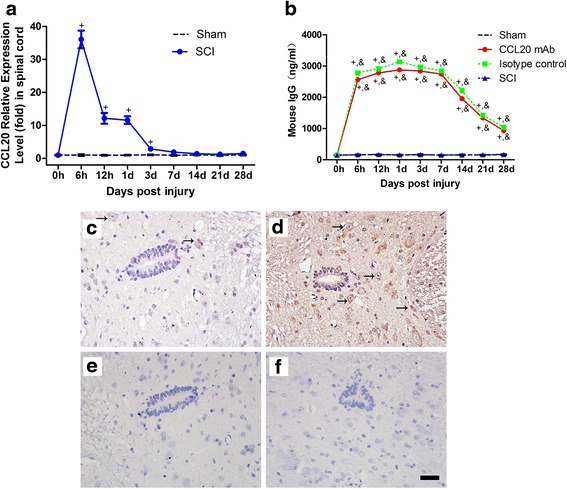
Spinal cord injury (SCI) is a severe traumatic injury that often leads to paralysis. The neuroinflammation following SCI plays an important role during the secondary injury phase. C-C motif chemokine ligand 20 (CCL20) works like a magnet to attract inflammatory cells and subsequently regulate inflammation. However, the role and mechanisms of CCL20 in neuroinflammation following traumatic injury are poorly understood.
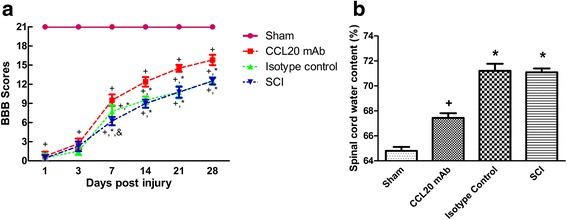
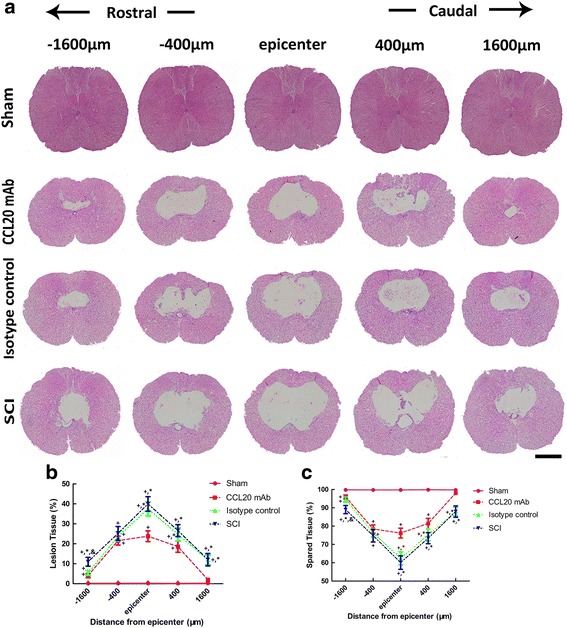
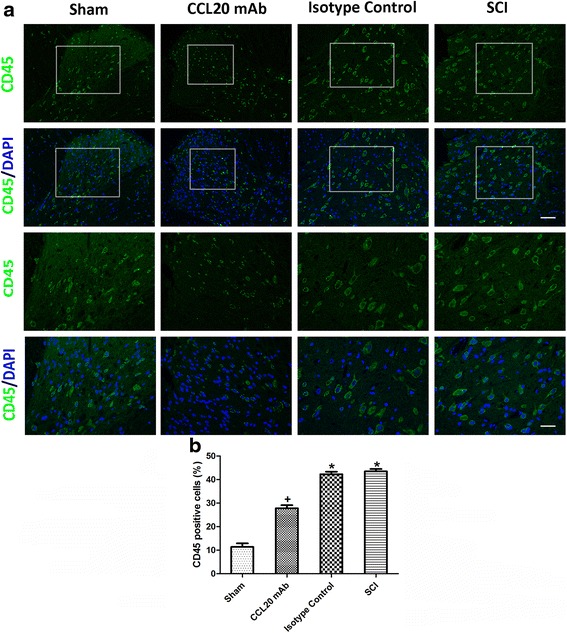
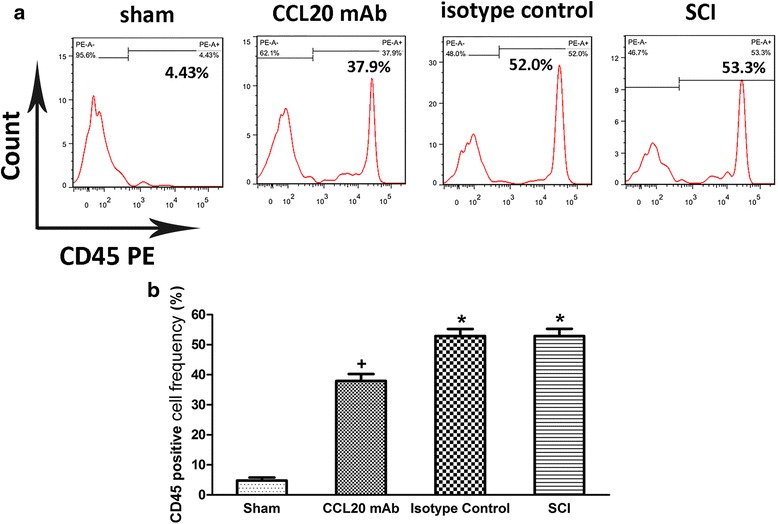
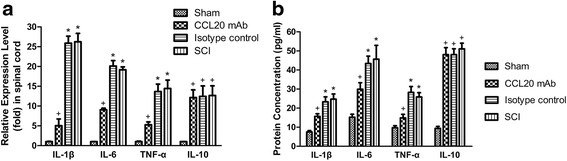
A modified Allen's weight drop method was applied to induce a rat moderate contusion injury model. HE staining was used to assess spinal cord histopathology, and the water content test was used to estimate spinal cord edema. Motor function scores were quantified to evaluate locomotor ability, and leukocyte infiltration was observed by CD45 immunofluorescence and flow cytometry. Additionally, qRT-PCR and ELISA were used to determine inflammatory mediator gene expression. Th17 cell recruitment was identified by flow cytometry.
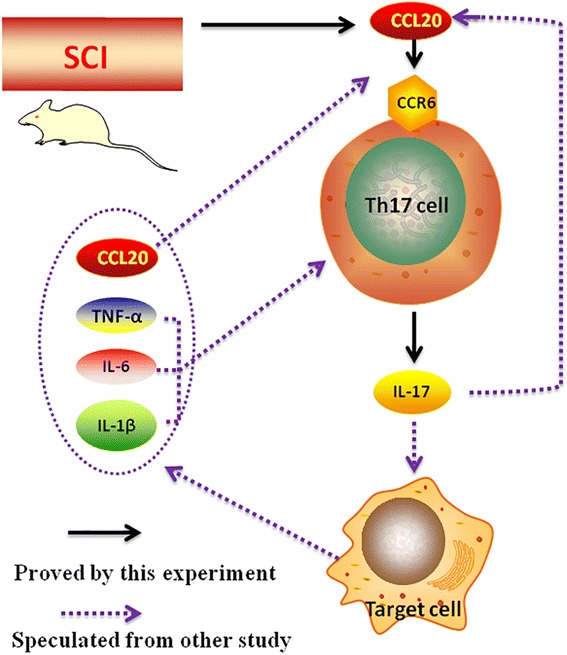
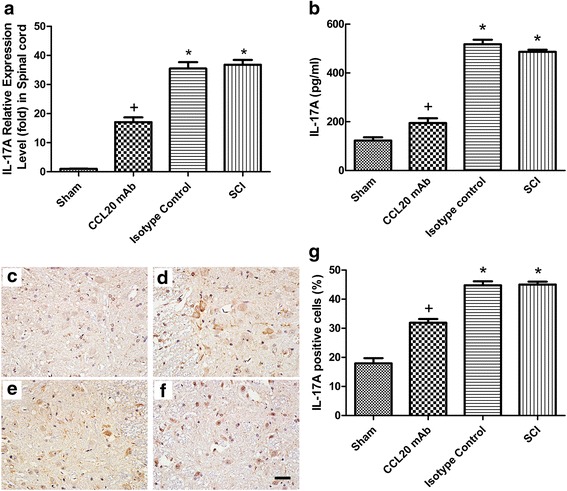
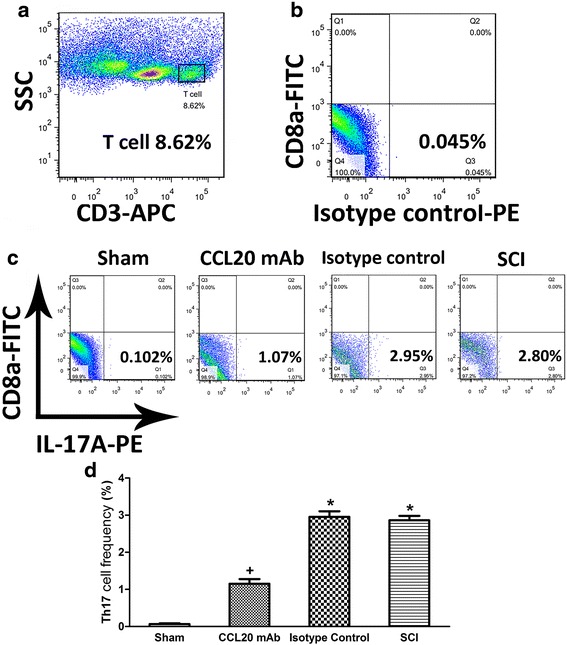
Compared with the injury control groups, histological analysis of the lesion area and tissue edema revealed reduced spinal cord edema and decreased lesion volume in the group administrated with CCL20 neutralizing antibody. Locomotor activity, as assessed by Basso, Beattie, and Bresnahan (BBB) score, showed that CCL20 blockade was beneficial for motor function recovery. Results also showed that leukocyte infiltration was reduced by neutralizing CCL20 at 7 days post-injury. More importantly, expression levels of IL-1β, IL-6, and TNF-α at 24 h after SCI demonstrated that a reduced inflammatory reaction in the CCL20 antibody group compared with the injury controls. Although CCL20 altered the expression of IL-1β, IL-6, and TNF-α, it had no effect on anti-inflammatory IL-10 expression at 24 h after damage. Notably, tissue flow cytometry confirmed that Th17 cell recruitment in the CCL20 antibody group was decreased compared with the control groups at 14 days post-injury. Additionally, IL-17A expression, which is mainly secreted by Th17 cell, suggested that CCL20 blockade also reduced IL-17A levels at 14 days after SCI.
These results suggested that CCL20 aggravates neuroinflammation following SCI via regulation of Th17 cell recruitment and IL-17A level. Thus, CCL20-target therapy could be a promising clinical application for the treatment of SCI.
脊髓损伤(SCI)是一种严重的创伤性损伤,常导致瘫痪。SCI后的神经炎症在继发性损伤阶段起重要作用。C-C基序趋化因子配体20(CCL20)像磁铁一样吸引炎症细胞,随后调节炎症。然而,CCL20在创伤性损伤后神经炎症中的作用和机制尚不清楚。
采用改良的Allen氏重物坠落法诱导大鼠中度挫伤损伤模型。用苏木精-伊红(HE)染色评估脊髓组织病理学,用含水量测试评估脊髓水肿。对运动功能评分进行量化以评估运动能力,通过CD45免疫荧光和流式细胞术观察白细胞浸润。此外,用实时定量聚合酶链反应(qRT-PCR)和酶联免疫吸附测定(ELISA)检测炎症介质基因表达。通过流式细胞术鉴定Th17细胞募集情况。
与损伤对照组相比,对损伤区域的组织学分析和组织水肿显示,给予CCL20中和抗体的组脊髓水肿减轻,损伤体积减小。通过Basso、Beattie和Bresnahan(BBB)评分评估的运动活性表明,阻断CCL20有利于运动功能恢复。结果还显示,在损伤后7天,中和CCL20可减少白细胞浸润。更重要的是,SCI后24小时白细胞介素-1β(IL-1β)、白细胞介素-6(IL-6)和肿瘤坏死因子-α(TNF-α)的表达水平表明,与损伤对照组相比,CCL20抗体组的炎症反应减轻。虽然CCL20改变了IL-1β、IL-6和TNF-α的表达,但在损伤后24小时对抗炎性白细胞介素-10(IL-10)的表达没有影响。值得注意的是,组织流式细胞术证实,与对照组相比,在损伤后14天,CCL20抗体组的Th17细胞募集减少。此外,主要由Th17细胞分泌的IL-17A表达表明,在SCI后14天,阻断CCL20也降低了IL-17A水平。
这些结果表明,CCL20通过调节Th17细胞募集和IL-17A水平加重SCI后的神经炎症。因此,针对CCL20的治疗可能是一种有前景的治疗SCI的临床应用方法。