Department of Epidemiology , University of Alabama at Birmingham School of Public Health , Birmingham, Alabama , USA.
Department of Epidemiology , Johns Hopkins University Bloomberg School of Public Health , Baltimore, Maryland , USA.
BMJ Open Diabetes Res Care. 2016 Jun 10;4(1):e000213. doi: 10.1136/bmjdrc-2016-000213. eCollection 2016.
It is well known that A1c varies by race. However, racial differences in other biomarkers of hyperglycemia are less well characterized. The objective of this study was to determine whether average levels of glycemic markers differ by race in adults with and without diagnosed diabetes, before and after accounting for postchallenge glucose.
This cross-sectional study included 2692 middle-aged men and women (5.5% with diagnosed diabetes; 44% African-American; and 56% white) from the Coronary Artery Risk Development in Young Adults Study (2005-2006) who had fasting glucose, 2-hour postchallenge glucose, A1c, glycated albumin, fructosamine, and 1,5-anhydroglucitol (1,5-AG) measured. Multiple linear regression was used to evaluate racial differences in mean levels of each glycemic marker stratified by the diabetes status and adjusted for sociodemographics, cardiovascular factors, and postchallenge glucose.
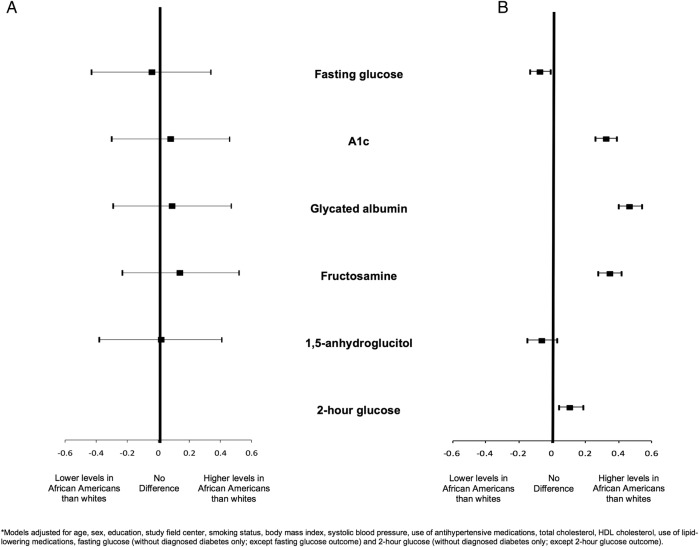
Among those with diagnosed diabetes, racial differences were not observed for any of the glycemic markers. In contrast, among those without diagnosed diabetes, African-Americans had higher mean levels than whites of A1c (β=0.19% points; 95% CI 0.14 to 0.24), glycated albumin (β=0.82% points; 95% CI 0.68 to 0.97), fructosamine (β=8.68 μmol/L; 95% CI 6.68 to 10.68), and 2-hour glucose (β=3.50 mg/dL; 95% CI 0.10 to 6.90) after multivariable adjustment, whereas there were no statistically significant racial difference in 1,5-AG. The racial differences observed for A1c, glycated albumin, and fructosamine persisted after further adjustment for fasting and 2-hour glucose and were of similar magnitude (SD units).
Racial differences in glycemic marker levels were evident among middle-aged adults without diagnosed diabetes even after adjustment for postchallenge glucose. Whether these racial differences in biomarkers of hyperglycemia affect the risk of complications warrants additional study.
众所周知,糖化血红蛋白(A1c)因种族而异。然而,血糖升高的其他生物标志物在种族间的差异则知之甚少。本研究的目的是确定在患有和不患有糖尿病的成年人中,在考虑到餐后血糖后,血糖标志物的平均水平是否因种族而不同。
这项横断面研究纳入了来自冠状动脉风险发展青年研究(2005-2006 年)的 2692 名中年男女(5.5%患有糖尿病;44%为非裔美国人;56%为白人),他们的空腹血糖、2 小时餐后血糖、A1c、糖化白蛋白、果糖胺和 1,5-脱水葡萄糖醇(1,5-AG)均有检测。采用多元线性回归分析评估了在糖尿病状态分层的情况下,每个血糖标志物的平均水平的种族差异,并调整了社会人口统计学、心血管因素和餐后血糖。
在患有糖尿病的人群中,各种血糖标志物均未观察到种族差异。相比之下,在没有诊断为糖尿病的人群中,非裔美国人的 A1c(β=0.19%;95%CI 0.14 至 0.24)、糖化白蛋白(β=0.82%;95%CI 0.68 至 0.97)、果糖胺(β=8.68 μmol/L;95%CI 6.68 至 10.68)和 2 小时血糖(β=3.50 mg/dL;95%CI 0.10 至 6.90)的平均水平高于白人,且在多变量调整后差异有统计学意义,而 1,5-AG 则无统计学差异。在进一步调整空腹和 2 小时血糖后,A1c、糖化白蛋白和果糖胺的种族差异仍然存在,且差异程度相似(标准差单位)。
即使在调整了餐后血糖后,在没有诊断为糖尿病的中年成年人中,血糖标志物水平的种族差异仍然明显。这些血糖升高的生物标志物的种族差异是否会影响并发症的风险,还需要进一步研究。