Yoon Sujung, Kim Jieun E, Kim Geon Ha, Kang Hee Jin, Kim Bori R, Jeon Saerom, Im Jooyeon Jamie, Hyun Heejung, Moon Sohyeon, Lim Soo Mee, Lyoo In Kyoon
Ewha Brain Institute, Ewha Womans University, Seoul, South Korea.
Department of Brain and Cognitive Sciences, Ewha Womans University, Seoul, South Korea.
PLoS One. 2016 Jun 23;11(6):e0157856. doi: 10.1371/journal.pone.0157856. eCollection 2016.
The amygdala has been known to play a pivotal role in mediating fear-related responses including panic attacks. Given the functionally distinct role of the amygdalar subregions, morphometric measurements of the amygdala may point to the pathophysiological mechanisms underlying panic disorder. The current study aimed to determine the global and local morphometric alterations of the amygdala related to panic disorder.
Volumetric and surface-based morphometric approach to high-resolution three-dimensional T1-weighted images was used to examine the structural variations of the amygdala, with respect to extent and location, in 23 patients with panic disorder and 31 matched healthy individuals.
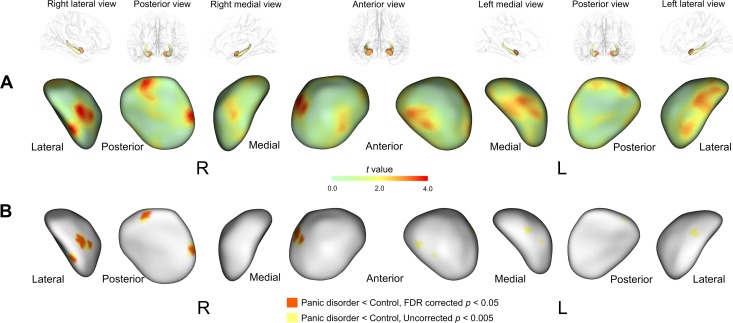
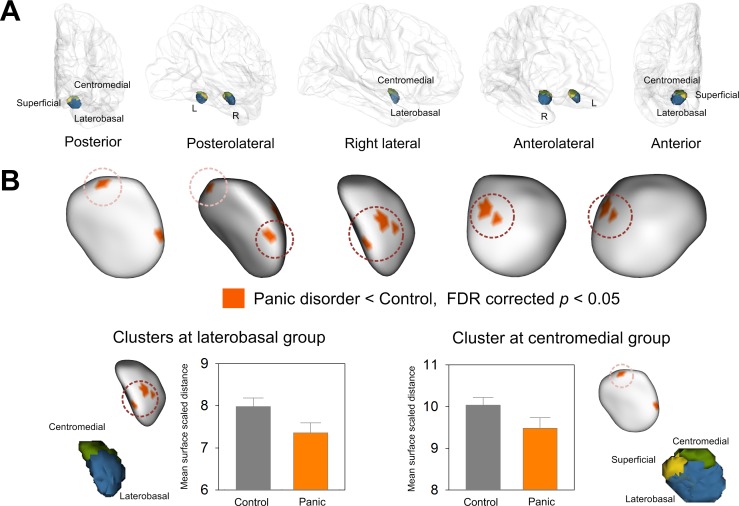
There were no significant differences in bilateral amygdalar volumes between patients with panic disorder and healthy individuals despite a trend-level right amygdalar volume reduction related to panic disorder (right, β = -0.23, p = 0.09, Cohen's d = 0.51; left, β = -0.18, p = 0.19, Cohen's d = 0.45). Amygdalar subregions were localized into three groups including the superficial, centromedial, and laterobasal groups based on the cytoarchitectonically defined probability map. Surface-based morphometric analysis revealed shape alterations in the laterobasal and centromedial groups of the right amygdala in patients with panic disorder (false discovery rate corrected p < 0.05).
The current findings suggest that subregion-specific shape alterations in the right amygdala may be involved in the development and maintenance of panic disorder, which may be attributed to the cause or effects of amygdalar hyperactivation.
已知杏仁核在介导包括惊恐发作在内的与恐惧相关的反应中起关键作用。鉴于杏仁核亚区域功能不同,对杏仁核的形态测量可能指向惊恐障碍潜在的病理生理机制。本研究旨在确定与惊恐障碍相关的杏仁核整体和局部形态学改变。
采用基于容积和表面的形态测量方法,对高分辨率三维T1加权图像进行分析,以检查23例惊恐障碍患者和31名匹配的健康个体中杏仁核在范围和位置方面的结构变化。
惊恐障碍患者和健康个体之间双侧杏仁核体积无显著差异,尽管存在与惊恐障碍相关的右侧杏仁核体积呈趋势性减小(右侧,β = -0.23,p = 0.09,Cohen's d = 0.51;左侧,β = -0.18,p = 0.19,Cohen's d = 0.45)。根据细胞构筑学定义的概率图,杏仁核亚区域分为三组,包括浅表组、中央内侧组和外侧基底组。基于表面的形态测量分析显示,惊恐障碍患者右侧杏仁核的外侧基底组和中央内侧组存在形状改变(错误发现率校正p < 0.05)。
目前的研究结果表明,右侧杏仁核特定亚区域的形状改变可能参与惊恐障碍的发生和维持,这可能归因于杏仁核过度激活的原因或结果。