Spensieri Fabiana, Siena Emilio, Borgogni Erica, Zedda Luisanna, Cantisani Rocco, Chiappini Nico, Schiavetti Francesca, Rosa Domenico, Castellino Flora, Montomoli Emanuele, Bodinham Caroline L, Lewis David J, Medini Duccio, Bertholet Sylvie, Del Giudice Giuseppe
Novartis Vaccines & Diagnostics S.r.l., Siena, Italy.
Departement of Molecular and Developmental Medicine, University of Siena, & VisMederi S.r.l., Siena, Italy.
PLoS One. 2016 Jun 23;11(6):e0157066. doi: 10.1371/journal.pone.0157066. eCollection 2016.
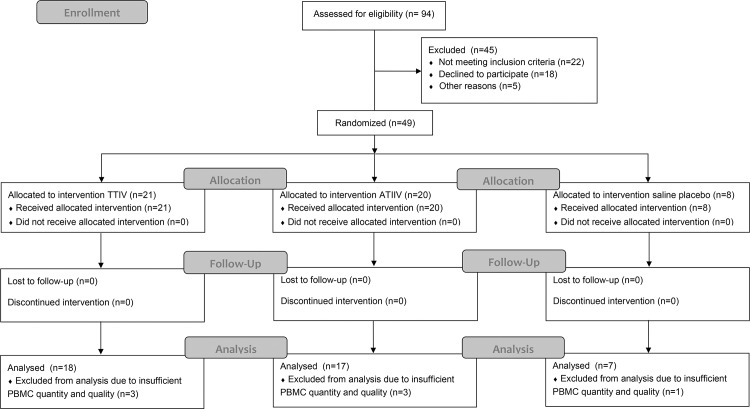
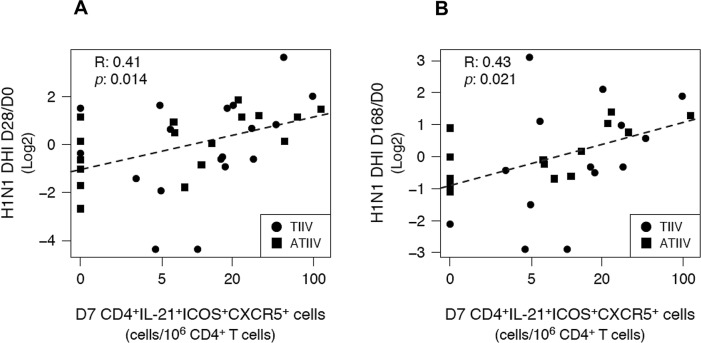
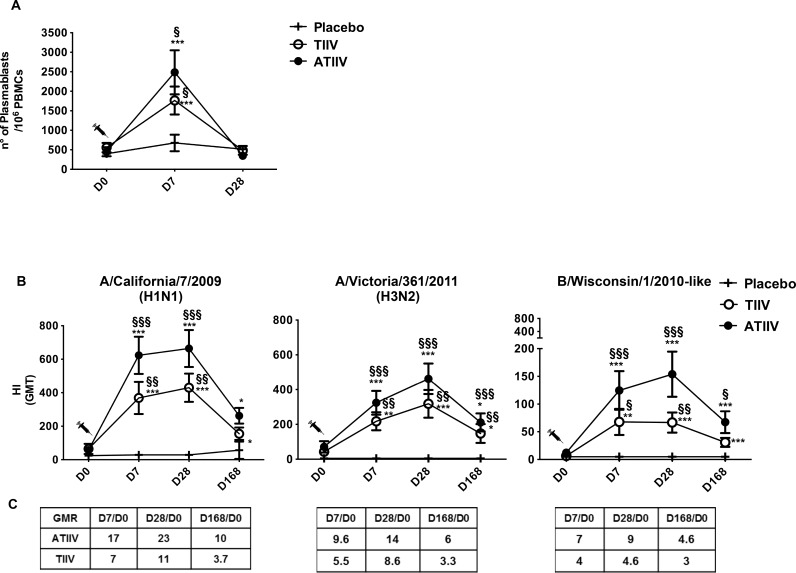
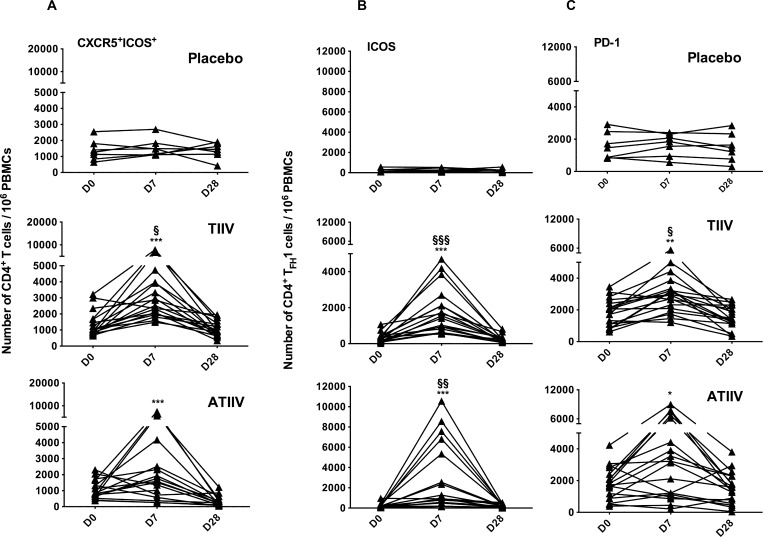
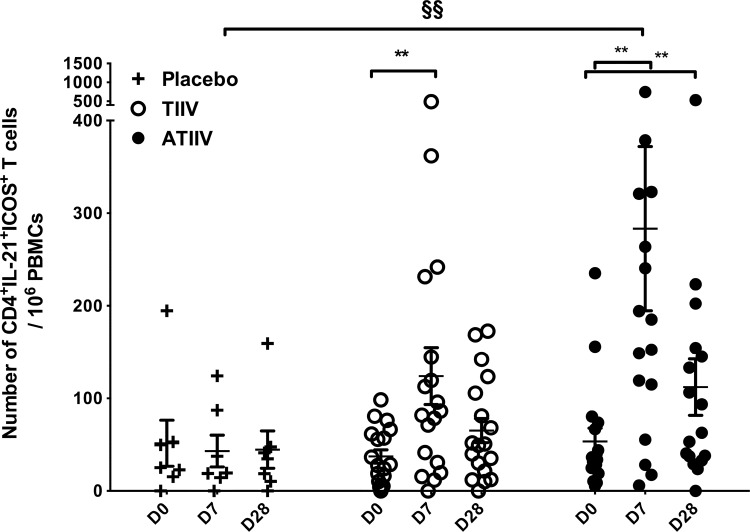
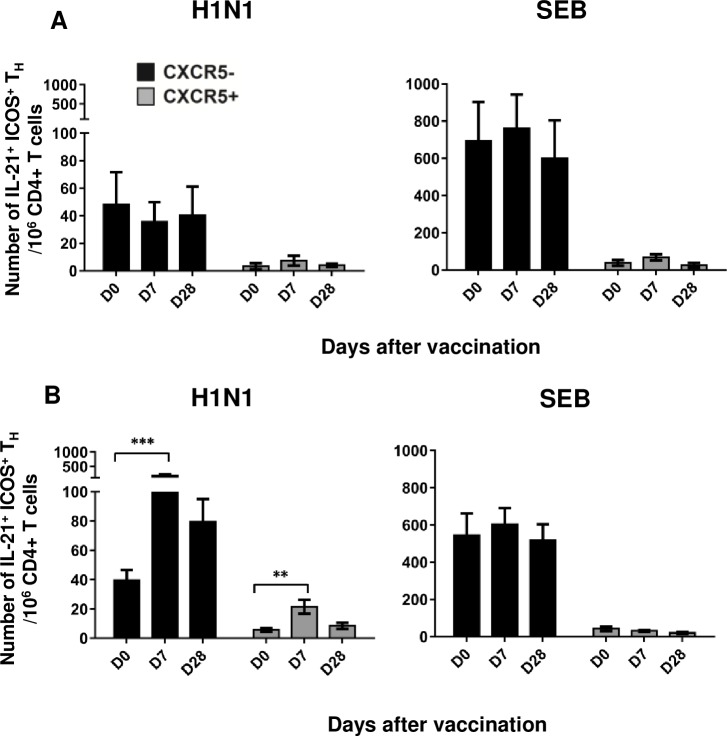
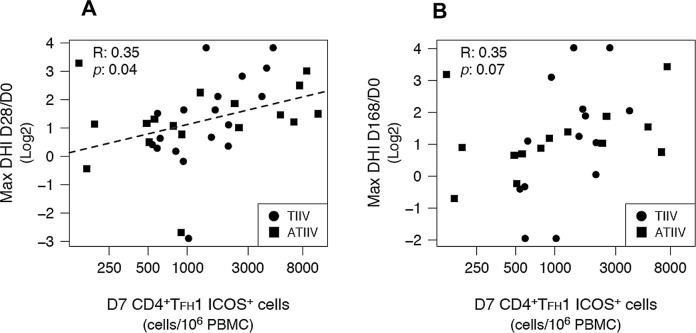
CD4+ T follicular helper cells (T(FH)) have been identified as the T-cell subset specialized in providing help to B cells for optimal activation and production of high affinity antibody. We recently demonstrated that the expansion of peripheral blood influenza-specific CD4(+)IL-21(+)ICOS1(+) T helper (T(H)) cells, three weeks after vaccination, associated with and predicted the rise of protective neutralizing antibodies to avian H5N1. In this study, healthy adults were vaccinated with plain seasonal trivalent inactivated influenza vaccine (TIIV), MF59(®)-adjuvanted TIIV (ATIIV), or saline placebo. Frequencies of circulating CD4(+) T(FH)1 ICOS(+) T(FH) cells and H1N1-specific CD4(+-)IL-21(+)ICOS(+) CXCR5(+) T(FH) and CXCR5(-) T(H) cell subsets were determined at various time points after vaccination and were then correlated with hemagglutination inhibition (HI) titers. All three CD4(+) T cell subsets expanded in response to TIIV and ATIIV, and peaked 7 days after vaccination. To demonstrate that these T(FH) cell subsets correlated with functional antibody titers, we defined an alternative endpoint metric, decorrelated HI (DHI), which removed any correlation between day 28/day 168 and day 0 HI titers, to control for the effect of preexisting immunity to influenza vaccine strains. The numbers of total circulating CD4(+)T(FH)1 ICOS(+) cells and of H1N1-specific CD4(+)IL-21(+)ICOS(+) CXCR5(+), measured at day 7, were significantly associated with day 28, and day 28 and 168 DHI titers, respectively. Altogether, our results show that CD4(+) T(FH) subsets may represent valuable biomarkers of vaccine-induced long-term functional immunity.
CD4+滤泡辅助性T细胞(T(FH))已被确定为专门为B细胞提供帮助以实现最佳激活和产生高亲和力抗体的T细胞亚群。我们最近证明,接种疫苗三周后,外周血流感特异性CD4(+)IL-21(+)ICOS1(+)辅助性T(T(H))细胞的扩增与针对禽流感H5N1的保护性中和抗体的升高相关并可预测其升高。在本研究中,健康成年人接种了普通季节性三价灭活流感疫苗(TIIV)、MF59(®)佐剂TIIV(ATIIV)或生理盐水安慰剂。在接种疫苗后的不同时间点测定循环CD4(+)T(FH)1 ICOS(+) T(FH)细胞以及H1N1特异性CD4(+-)IL-21(+)ICOS(+) CXCR5(+) T(FH)和CXCR5(-) T(H)细胞亚群的频率,然后将其与血凝抑制(HI)滴度相关联。所有这三个CD4(+) T细胞亚群均对TIIV和ATIIV产生反应而扩增,并在接种疫苗后7天达到峰值。为了证明这些T(FH)细胞亚群与功能性抗体滴度相关,我们定义了一个替代终点指标,即去相关HI(DHI),它消除了第28天/第168天与第0天HI滴度之间的任何相关性,以控制对流感疫苗株的预先存在的免疫的影响。在第7天测量的总循环CD4(+)T(FH)1 ICOS(+)细胞数量以及H1N1特异性CD4(+)IL-21(+)ICOS(+) CXCR5(+)细胞数量分别与第28天以及第28天和168天的DHI滴度显著相关。总之,我们的结果表明,CD4(+) T(FH)亚群可能代表疫苗诱导的长期功能性免疫的有价值的生物标志物。