Kasap Hatice, Caputo Christine A, Martindale Benjamin C M, Godin Robert, Lau Vincent Wing-Hei, Lotsch Bettina V, Durrant James R, Reisner Erwin
Christian Doppler Laboratory for Sustainable SynGas Chemistry, Department of Chemistry, University of Cambridge , Lensfield Road, Cambridge CB2 1EW, U.K.
Department of Chemistry, Imperial College London , Exhibition Road, London SW7 2AZ, U.K.
J Am Chem Soc. 2016 Jul 27;138(29):9183-92. doi: 10.1021/jacs.6b04325. Epub 2016 Jul 14.
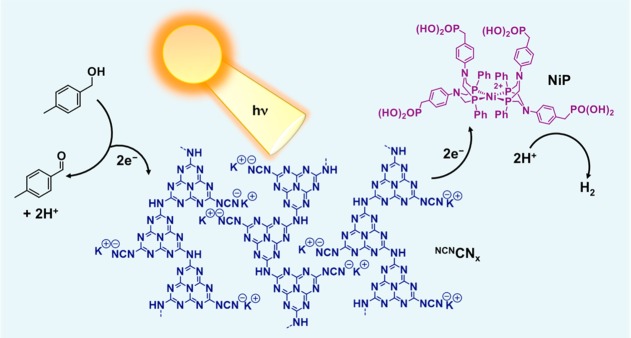
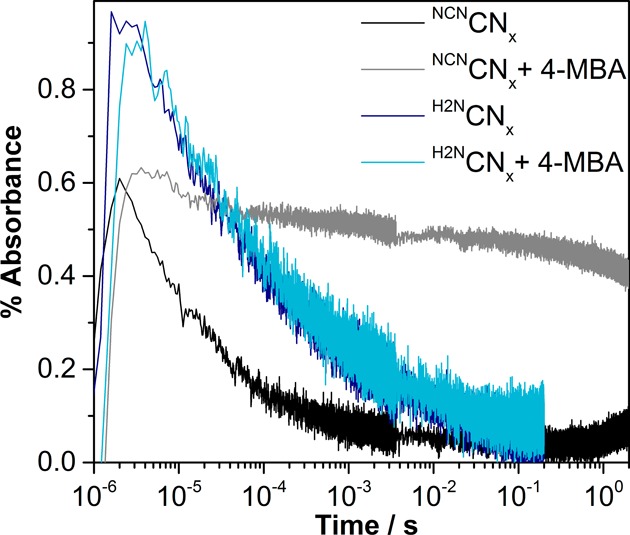
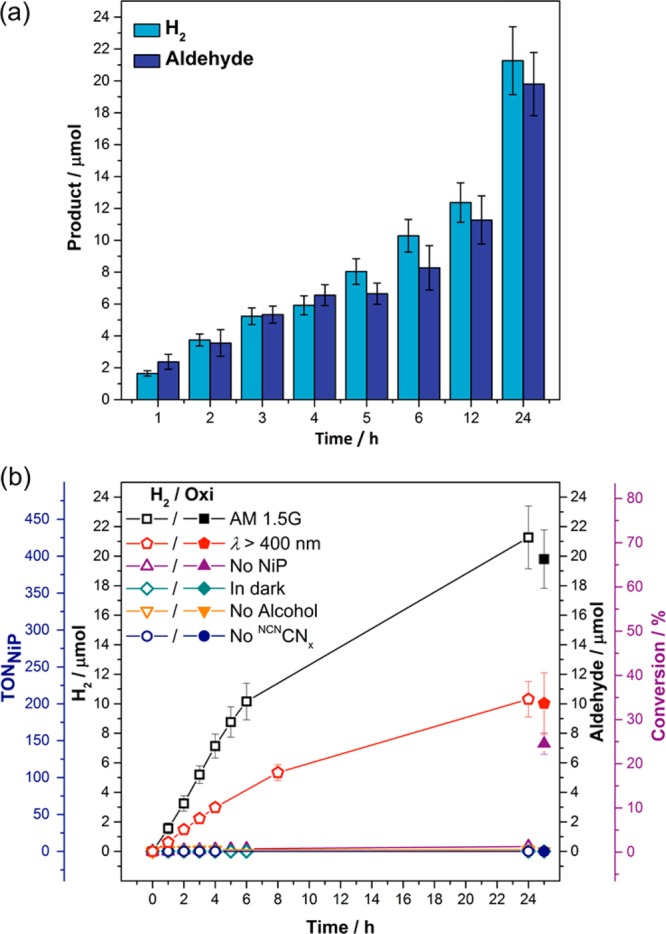
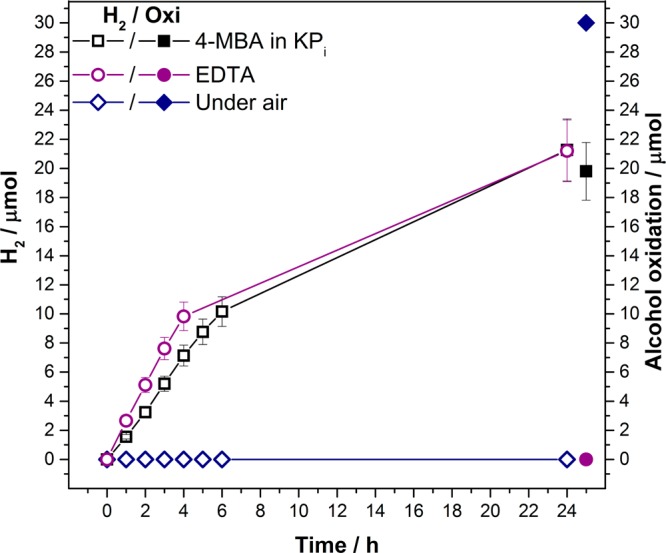
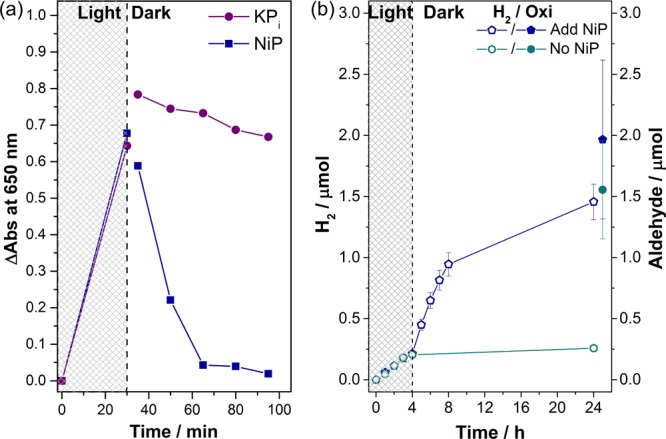
Solar water-splitting represents an important strategy toward production of the storable and renewable fuel hydrogen. The water oxidation half-reaction typically proceeds with poor efficiency and produces the unprofitable and often damaging product, O2. Herein, we demonstrate an alternative approach and couple solar H2 generation with value-added organic substrate oxidation. Solar irradiation of a cyanamide surface-functionalized melon-type carbon nitride ((NCN)CNx) and a molecular nickel(II) bis(diphosphine) H2-evolution catalyst (NiP) enabled the production of H2 with concomitant selective oxidation of benzylic alcohols to aldehydes in high yield under purely aqueous conditions, at room temperature and ambient pressure. This one-pot system maintained its activity over 24 h, generating products in 1:1 stoichiometry, separated in the gas and solution phases. The (NCN)CNx-NiP system showed an activity of 763 μmol (g CNx)(-1) h(-1) toward H2 and aldehyde production, a Ni-based turnover frequency of 76 h(-1), and an external quantum efficiency of 15% (λ = 360 ± 10 nm). This precious metal-free and nontoxic photocatalytic system displays better performance than an analogous system containing platinum instead of NiP. Transient absorption spectroscopy revealed that the photoactivity of (NCN)CNx is due to efficient substrate oxidation of the material, which outweighs possible charge recombination compared to the nonfunctionalized melon-type carbon nitride. Photoexcited (NCN)CNx in the presence of an organic substrate can accumulate ultralong-lived "trapped electrons", which allow for fuel generation in the dark. The artificial photosynthetic system thereby catalyzes a closed redox cycle showing 100% atom economy and generates two value-added products, a solar chemical, and solar fuel.
太阳能水分解是生产可储存的可再生燃料氢气的一项重要策略。水氧化半反应通常效率低下,并且会产生无利可图且往往具有破坏性的产物氧气。在此,我们展示了一种替代方法,即将太阳能制氢与增值有机底物氧化相结合。对氰胺表面功能化的瓜型氮化碳((NCN)CNx)和分子镍(II)双(二膦)析氢催化剂(NiP)进行太阳光照,能够在纯水性条件、室温及常压下,伴随着苄醇选择性氧化为醛的高产率,实现氢气的生产。这个一锅法体系在24小时内保持其活性,以1:1的化学计量比生成产物,产物分别存在于气相和溶液相中。(NCN)CNx - NiP体系对氢气和醛的生产表现出763 μmol (g CNx)(-1) h(-1)的活性、76 h(-1)的镍基周转频率以及15%(λ = 360 ± 10 nm)的外量子效率。这个无贵金属且无毒的光催化体系比含有铂而非NiP的类似体系表现出更好的性能。瞬态吸收光谱表明,(NCN)CNx的光活性归因于该材料高效的底物氧化,与未功能化的瓜型氮化碳相比,这一过程超过了可能的电荷复合。在有机底物存在下光激发的(NCN)CNx能够积累超长寿命的“捕获电子”,这使得在黑暗中也能产生燃料。因此,这个人造光合体系催化一个显示100%原子经济性的封闭氧化还原循环,并产生两种增值产物,一种太阳能化学品和太阳能燃料。