Ammerlaan Judy W, Mulder Olga K, de Boer-Nijhof Nienke C, Maat Bertha, Kruize Aike A, van Laar Jaap, van Os-Medendorp Harmieke, Geenen Rinie
University Medical Center Utrecht, Department Rheumatology and Clinical Immunology, Utrecht, Netherlands.
JMIR Res Protoc. 2016 Jun 23;5(2):e113. doi: 10.2196/resprot.5735.
The chronic nature of rheumatic diseases imposes daily challenges upon those affected and causes patients to make daily decisions about the way they self-manage their illness. Although there is attention to self-management and evidence for the desirability of tailored interventions to support people with a rheumatic disease, interventions based on individual needs and preferences are scarce.
To provide a systematic and comprehensive description of the theoretical considerations for building a Web-based, expert, patient-guided, and tailored intervention for adult patients with a rheumatic disease. Also, to present the results of a usability study on the feasibility of this intervention, and its study design in order to measure the effectiveness.
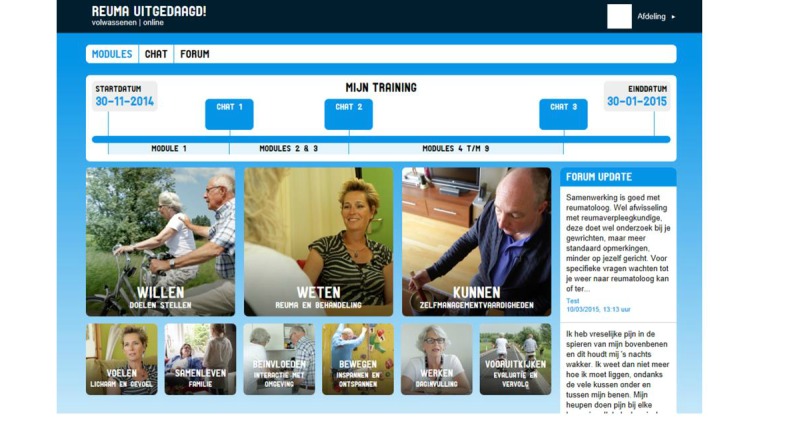
To fit the intervention closely to the autonomy, needs, and preferences of the individual patient, a research team comprising patient representatives, health professionals, Web technicians, and communication experts was formed. The research team followed the new guidance by the Medical Research Council (MRC) for developing and evaluating complex interventions as a guide for the design of the intervention.
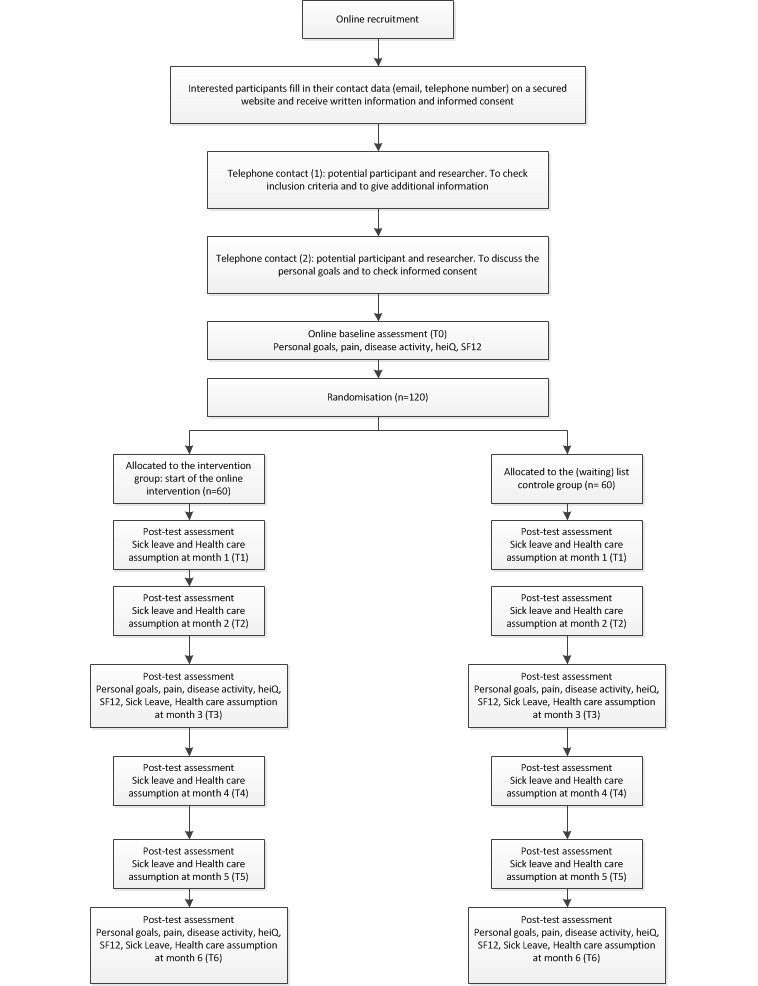
Considerations from self-determination theory and a comprehensive assessment of preferences and needs in patients with a rheumatic disease guided the development of the Web-based intervention. The usability study showed that the intervention was useful, easy to use, and accepted and appreciated by the target group of patients. The planned randomized controlled trial is designed to be conducted among 120 adults with a rheumatic disease, who are assigned to the self-management intervention or a self-help control group. Both groups will be asked to formulate personal goals they want to achieve concerning their self-management. Progress toward the personal goal is the primary outcome measure of this study. Self-reported Web-based measures will be assessed before randomization at baseline, and 3 and 6 months after randomization. Also, feasibility and adherence to the Web-based self-management intervention as process outcomes will be evaluated.
By identifying the individual goals at the beginning of the intervention and customizing the intervention to the individual patient, we aim to improve the usefulness and effectiveness of the Web-based self-management intervention. If proven effective, ReumaUitgedaagd! Online will be implemented in the Netherlands.
风湿性疾病的慢性性质给患者带来了日常挑战,使他们每天都要就自身疾病的自我管理方式做出决策。尽管人们关注自我管理,且有证据表明为风湿性疾病患者提供量身定制的干预措施是可取的,但基于个体需求和偏好的干预措施却很少。
系统全面地描述为成年风湿性疾病患者构建基于网络、由专家指导且量身定制的干预措施的理论考量。此外,展示一项关于该干预措施可行性的可用性研究结果及其用于测量有效性的研究设计。
为使干预措施紧密契合个体患者的自主性、需求和偏好,组建了一个由患者代表、健康专业人员、网络技术人员和沟通专家组成的研究团队。该研究团队遵循医学研究理事会(MRC)关于开发和评估复杂干预措施的新指南,以此作为干预措施设计的指导。
自我决定理论的考量以及对风湿性疾病患者偏好和需求的全面评估指导了基于网络的干预措施的开发。可用性研究表明,该干预措施有用、易于使用,且为目标患者群体所接受和赞赏。计划中的随机对照试验旨在对120名成年风湿性疾病患者进行,他们被分配到自我管理干预组或自助对照组。两组都将被要求制定关于自我管理的个人目标。朝着个人目标取得的进展是本研究的主要结局指标。基于网络的自我报告测量将在随机分组前的基线期以及随机分组后3个月和6个月进行评估。此外,将评估基于网络的自我管理干预措施的可行性和依从性作为过程结局。
通过在干预开始时确定个体目标并根据个体患者定制干预措施,我们旨在提高基于网络的自我管理干预措施的有用性和有效性。如果被证明有效,“ReumaUitgedaagd! Online”将在荷兰实施。