Zalwango Sarah K, Kizza Florence N, Nkwata Allan K, Sekandi Juliet N, Kakaire Robert, Kiwanuka Noah, Whalen Christopher C, Ezeamama Amara E
Directorate of Public Health and Environment, Kampala Capital City Authority, Kampala, Uganda.
Department of Epidemiology and Biostatistics, University of Georgia, Athens, Georgia.
J Int AIDS Soc. 2016 Jun 23;19(1):20694. doi: 10.7448/IAS.19.1.20694. eCollection 2016.
To determine whether perinatal HIV infection and exposure adversely affected psychosocial adjustment (PA) between 6 and 18 years of life (i.e. during school-age and adolescence).
We enrolled 58 perinatally HIV-infected, 56 HIV-exposed uninfected and 54 unexposed controls from Kampala, Uganda. Perinatal HIV status was determined by 18 months of age using a DNA-polymerase chain-reaction test and was confirmed via HIV rapid diagnostic test at psychosocial testing when the children were 6 to 18 years old. Five indicators of PA (depressive symptoms, distress, hopelessness, positive future orientation and esteem) were measured using validated, culturally adapted and translated instruments. Multivariable linear regression analyses estimated HIV-status-related percent differences (β) in PA indicators and corresponding 95% confidence intervals (CIs).
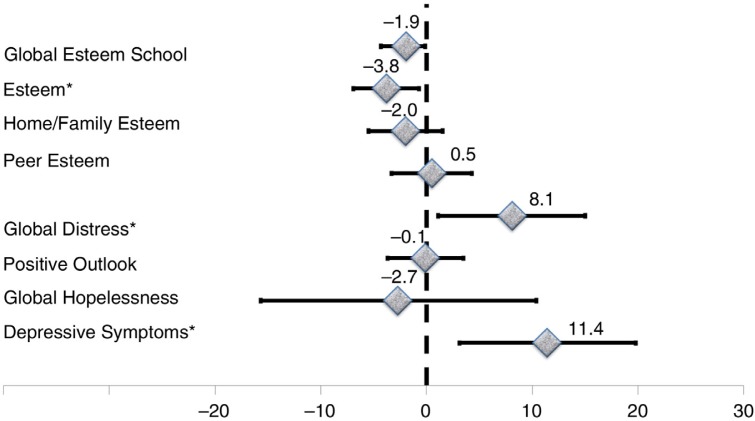
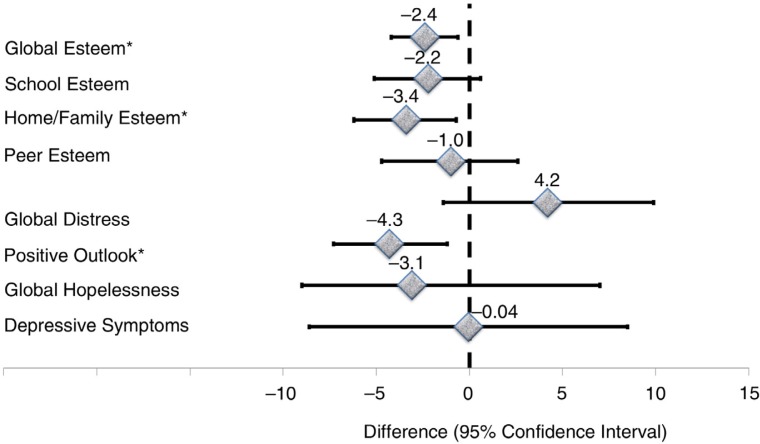
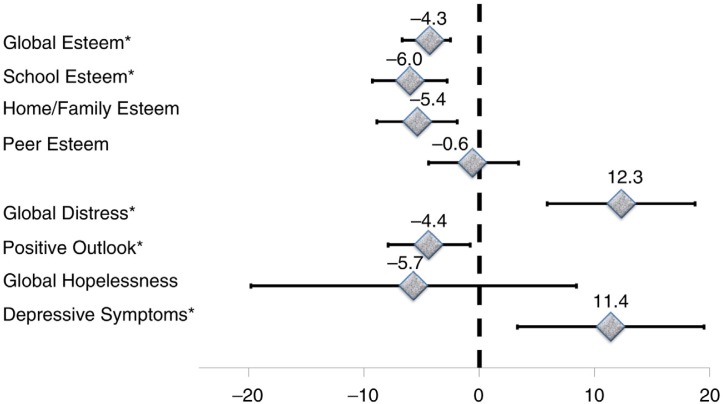
During school-age and adolescence, positive outlook (β=-3.8, 95% CI: -7.2, -0.1) and self-esteem (β=-4.3, 95% CI: -6.7, -1.8) scores were significantly lower, whereas depressive (β=11.4, 95% CI: 3.3, 19.5) and distress (β=12.3, 95% CI: 5.9, 18.7) symptoms were elevated for perinatally HIV-infected, compared to unexposed controls and exposed uninfected children. Similarly, positive outlook (β=-4.3, 95% CI: -7.3, -1.2) and self-esteem were lower for exposed controls versus HIV-unexposed children. Hopelessness was similar by perinatal HIV status. Likewise, the distress and depressive symptom levels were comparable for HIV-exposed uninfected and HIV-unexposed children.
Perinatal HIV infection predicted higher distress and depressive symptoms, while HIV-affected status (infection/exposure) predicted low self-esteem and diminished positive outlook in the long term. However, HIV-affected status had no impact on hopelessness, suggesting that psychosocial interventions as an integral component of HIV care for infected children or primary care exposed uninfected children may improve PA and quality of life in these vulnerable groups.
确定围产期HIV感染和暴露是否会对6至18岁(即学龄期和青春期)的心理社会适应(PA)产生不利影响。
我们从乌干达坎帕拉招募了58名围产期感染HIV的儿童、56名暴露于HIV但未感染的儿童和54名未暴露的对照儿童。通过DNA聚合酶链反应检测在18个月大时确定围产期HIV感染状况,并在儿童6至18岁进行心理社会测试时通过HIV快速诊断测试进行确认。使用经过验证、文化适应和翻译的工具测量PA的五个指标(抑郁症状、痛苦、绝望、积极的未来取向和自尊)。多变量线性回归分析估计了PA指标中与HIV感染状况相关的百分比差异(β)以及相应的95%置信区间(CI)。
在学龄期和青春期,与未暴露的对照儿童和暴露但未感染的儿童相比,围产期感染HIV的儿童的积极展望(β=-3.8,95%CI:-7.2,-0.1)和自尊(β=-4.3,95%CI:-6.7,-1.8)得分显著较低,而抑郁(β=11.4,95%CI:3.3,19.5)和痛苦(β=12.3,95%CI:5.9,18.7)症状有所升高。同样,与未暴露于HIV的儿童相比,暴露但未感染的儿童的积极展望(β=-4.3,95%CI:-7.3,-1.2)和自尊较低。绝望程度在不同围产期HIV感染状况下相似。同样,暴露于HIV但未感染的儿童和未暴露于HIV的儿童的痛苦和抑郁症状水平相当。
围产期HIV感染预示着更高的痛苦和抑郁症状,而受HIV影响的状况(感染/暴露)预示着长期的低自尊和积极展望的降低。然而,受HIV影响的状况对绝望感没有影响,这表明心理社会干预作为感染儿童HIV护理或初级保健中暴露但未感染儿童护理的一个组成部分,可能会改善这些弱势群体的心理社会适应和生活质量。