Dötterl Stefan, Vater Marina, Rupp Thomas, Held Andreas
Department of Ecology & Evolution, Plant Ecology, University of Salzburg, 5020, Salzburg, Austria.
Department of Plant Systematics, University of Bayreuth, 95440, Bayreuth, Germany.
J Chem Ecol. 2016 Jun;42(6):486-9. doi: 10.1007/s10886-016-0717-8. Epub 2016 Jun 25.
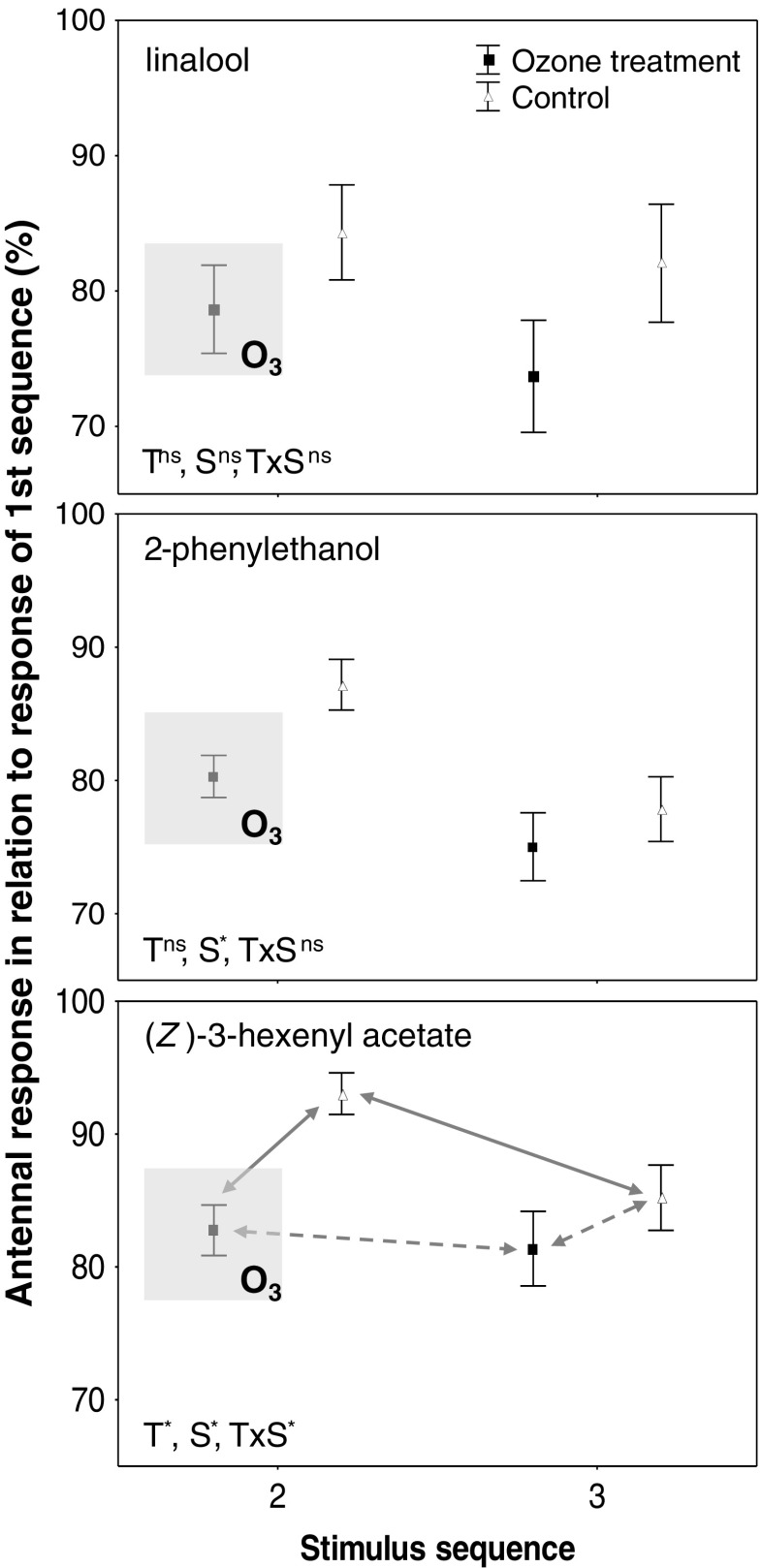
Floral scents play a key role in mediating plant-pollinator interactions. Volatile organic compounds (VOCs) emitted by flowers are used by flower visitors as olfactory cues to locate flowers, both from a distance and at close range. More recently it has been demonstrated that reactive molecules such as ozone can modify or degrade VOCs, and this may impair the communication between plants and their pollinators. However, it is not known whether such reactive molecules also may affect the olfactory system of pollinators, and thus not only influence signal transmission but perception of the signal. In this study, we used electroantennographic measurements to determine the effect of increased levels of ozone on antennal responses in western honey bees (Apis mellifera L.). Linalool and 2-phenylethanol, both known to be involved in location of flowers by the bees, and (Z)-3-hexenyl acetate, a widespread green leaf volatile also detected by bees, were used. The results showed that ozone affected antennal responses to the different substances differently. Ozone decreased antennal responses to (Z)-3-hexenyl acetate, whereas responses to linalool and 2-phenylethanol were not influenced by ozone. Overall, the study does not provide evidence that pollination by honey bees is impaired by damage in the olfactory system of the bees caused by increased levels of ozone, at least when linalool and 2-phenylethanol are the attractive signals. However, the results also suggest that ozone can change the overall perception of an odor blend. This might have negative effects in pollination systems and other organismic interactions mediated by specific ratios of compounds.
花香在介导植物与传粉者的相互作用中起着关键作用。花朵释放的挥发性有机化合物(VOCs)被访花者用作嗅觉线索,以便在远距离和近距离定位花朵。最近有研究表明,诸如臭氧等活性分子能够改变或降解VOCs,这可能会损害植物与其传粉者之间的通讯。然而,尚不清楚此类活性分子是否也会影响传粉者的嗅觉系统,从而不仅影响信号传递,还影响信号的感知。在本研究中,我们使用触角电图测量来确定臭氧水平升高对西方蜜蜂(Apis mellifera L.)触角反应的影响。使用了已知参与蜜蜂定位花朵的芳樟醇和2-苯乙醇,以及蜜蜂也能检测到的一种广泛存在的绿叶挥发物(Z)-3-己烯基乙酸酯。结果表明,臭氧对不同物质的触角反应影响不同。臭氧降低了对(Z)-3-己烯基乙酸酯的触角反应,而对芳樟醇和2-苯乙醇的反应不受臭氧影响。总体而言,该研究没有提供证据表明,至少当芳樟醇和2-苯乙醇为吸引信号时,臭氧水平升高导致蜜蜂嗅觉系统受损会损害蜜蜂传粉。然而,结果也表明臭氧可以改变对气味混合物的整体感知。这可能会对授粉系统以及由特定化合物比例介导的其他生物相互作用产生负面影响。