Rubio Gregorio, Martínez José Fernán, Gómez David, Li Xin
Centro de Investigación en Tecnologías Software y Sistemas Multimedia para la Sostenibilidad (CITSEM), Universidad Politécnica de Madrid (UPM), Edificio La Arboleda, Campus Sur UPM. Ctra. Valencia, Km 7, 28031 Madrid, Spain.
Sensors (Basel). 2016 Jun 24;16(7):955. doi: 10.3390/s16070955.
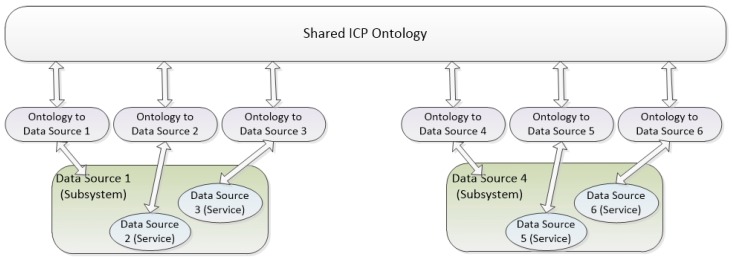
Smart subsystems like traffic, Smart Homes, the Smart Grid, outdoor lighting, etc. are built in many urban areas, each with a set of services that are offered to citizens. These subsystems are managed by self-contained embedded systems. However, coordination and cooperation between them are scarce. An integration of these systems which truly represents a "system of systems" could introduce more benefits, such as allowing the development of new applications and collective optimization. The integration should allow maximum reusability of available services provided by entities (e.g., sensors or Wireless Sensor Networks). Thus, it is of major importance to facilitate the discovery and registration of available services and subsystems in an integrated way. Therefore, an ontology-based and automatic system for subsystem and service registration and discovery is presented. Using this proposed system, heterogeneous subsystems and services could be registered and discovered in a dynamic manner with additional semantic annotations. In this way, users are able to build customized applications across different subsystems by using available services. The proposed system has been fully implemented and a case study is presented to show the usefulness of the proposed method.
智能子系统,如交通、智能家居、智能电网、户外照明等,已在许多城市地区建成,每个子系统都为市民提供一系列服务。这些子系统由独立的嵌入式系统管理。然而,它们之间的协调与合作却很少。这些系统的真正集成,即一个“系统之系统”,可以带来更多益处,比如允许开发新应用并实现集体优化。这种集成应允许实体(如传感器或无线传感器网络)提供的可用服务实现最大程度的重用。因此,以集成方式促进可用服务和子系统的发现与注册至关重要。为此,提出了一种基于本体的子系统和服务注册与发现自动系统。使用该系统,异构子系统和服务能够以动态方式进行注册和发现,并带有额外的语义注释。通过这种方式,用户能够利用可用服务跨不同子系统构建定制应用。所提出的系统已全面实现,并通过一个案例研究展示了该方法的实用性。