Li Jinlei, Smith Alex, Crouch Simon, Oliver Steven, Roman Eve
Department of Health Sciences, University of York, Seebohm Rowntree Building, Heslington, York, YO10 5DD, UK.
Peking Union Medical College, Beijing, China.
Cancer Causes Control. 2016 Aug;27(8):1019-26. doi: 10.1007/s10552-016-0780-z. Epub 2016 Jun 28.
Well-established cancer registries that routinely link to death registrations can estimate prevalence directly by counting patients alive at a particular point in time (observed prevalence). Such direct methods can only provide prevalence for the years over which the registry has been operational. Time-defined estimates, including 5- and 10-year prevalence, may however underestimate the total cancer burden, and compared with other cancers, there is a lack of accurate information on the total prevalence of hematological malignancy subtypes. Accordingly, we aimed to estimate prevalence (observed and total prevalence) of hematological malignancies and precursor conditions by clinically meaningful subtypes using data from the UK's specialist population-based register, the Haematological Malignancy Research Network ( www.hmrn.org ).
Observed and total prevalences were estimated from 15,810 new diagnoses of hematological malignancies from 2004 to 2011 and followed up to the 31 August 2011 (index data). Observed prevalence was calculated by the counting method, and a method based on modelling incidence and survival was used to estimate total prevalence. Estimates were made according to current disease classification for the HMRN region and for the UK.
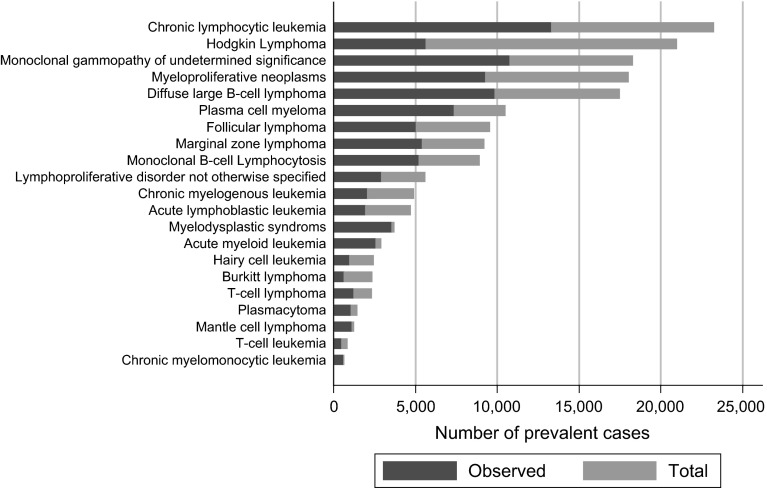
The overall observed and total prevalence rates were 281.9 and 548.8 per 100,000, respectively; the total number of observed and total prevalent cases in the UK was estimated as 165,841 and 327,818 cases, as expected variation existed by disease subtype reflecting the heterogeneity in underlying disease incidence, survival and age distribution of hematological cancers.
This study demonstrates the importance of estimating 'total' prevalence rather than 'observed' prevalence by current disease classification (ICD-O-3), particularly for subtypes that have a more indolent nature and for those that are curable. Importantly, these analyses demonstrate that relying on observed prevalence alone would result in a significant underestimation of the relative burden of some subtypes. While many of these cases may be considered cured and no longer being actively treated, people in this survivorship phase may have long-term medical needs and accordingly, it is important to provide accurate counts to allow for healthcare planning.
成熟的癌症登记机构若能定期与死亡登记相链接,便可通过统计特定时间点存活的患者数量(观察患病率)直接估算患病率。此类直接方法仅能提供登记机构运营年份的患病率。然而,按时间定义的估算值,包括5年和10年患病率,可能会低估癌症总负担,而且与其他癌症相比,血液系统恶性肿瘤亚型的总患病率缺乏准确信息。因此,我们旨在利用英国基于人群的专科登记机构血液系统恶性肿瘤研究网络(www.hmrn.org)的数据,按具有临床意义的亚型估算血液系统恶性肿瘤及其前驱疾病的患病率(观察患病率和总患病率)。
根据2004年至2011年15810例血液系统恶性肿瘤新诊断病例并随访至2011年8月31日(索引数据)估算观察患病率和总患病率。观察患病率通过计数法计算,基于发病率和生存率建模的方法用于估算总患病率。根据血液系统恶性肿瘤研究网络地区及英国的现行疾病分类进行估算。
总体观察患病率和总患病率分别为每10万人281.9例和548.8例;英国观察到的病例总数和总患病病例数估计分别为165841例和327818例,正如预期的那样,不同疾病亚型存在差异,这反映了血液系统癌症在基础疾病发病率、生存率和年龄分布方面的异质性。
本研究表明,按现行疾病分类(ICD - O - 3)估算“总”患病率而非“观察”患病率很重要,特别是对于那些性质较为惰性和可治愈的亚型。重要的是,这些分析表明,仅依靠观察患病率会导致对某些亚型的相对负担严重低估。虽然其中许多病例可能被视为已治愈且不再接受积极治疗,但处于这一存活阶段的人群可能有长期医疗需求,因此,提供准确的病例数对于医疗规划很重要。