King Abby C, Hekler Eric B, Grieco Lauren A, Winter Sandra J, Sheats Jylana L, Buman Matthew P, Banerjee Banny, Robinson Thomas N, Cirimele Jesse
Stanford Prevention Research Center, Department of Medicine, and Epidemiology Division, Department of Health Research & Policy, Stanford University School of Medicine, Stanford, California, United States of America.
Stanford Prevention Research Center, Department of Medicine, Stanford University School of Medicine, Stanford, California, United States of America.
PLoS One. 2016 Jun 28;11(6):e0156370. doi: 10.1371/journal.pone.0156370. eCollection 2016.
While there has been an explosion of mobile device applications (apps) promoting healthful behaviors, including physical activity and sedentary patterns, surprisingly few have been based explicitly on strategies drawn from behavioral theory and evidence.
This study provided an initial 8-week evaluation of three different customized physical activity-sedentary behavior apps drawn from conceptually distinct motivational frames in comparison with a commercially available control app.
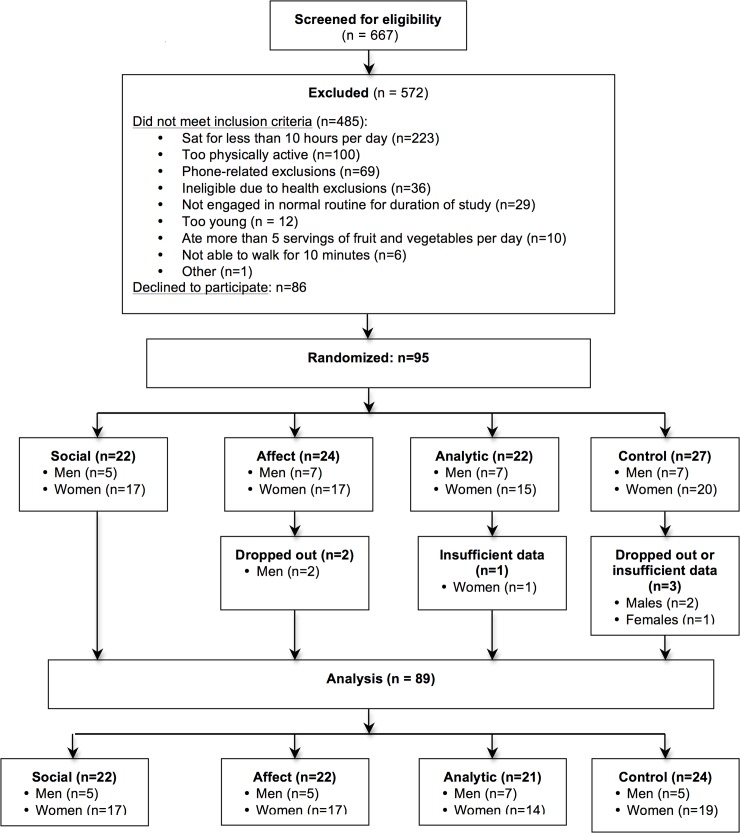
Ninety-five underactive adults ages 45 years and older with no prior smartphone experience were randomized to use an analytically framed app, a socially framed app, an affectively framed app, or a diet-tracker control app. Daily physical activity and sedentary behavior were measured using the smartphone's built-in accelerometer and daily self-report measures.
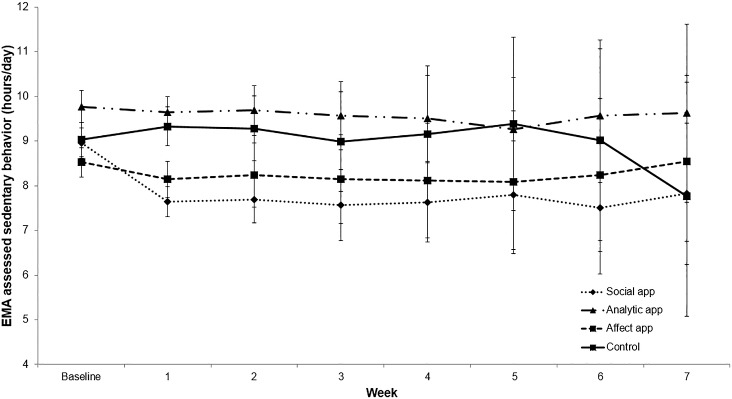
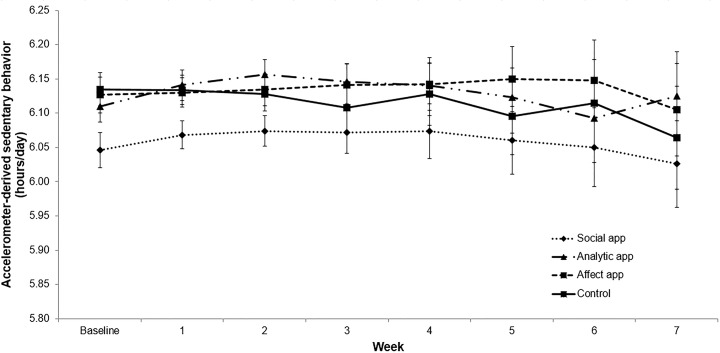
Mixed-effects models indicated that, over the 8-week period, the social app users showed significantly greater overall increases in weekly accelerometry-derived moderate to vigorous physical activity relative to the other three arms (P values for between-arm differences = .04-.005; Social vs. Control app: d = 1.05, CI = 0.44,1.67; Social vs. Affect app: d = 0.89, CI = 0.27,1.51; Social vs. Analytic app: d = 0.89, CI = 0.27,1.51), while more variable responses were observed among users of the other two motivationally framed apps. Social app users also had significantly lower overall amounts of accelerometry-derived sedentary behavior relative to the other three arms (P values for between-arm differences = .02-.001; Social vs. Control app: d = 1.10,CI = 0.48,1.72; Social vs. Affect app: d = 0.94, CI = 0.32,1.56; Social vs. Analytic app: d = 1.24, CI = 0.59,1.89). Additionally, Social and Affect app users reported lower overall sitting time compared to the other two arms (P values for between-arm differences < .001; Social vs. Control app: d = 1.59,CI = 0.92, 2.25; Social vs. Analytic app: d = 1.89,CI = 1.17, 2.61; Affect vs. Control app: d = 1.19,CI = 0.56, 1.81; Affect vs. Analytic app: d = 1.41,CI = 0.74, 2.07).
The results provide initial support for the use of a smartphone-delivered social frame in the early induction of both physical activity and sedentary behavior changes. The information obtained also sets the stage for further investigation of subgroups that might particularly benefit from different motivationally framed apps in these two key health promotion areas.
ClinicalTrials.gov NCT01516411.
尽管促进健康行为(包括身体活动和久坐模式)的移动设备应用程序(应用)激增,但令人惊讶的是,很少有应用明确基于行为理论和证据得出的策略。
本研究对三款从概念上不同的动机框架中提取的不同定制身体活动 - 久坐行为应用与一款商业可用的对照应用进行了为期8周的初步评估。
95名年龄在45岁及以上且此前无智能手机使用经验的不活跃成年人被随机分配使用分析框架应用、社交框架应用、情感框架应用或饮食追踪对照应用。使用智能手机内置的加速度计和每日自我报告测量方法来测量每日身体活动和久坐行为。
混合效应模型表明,在8周期间,社交应用的用户相对于其他三组,每周通过加速度计测量得出的中度至剧烈身体活动的总体增加显著更大(组间差异的P值 = 0.04 - 0.005;社交应用与对照应用:d = 1.05,CI = 0.44,1.67;社交应用与情感应用:d = 0.89,CI = .....
研究结果为在早期诱导身体活动和久坐行为改变中使用智能手机提供的社交框架提供了初步支持。所获得的信息也为进一步研究在这两个关键健康促进领域中可能特别受益于不同动机框架应用的亚组奠定了基础。
ClinicalTrials.gov NCT01516411 。