• 文献检索
  • 文档翻译
  • 深度研究
  • 学术资讯
  • Suppr Zotero 插件Zotero 插件
  • 邀请有礼
  • 套餐&价格
  • 历史记录
应用&插件
Suppr Zotero 插件Zotero 插件浏览器插件Mac 客户端Windows 客户端微信小程序
定价
高级版会员购买积分包购买API积分包
服务
文献检索文档翻译深度研究API 文档MCP 服务
关于我们
关于 Suppr公司介绍联系我们用户协议隐私条款
关注我们

Suppr 超能文献

核心技术专利:CN118964589B侵权必究
粤ICP备2023148730 号-1Suppr @ 2026

文献检索

告别复杂PubMed语法,用中文像聊天一样搜索,搜遍4000万医学文献。AI智能推荐,让科研检索更轻松。

立即免费搜索

文件翻译

保留排版,准确专业,支持PDF/Word/PPT等文件格式,支持 12+语言互译。

免费翻译文档

深度研究

AI帮你快速写综述,25分钟生成高质量综述,智能提取关键信息,辅助科研写作。

立即免费体验

使用 StepMATE 应用程序测量久坐老年人的步行和日常情绪:初步随机对照试验。

Walking and Daily Affect Among Sedentary Older Adults Measured Using the StepMATE App: Pilot Randomized Controlled Trial.

机构信息

Psychology Department, Brandeis University, Waltham, MA, United States.

Psychiatry Department, Brigham and Women's Hospital, Boston, MA, United States.

出版信息

JMIR Mhealth Uhealth. 2021 Dec 1;9(12):e27208. doi: 10.2196/27208.

DOI:10.2196/27208
PMID:34855609
原文链接:https://pmc.ncbi.nlm.nih.gov/articles/PMC8686479/
Abstract

BACKGROUND

Although fitness technology can track and encourage increases in physical activity, few smartphone apps are based on behavior change theories. Apps that do include behavioral components tend to be costly and often do not include strategies to help those who are unsure of how to increase their physical activity.

OBJECTIVE

The aim of this pilot study is to test the efficacy of a new app, StepMATE, for increasing daily walking in a sample of inactive adults and to examine daily relationships between walking and self-reported mood and energy.

METHODS

The participants were middle-aged and older adults aged ≥50 years (mean 61.64, SD 7.67 years). They were randomly assigned to receive either a basic, pedometer-like version of the app or a version with supports to help them determine where, when, and with whom to walk. Of the 96 participants randomized to 1 of 2 conditions, 87 (91%) completed pretest assessments and 81 (84%) successfully downloaded the app. Upon downloading the app, step data from the week prior were automatically recorded. The participants in both groups were asked to set a daily walking goal, which they could change at any point during the intervention. They were asked to use the app as much as possible over the next 4 weeks. Twice per day, pop-up notifications assessed mood and energy levels.

RESULTS

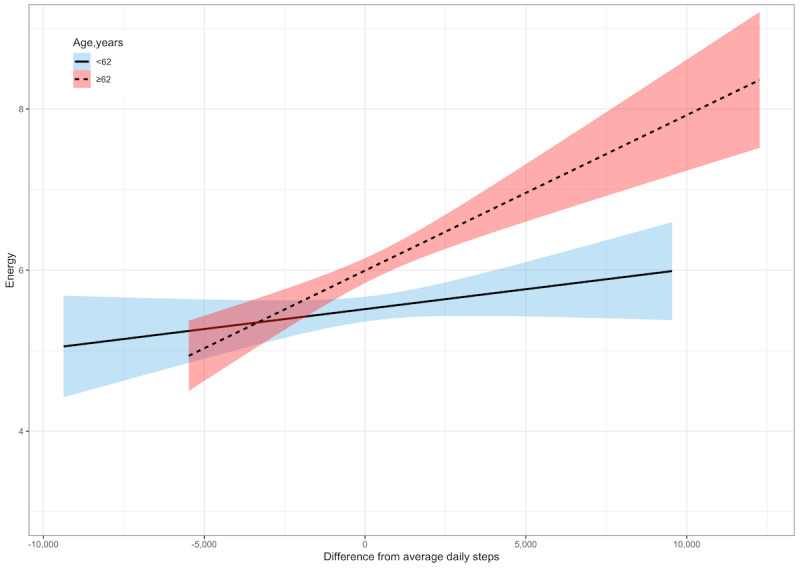
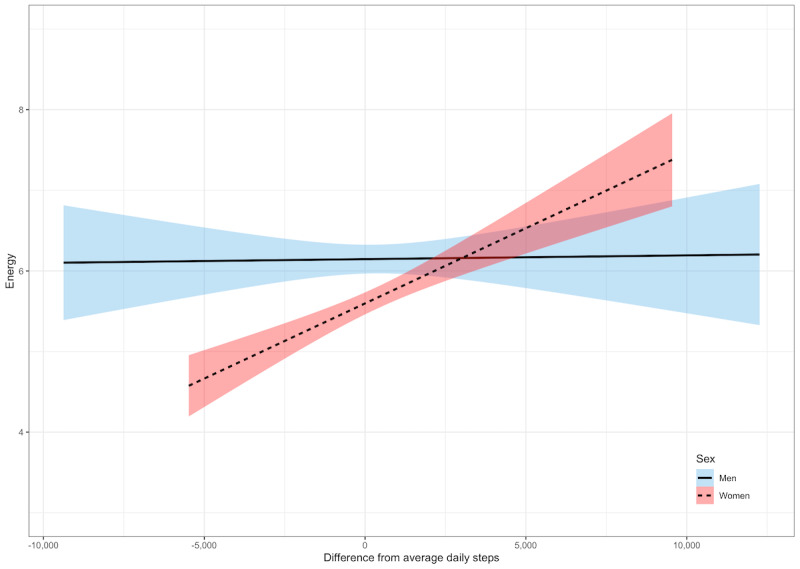
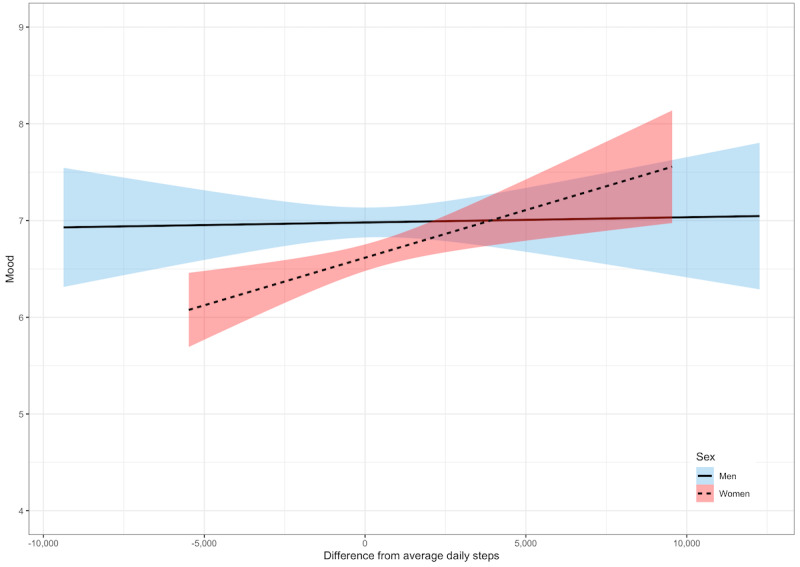
Although one group had access to additional app features, both groups used the app in a similar way, mainly using just the walk-tracking feature. Multilevel models revealed that both groups took significantly more steps during the 4-week study than during the week before downloading the app (γ=0.24; P<.001). During the study, the participants in both groups averaged 5248 steps per day compared with an average of 3753 steps per day during the baseline week. Contrary to predictions, there were no differences in step increases between the two conditions. Cognition significantly improved from pre- to posttest (γ=0.17; P=.02). Across conditions, on days in which the participants took more steps than average, they reported better mood and higher energy levels on the same day and better mood on the subsequent day. Daily associations among walking, mood, and energy were significant for women but not for men and were stronger for older participants (those aged ≥62 years) than for the younger participants.

CONCLUSIONS

Both groups increased their steps to a similar extent, suggesting that setting and monitoring daily walking goals was sufficient for an initial increase and maintenance of steps. Across conditions, walking had benefits for positive mood and energy levels, particularly for women and older participants. Further investigations should identify other motivating factors that could lead to greater and more sustained increases in physical activity.

TRIAL REGISTRATION

ClinicalTrials.gov NCT03124537; https://clinicaltrials.gov/ct2/show/NCT03124537.
https://cdn.ncbi.nlm.nih.gov/pmc/blobs/58b0/8686479/1543f8dea867/mhealth_v9i12e27208_fig7.jpg
https://cdn.ncbi.nlm.nih.gov/pmc/blobs/58b0/8686479/129b00663cba/mhealth_v9i12e27208_fig4.jpg
https://cdn.ncbi.nlm.nih.gov/pmc/blobs/58b0/8686479/1f06d857f7cf/mhealth_v9i12e27208_fig6.jpg
https://cdn.ncbi.nlm.nih.gov/pmc/blobs/58b0/8686479/1543f8dea867/mhealth_v9i12e27208_fig7.jpg
https://cdn.ncbi.nlm.nih.gov/pmc/blobs/58b0/8686479/129b00663cba/mhealth_v9i12e27208_fig4.jpg
https://cdn.ncbi.nlm.nih.gov/pmc/blobs/58b0/8686479/1f06d857f7cf/mhealth_v9i12e27208_fig6.jpg
https://cdn.ncbi.nlm.nih.gov/pmc/blobs/58b0/8686479/1543f8dea867/mhealth_v9i12e27208_fig7.jpg
摘要

背景

尽管健身技术可以跟踪和鼓励增加身体活动,但很少有智能手机应用程序基于行为改变理论。那些确实包含行为成分的应用程序往往成本高昂,而且通常不包括帮助那些不确定如何增加身体活动的人的策略。

目的

本初步研究旨在测试一款名为 StepMate 的新应用程序在增加不活跃成年人日常步行方面的功效,并研究日常步行与自我报告的情绪和能量之间的关系。

方法

参与者为年龄在 50 岁及以上的中年人(平均 61.64,SD 7.67 岁)。他们被随机分配接受基本的计步器应用程序版本或具有帮助他们确定何时何地以及与谁一起散步的支持的版本。在随机分配到 2 个条件之一的 96 名参与者中,有 87 名(91%)完成了预测试评估,有 81 名(84%)成功下载了应用程序。在下载应用程序后,会自动记录前一周的步数数据。两组参与者都被要求设定一个日常步行目标,他们可以在干预过程中的任何时候更改目标。要求他们在接下来的 4 周内尽可能多地使用该应用程序。每天两次弹出通知评估情绪和能量水平。

结果

尽管一组人可以访问更多的应用程序功能,但两组人使用应用程序的方式相似,主要只使用步行跟踪功能。多层次模型显示,与下载应用程序前一周相比,两组在 4 周的研究期间都走了更多的步数(γ=0.24;P<.001)。在研究期间,两组参与者的平均每天步数为 5248 步,而基线周的平均每天步数为 3753 步。与预测相反,两种情况下的步数增加没有差异。认知能力从预测试到后测试都有显著提高(γ=0.17;P=.02)。在两种情况下,当参与者每天的步数超过平均水平时,他们当天和随后一天的情绪和能量水平都更好。步行、情绪和能量之间的日常关联对女性有意义,但对男性没有意义,对年龄较大的参与者(年龄≥62 岁)比年轻参与者更强。

结论

两组参与者都将他们的步数增加到相似的程度,这表明设定和监测日常步行目标足以实现初始的步数增加和维持。在两种情况下,步行对积极的情绪和能量水平都有好处,特别是对女性和年龄较大的参与者。进一步的研究应该确定其他可以促进更大和更持续的身体活动增加的激励因素。

试验注册

ClinicalTrials.gov NCT03124537;https://clinicaltrials.gov/ct2/show/NCT03124537。

相似文献

1
Walking and Daily Affect Among Sedentary Older Adults Measured Using the StepMATE App: Pilot Randomized Controlled Trial.使用 StepMATE 应用程序测量久坐老年人的步行和日常情绪:初步随机对照试验。
JMIR Mhealth Uhealth. 2021 Dec 1;9(12):e27208. doi: 10.2196/27208.
2
A Mobile Phone App Designed to Support Weight Loss Maintenance and Well-Being (MotiMate): Randomized Controlled Trial.一款旨在支持体重维持和健康的手机应用(MotiMate):随机对照试验。
JMIR Mhealth Uhealth. 2019 Sep 4;7(9):e12882. doi: 10.2196/12882.
3
Effect of an mHealth Intervention Using a Pedometer App With Full In-Person Counseling on Body Composition of Overweight Adults: Randomized Controlled Weight Loss Trial.基于计步器应用程序的 mHealth 干预措施联合全面的面对面咨询对超重成年人身体成分的影响:一项随机对照减重试验。
JMIR Mhealth Uhealth. 2020 May 27;8(5):e16999. doi: 10.2196/16999.
4
The effect of digital physical activity interventions on daily step count: a randomised controlled crossover substudy of the MyHeart Counts Cardiovascular Health Study.数字体力活动干预对日常步数的影响:MyHeart Counts 心血管健康研究的一项随机对照交叉亚研究。
Lancet Digit Health. 2019 Nov;1(7):e344-e352. doi: 10.1016/S2589-7500(19)30129-3. Epub 2019 Oct 9.
5
Digital Peer-Supported App Intervention to Promote Physical Activity Among Community-Dwelling Older Adults: Nonrandomized Controlled Trial.数字同辈支持应用程序干预以促进社区居住的老年人的身体活动:非随机对照试验。
JMIR Aging. 2024 May 30;7:e56184. doi: 10.2196/56184.
6
Increasing the Effectiveness of a Physical Activity Smartphone Intervention With Positive Suggestions: Randomized Controlled Trial.提高基于智能手机的身体活动干预有效性的研究:一项随机对照试验
J Med Internet Res. 2022 Mar 1;24(3):e32130. doi: 10.2196/32130.
7
Long-term Effects of the Use of a Step Count-Specific Smartphone App on Physical Activity and Weight Loss: Randomized Controlled Clinical Trial.使用计步特定智能手机应用程序对身体活动和减肥的长期影响:随机对照临床试验。
JMIR Mhealth Uhealth. 2022 Oct 24;10(10):e35628. doi: 10.2196/35628.
8
Effects of Three Motivationally Targeted Mobile Device Applications on Initial Physical Activity and Sedentary Behavior Change in Midlife and Older Adults: A Randomized Trial.三款针对动机的移动设备应用程序对中年及老年人初始身体活动和久坐行为改变的影响:一项随机试验
PLoS One. 2016 Jun 28;11(6):e0156370. doi: 10.1371/journal.pone.0156370. eCollection 2016.
9
Evaluating Machine Learning-Based Automated Personalized Daily Step Goals Delivered Through a Mobile Phone App: Randomized Controlled Trial.评估通过手机应用程序提供的基于机器学习的自动化个性化每日步数目标:随机对照试验。
JMIR Mhealth Uhealth. 2018 Jan 25;6(1):e28. doi: 10.2196/mhealth.9117.
10
Mobile Technology for Vegetable Consumption: A Randomized Controlled Pilot Study in Overweight Adults.移动技术促进蔬菜摄入:超重成年人的随机对照初步研究。
JMIR Mhealth Uhealth. 2016 May 18;4(2):e51. doi: 10.2196/mhealth.5146.

引用本文的文献

1
Digital Behavior Change Intervention Designs for Habit Formation: Systematic Review.用于习惯养成的数字行为改变干预设计:系统评价。
J Med Internet Res. 2024 May 24;26:e54375. doi: 10.2196/54375.
2
Attitudes, Barriers, and Motivators Toward Daily Walking and a Mobile App to Increase Walking Among Women: Web-Based Anonymous Survey.女性对日常步行及一款促进步行的移动应用的态度、障碍和动机:基于网络的匿名调查
JMIR Form Res. 2024 Feb 6;8:e48668. doi: 10.2196/48668.
3
Effects of a digital self-control intervention to increase physical activity in middle-aged adults.

本文引用的文献

1
Promotion of Physical Activity in Older People Using mHealth and eHealth Technologies: Rapid Review of Reviews.使用移动健康和电子健康技术促进老年人身体活动:快速综述。
J Med Internet Res. 2020 Dec 29;22(12):e22201. doi: 10.2196/22201.
2
Engagement Features in Physical Activity Smartphone Apps: Focus Group Study With Sedentary People.运动类智能手机应用程序的参与功能:对久坐人群的焦点小组研究。
JMIR Mhealth Uhealth. 2020 Nov 16;8(11):e20460. doi: 10.2196/20460.
3
Fitbit-Based Interventions for Healthy Lifestyle Outcomes: Systematic Review and Meta-Analysis.
数字自我控制干预对增加中年成年人身体活动的影响。
J Health Psychol. 2023 Sep;28(10):984-996. doi: 10.1177/13591053231166756. Epub 2023 Apr 12.
4
Evolution led humans to bipedalism, but we live in a sedentary society: Will "Sunday running" protect us from NCDs at no cost?进化使人类成为两足动物,但我们生活在一个久坐不动的社会中:“周日跑步”是否可以免费保护我们免受非传染性疾病的侵害?
Front Public Health. 2023 Jan 6;10:1031911. doi: 10.3389/fpubh.2022.1031911. eCollection 2022.
5
The relationship of daily physical activity and sleep in adults: variations by age, sex, and race.成年人中日常身体活动与睡眠的关系:按年龄、性别和种族的变化。
J Behav Med. 2023 Aug;46(4):642-654. doi: 10.1007/s10865-022-00387-2. Epub 2023 Jan 12.
6
Measurement of Adherence to mHealth Physical Activity Interventions and Exploration of the Factors That Affect the Adherence: Scoping Review and Proposed Framework.测量移动健康体力活动干预措施的依从性并探索影响其依从性的因素:范围综述和拟议框架。
J Med Internet Res. 2022 Jun 8;24(6):e30817. doi: 10.2196/30817.
基于 Fitbit 的健康生活方式干预措施的效果:系统评价和荟萃分析。
J Med Internet Res. 2020 Oct 12;22(10):e23954. doi: 10.2196/23954.
4
Walk to a better night of sleep: testing the relationship between physical activity and sleep.多走走路,晚上睡得香:测试体力活动与睡眠的关系。
Sleep Health. 2019 Oct;5(5):487-494. doi: 10.1016/j.sleh.2019.06.003. Epub 2019 Jul 26.
5
Bidirectional, Daily Temporal Associations between Sleep and Physical Activity in Adolescents.青少年睡眠与身体活动的双向、每日时间关联。
Sci Rep. 2019 May 22;9(1):7732. doi: 10.1038/s41598-019-44059-9.
6
Innovations in Technology and Mechanisms of Change in Behavioral Interventions.技术创新与行为干预变化机制。
Behav Modif. 2023 Nov;47(6):1292-1319. doi: 10.1177/0145445519845603. Epub 2019 Apr 29.
7
How Well iPhones Measure Steps in Free-Living Conditions: Cross-Sectional Validation Study.iPhone 手机在自由活动条件下计步的效果如何:横断面验证研究。
JMIR Mhealth Uhealth. 2019 Jan 9;7(1):e10418. doi: 10.2196/10418.
8
Time for change: using implementation intentions to promote physical activity in a randomised pilot trial.改变的时机:使用实施意向促进随机试点试验中的身体活动。
Psychol Health. 2019 Feb;34(2):232-254. doi: 10.1080/08870446.2018.1539487. Epub 2018 Dec 30.
9
When Adults Don't Exercise: Behavioral Strategies to Increase Physical Activity in Sedentary Middle-Aged and Older Adults.当成年人不运动时:增加久坐不动的中老年人身体活动的行为策略。
Innov Aging. 2018 Jan;2(1):igy007. doi: 10.1093/geroni/igy007. Epub 2018 Apr 5.
10
The Effects of Acute Exercise on Mood, Cognition, Neurophysiology, and Neurochemical Pathways: A Review.急性运动对情绪、认知、神经生理学和神经化学通路的影响:综述
Brain Plast. 2017 Mar 28;2(2):127-152. doi: 10.3233/BPL-160040.