Lahat Adi, Kopylov Uri, Amitai Marianne M, Neuman Sandra, Levhar Nina, Yablecovitch Doron, Avidan Benjamin, Yanai Henit, Dotan Iris, Chowers Yehuda, Weiss Batya, Ben-Horin Shomron, Eliakim Rami
Department of Gastroenterology, Chaim Sheba Medical Center, Tel Hashomer, Israel; Sackler Faculty of Medicine, Tel Aviv University, Tel Aviv, Israel.
Department of Diagnostic Imaging, Chaim Sheba Medical Center, Tel Hashomer, Israel.
Patient Prefer Adherence. 2016 Jun 8;10:1043-50. doi: 10.2147/PPA.S99690. eCollection 2016.
Despite differences in the information obtained by capsule endoscopy (CE) and magnetic resonance enterography (MRE), one of these modalities is usually needed when evaluating disease activity. There are no data on patients' preference that would help guide the choice between these two modalities in these instances.
To compare patients' tolerance and preference to MRE versus CE.
Patients with known small bowel Crohn's disease (CD) in clinical remission (Crohn's disease activity index [CDAI] <150) or with mild symptoms (CDAI <220) were prospectively recruited. All patients underwent MRE followed by CE. Patients were asked to fill out a questionnaire addressing specific points regarding inconvenience during the preparation for the procedures, the procedures, and postprocedures. Side effects and procedure preference were addressed. Questionnaires were included for analysis only when more than 95% of the items were addressed.
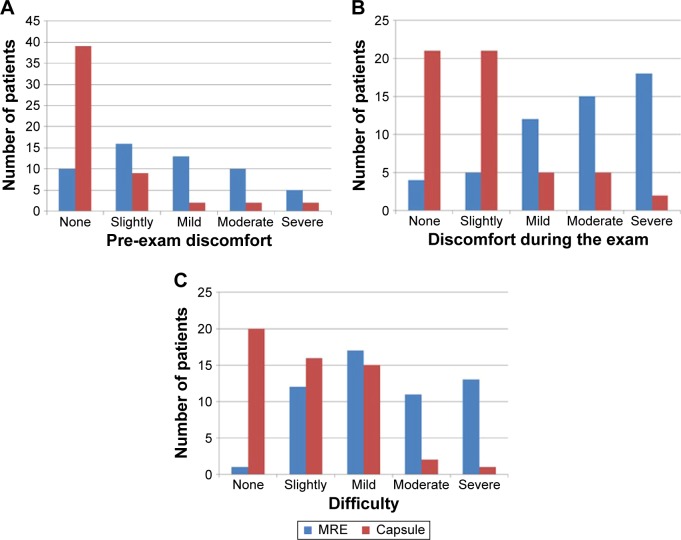
Fifty-six patients fulfilled inclusion criteria. Pre-exam discomfort, during-exam discomfort, nausea, vomiting, bloating, and abdominal pain were all significantly more prominent in MRE as compared to CE (P<0.0001, P<0.0001, P<0.0001, P=0.009, P=0.0002, P<0.0001, respectively). MRE was perceived as a more difficult procedure (P<0.0001). Furthermore, MRE was associated with a specific adverse event - claustrophobia. Seventy-eight percent of patients (44 patients) preferred to repeat CE as compared to 22% (P<0.0001) who preferred MRE.
CE was better tolerated by CD patients compared to MRE and was preferred by 78% of patients. The superior tolerability of CE should be considered along with the diagnostic features, and more data sought when choosing between these two modalities for CD patients for long-term follow-up.
尽管胶囊内镜检查(CE)和磁共振小肠造影(MRE)所获取的信息存在差异,但在评估疾病活动度时通常需要使用其中一种检查方式。目前尚无关于患者偏好的数据可帮助在这些情况下指导这两种检查方式的选择。
比较患者对MRE和CE的耐受性及偏好。
前瞻性招募临床缓解(克罗恩病活动指数[CDAI]<150)或症状轻微(CDAI<220)的已知小肠克罗恩病(CD)患者。所有患者先接受MRE检查,随后接受CE检查。要求患者填写一份问卷,涉及检查前准备、检查过程及检查后不便之处的具体要点。问卷还涉及副作用和检查偏好。仅当超过95%的项目得到回答时,问卷才纳入分析。
56例患者符合纳入标准。与CE相比,MRE检查前不适、检查期间不适、恶心、呕吐、腹胀和腹痛均更为明显(分别为P<0.0001、P<0.0001、P<0.0001、P=0.009、P=0.0002、P<0.0001)。MRE被认为是更困难的检查(P<0.0001)。此外,MRE与一种特定不良事件——幽闭恐惧症相关。78%的患者(44例)更倾向于重复CE检查,而倾向于MRE检查的患者为22%(P<0.0001)。
与MRE相比,CD患者对CE的耐受性更好,78%的患者更倾向于CE。在为CD患者选择这两种检查方式进行长期随访时,应考虑CE更好的耐受性以及诊断特征,并寻求更多数据。