Renoux Céline, Romana Marc, Joly Philippe, Ferdinand Séverine, Faes Camille, Lemonne Nathalie, Skinner Sarah, Garnier Nathalie, Etienne-Julan Maryse, Bertrand Yves, Petras Marie, Cannas Giovanna, Divialle-Doumdo Lydia, Nader Elie, Cuzzubbo Daniela, Lamarre Yann, Gauthier Alexandra, Waltz Xavier, Kebaili Kamila, Martin Cyril, Hot Arnaud, Hardy-Dessources Marie-Dominique, Pialoux Vincent, Connes Philippe
Unité de Pathologie Moléculaire du Globule Rouge, Laboratoire de Biochimie et de Biologie Moléculaire, Hôpital Edouard Herriot, Hospices Civils de Lyon, Lyon, France.
Laboratoire Interuniversitaire de Biologie de la Motricité, Equipe "Vascular Biology and Red Blood Cell", Université Claude Bernard Lyon 1, Lyon, France.
PLoS One. 2016 Jun 29;11(6):e0158182. doi: 10.1371/journal.pone.0158182. eCollection 2016.
Blood rheology plays a key role in the pathophysiology of sickle cell anaemia (SS) and sickle cell haemoglobin C disease (SC), but its evolution over the lifespan is unknown.
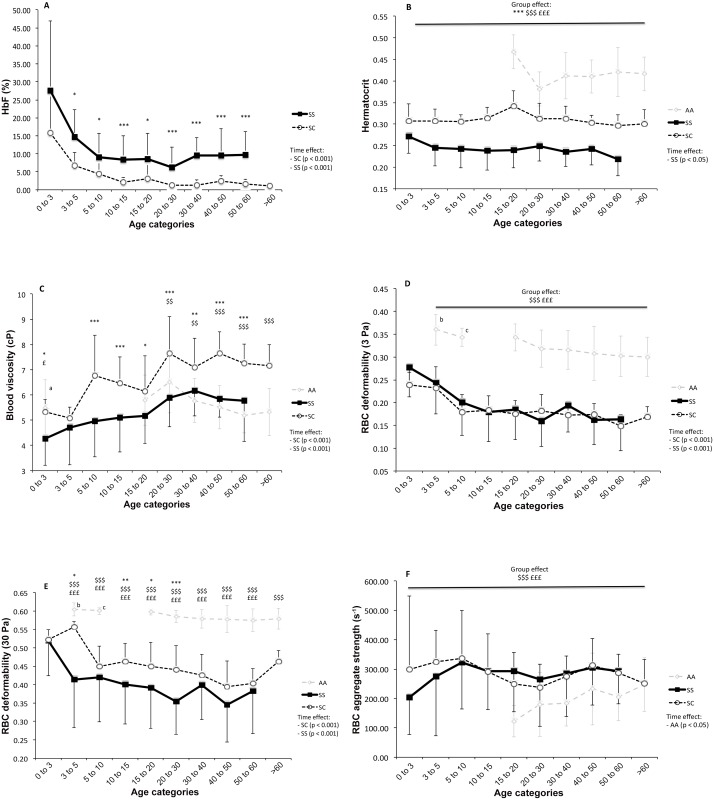
Blood viscosity, red blood cell (RBC) deformability and aggregation, foetal haemoglobin (HbF) and haematocrit were measured in 114 healthy individuals (AA), 267 SS (161 children + 106 adults) and 138 SC (74 children + 64 adults) patients.
Our results showed that 1) RBC deformability is at its maximal value during the early years of life in SS and SC populations, mainly because HbF level is also at its peak, 2) during childhood and adulthood, hydroxycarbamide treatment, HbF level and gender modulated RBC deformability in SS patients, independently of age, 3) blood viscosity is higher in older SS and SC patients compared to younger ones and 4) haematocrit decreases as SS patients age.
The hemorheological changes detected in older patients could play a role in the progressive development of several chronic disorders in sickle cell disease, whose prevalence increases with age. Retarding these age-related haemorheological impairments, by using suitable drugs, may minimize the risks of vaso-occlusive events and chronic disorders.
血液流变学在镰状细胞贫血(SS)和镰状细胞血红蛋白C病(SC)的病理生理学中起关键作用,但其在整个生命周期中的演变尚不清楚。
对114名健康个体(AA)、267名SS患者(161名儿童 + 106名成人)和138名SC患者(74名儿童 + 64名成人)测量了血液粘度、红细胞(RBC)变形性和聚集性、胎儿血红蛋白(HbF)和血细胞比容。
我们的结果表明,1)在SS和SC人群生命早期,RBC变形性处于最大值,主要是因为HbF水平也处于峰值;2)在儿童期和成年期,羟基脲治疗、HbF水平和性别可独立于年龄调节SS患者的RBC变形性;3)与年轻患者相比,老年SS和SC患者的血液粘度更高;4)随着SS患者年龄增长,血细胞比容降低。
在老年患者中检测到的血液流变学变化可能在镰状细胞病几种慢性疾病的渐进发展中起作用,这些疾病的患病率随年龄增加。通过使用合适的药物延缓这些与年龄相关的血液流变学损伤,可能会将血管闭塞事件和慢性疾病的风险降至最低。