Hu Yinan, Ghigliotti Laura, Vacchi Marino, Pisano Eva, Detrich H William, Albertson R Craig
Graduate Program in Organismic and Evolutionary Biology, University of Massachusetts, Amherst, MA, 01003, USA.
Present Address: Department of Biological Sciences, University of Rhode Island, Kingston, RI, 02881, USA.
BMC Evol Biol. 2016 Jun 29;16(1):142. doi: 10.1186/s12862-016-0704-2.
Over the past 40 million years water temperatures have dramatically dropped in the Southern Ocean, which has led to the local extinction of most nearshore fish lineages. The evolution of antifreeze glycoproteins in notothenioids, however, enabled these ancestrally benthic fishes to survive and adapt as temperatures reached the freezing point of seawater (-1.86 °C). Antarctic notothenioids now represent the primary teleost lineage in the Southern Ocean and are of fundamental importance to the local ecosystem. The radiation of notothenioids has been fostered by the evolution of "secondary pelagicism", the invasion of pelagic habitats, as the group diversified to fill newly available foraging niches in the water column. While elaborate craniofacial modifications have accompanied this adaptive radiation, little is known about how these morphological changes have contributed to the evolutionary success of notothenioids.
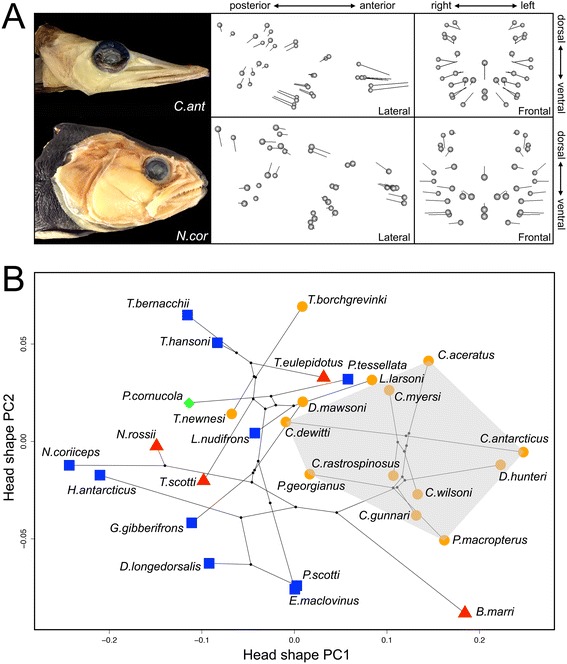
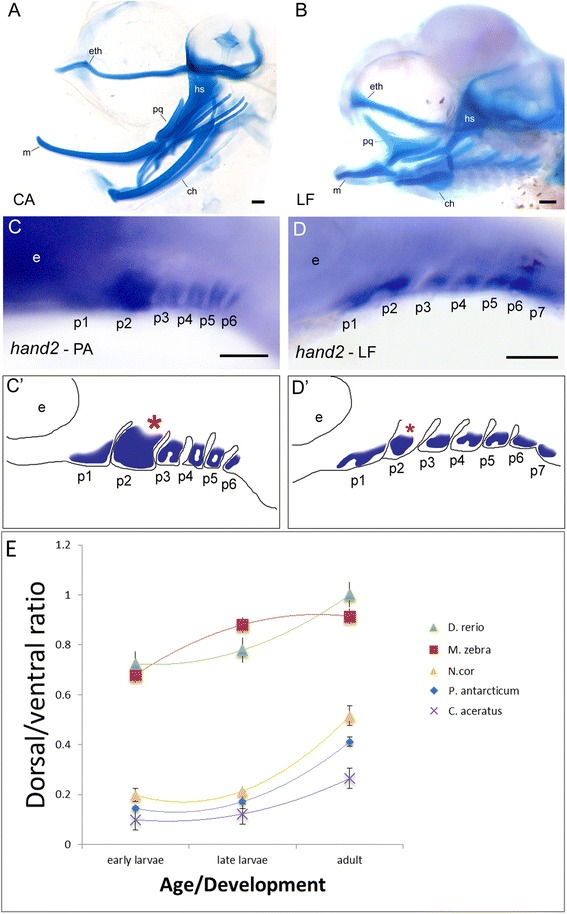
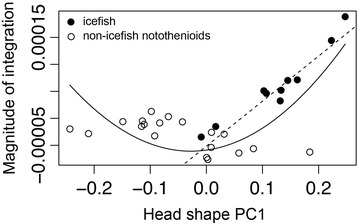
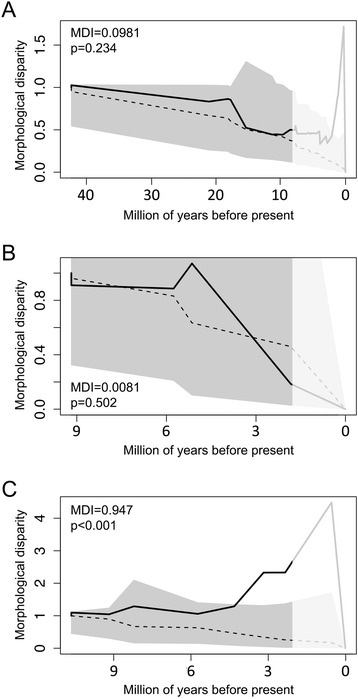
We used a 3D-morphometrics approach to investigate patterns of morphological variation in the craniofacial skeleton among notothenioids, and show that variation in head shape is best explained by divergent selection with respect to foraging niche. We document further an accelerated rate of morphological evolution in the icefish family Channichthyidae, and show that their rapid diversification was accompanied by the evolution of relatively high levels of morphological integration. Whereas most studies suggest that extensive integration should constrain phenotypic evolution, icefish stand out as a rare example of increased integration possibly facilitating evolutionary potential. Finally, we show that the unique feeding apparatus in notothenioids in general, and icefish in particular, can be traced to shifts in early developmental patterning mechanisms and ongoing growth of the pharyngeal skeleton.
Our work suggests that ecological opportunity is a major factor driving craniofacial variation in this group. Further, the observation that closely related lineages can differ dramatically in integration suggests that this trait can evolve quickly. We propose that the evolution of high levels of phenotypic integration in icefishes may be considered a key innovation that facilitated their morphological evolution and subsequent ecological expansion.
在过去的四千万年里,南大洋水温急剧下降,导致大多数近岸鱼类谱系在当地灭绝。然而,南极鱼亚目的抗冻糖蛋白的进化,使这些原本生活在海底的鱼类能够在水温降至海水冰点(-1.86°C)时生存并适应。南极鱼亚目现在是南大洋主要的硬骨鱼谱系,对当地生态系统至关重要。随着“次生浮游性”的进化,即向浮游栖息地的入侵,南极鱼亚目得以辐射演化,该群体多样化以填补水柱中新出现的觅食生态位。虽然这种适应性辐射伴随着精细的颅面形态改变,但对于这些形态变化如何促成南极鱼亚目的进化成功,人们知之甚少。
我们采用三维形态测量方法来研究南极鱼亚目颅面骨骼的形态变异模式,并表明头部形状的变异最好通过与觅食生态位相关的趋异选择来解释。我们进一步记录了冰鱼科形态进化的加速速率,并表明它们的快速多样化伴随着相对高水平的形态整合的进化。虽然大多数研究表明广泛的整合会限制表型进化,但冰鱼是一个罕见的例子,即增加的整合可能促进了进化潜力。最后,我们表明,一般来说南极鱼亚目独特的摄食器官,特别是冰鱼的摄食器官,可以追溯到早期发育模式机制的转变以及咽骨骼的持续生长。
我们的研究表明,生态机会是驱动该群体颅面变异的主要因素。此外,密切相关的谱系在整合方面可能存在显著差异,这一观察结果表明该特征可以快速进化。我们提出,冰鱼高水平表型整合的进化可能被视为一项关键创新,它促进了它们的形态进化和随后的生态扩张。