Yang Hyo-Joon, Lim Seon Hee, Lee Changhyun, Choi Ji Min, Yang Jong In, Chung Su Jin, Choi Seung Ho, Im Jong Pil, Kim Sang Gyun, Kim Joo Sung
Division of Gastroenterology, Department of Internal Medicine and Gastrointestinal Cancer Center, Kangbuk Samsung Hospital, Sungkyunkwan University School of Medicine, Seoul, Korea .
Department of Internal Medicine and Healthcare Research Institute, Healthcare System Gangnam Center, Seoul National University Hospital, Seoul, Korea .
J Korean Med Sci. 2016 Jul;31(7):1075-81. doi: 10.3346/jkms.2016.31.7.1075. Epub 2016 Apr 27.
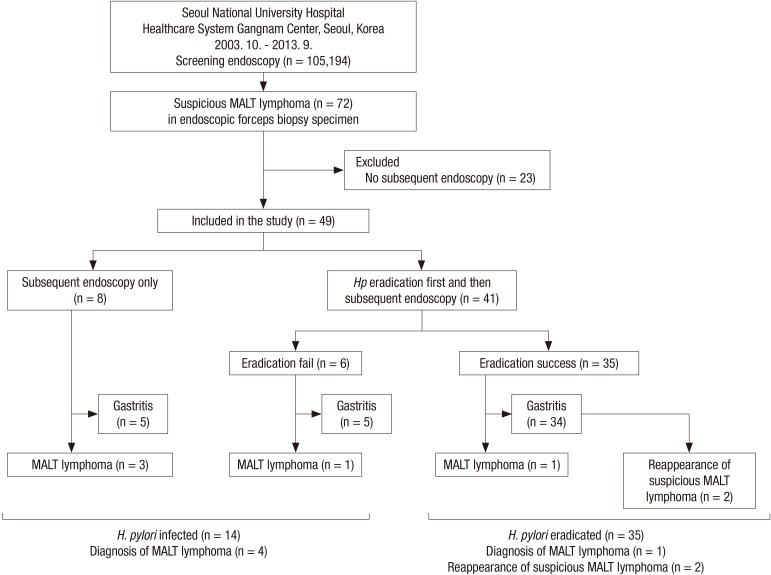
It is often difficult to differentiate gastric mucosa-associated lymphoid tissue (MALT) lymphoma from Helicobacter pylori-associated follicular gastritis, and thus, it becomes unclear how to manage these diseases. This study aimed to explore the management strategy for and the long-term outcomes of suspicious gastric MALT lymphoma detected by forceps biopsy during screening upper endoscopy. Between October 2003 and May 2013, consecutive subjects who were diagnosed with suspicious gastric MALT lymphomas by screening endoscopy in a health checkup program in Korea were retrospectively enrolled. Suspicious MALT lymphoma was defined as a Wotherspoon score of 3 or 4 upon pathological evaluation of the biopsy specimen. Of 105,164 subjects who underwent screening endoscopies, 49 patients with suspicious MALT lymphomas who underwent subsequent endoscopy were enrolled. Eight patients received a subsequent endoscopy without H. pylori eradication (subsequent endoscopy only group), and 41 patients received H. pylori eradication first followed by endoscopy (eradication first group). MALT lymphoma development was significantly lower in the eradication first group (2/41, 4.9%) than in the subsequent endoscopy only group (3/8, 37.5%, P = 0.026). Notably, among 35 patients with successful H. pylori eradication, there was only one MALT lymphoma patient (2.9%) in whom complete remission was achieved, and there was no recurrence during a median 45 months of endoscopic follow-up. H. pylori eradication with subsequent endoscopy would be a practical management option for suspicious MALT lymphoma detected in a forceps biopsy specimen obtained during screening upper endoscopy.
胃黏膜相关淋巴组织(MALT)淋巴瘤与幽门螺杆菌相关的滤泡性胃炎常常难以鉴别,因此,如何处理这些疾病尚不清楚。本研究旨在探讨在筛查性上消化道内镜检查中通过钳取活检发现的可疑胃MALT淋巴瘤的处理策略及长期预后。2003年10月至2013年5月,对在韩国一项健康体检项目中经筛查性内镜检查诊断为可疑胃MALT淋巴瘤的连续病例进行回顾性纳入。可疑MALT淋巴瘤定义为活检标本病理评估时Wotherspoon评分为3或4分。在105164例行筛查性内镜检查的受试者中,49例接受后续内镜检查的可疑MALT淋巴瘤患者被纳入。8例患者在未根除幽门螺杆菌的情况下接受了后续内镜检查(仅后续内镜检查组),41例患者先接受幽门螺杆菌根除治疗,随后接受内镜检查(先根除治疗组)。先根除治疗组MALT淋巴瘤的发生率(2/41, 4.9%)显著低于仅后续内镜检查组(3/8, 37.5%,P = 0.026)。值得注意的是,在35例成功根除幽门螺杆菌的患者中,仅有1例MALT淋巴瘤患者(2.9%)实现完全缓解,在中位45个月的内镜随访期间无复发。对于在筛查性上消化道内镜检查时通过钳取活检标本发现的可疑MALT淋巴瘤,根除幽门螺杆菌并进行后续内镜检查是一种切实可行的处理选择。