Lee Changhyun, Choe Eun Kyung, Choi Ji Min, Hwang Yunji, Lee Young, Park Boram, Chung Su Jin, Kwak Min-Sun, Lee Jong-Eun, Kim Joo Sung, Park Sue Kyung, Cho Sang-Heon
Healthcare Research Institute, Healthcare System Gangnam Center, Seoul National University Hospital, Seoul, South Korea.
Department of Preventive Medicine, Seoul National University College of Medicine, Seoul, South Korea.
BMJ Open. 2018 Apr 19;8(4):e019327. doi: 10.1136/bmjopen-2017-019327.
The Health and Prevention Enhancement (H-PEACE) study was designed to investigate the association of diagnostic imaging results, biomarkers and the predisease stage of non-communicable diseases (NCDs), such as malignancies and metabolic diseases, in an average-risk population in Korea.
This study enrolled a large-scale retrospective cohort at the Healthcare System Gangnam Center, Seoul National University Hospital, from October 2003 to December 2014.
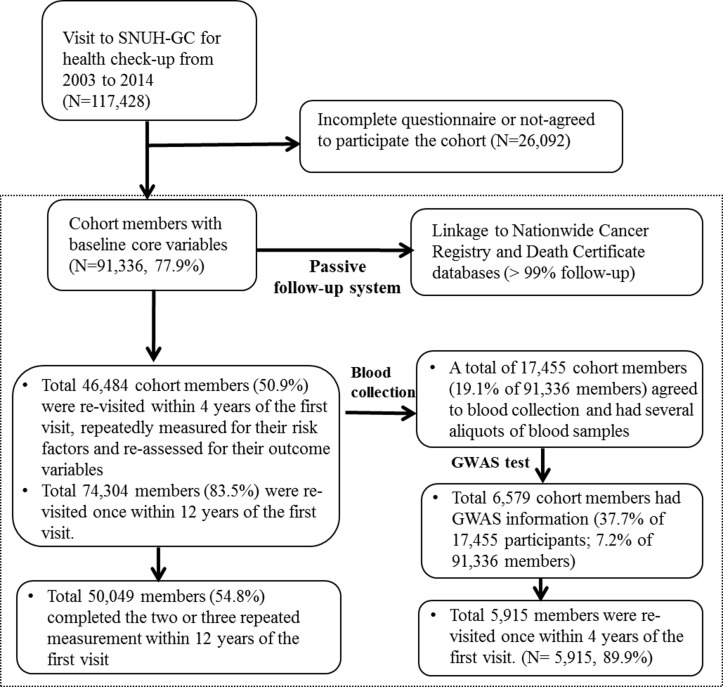
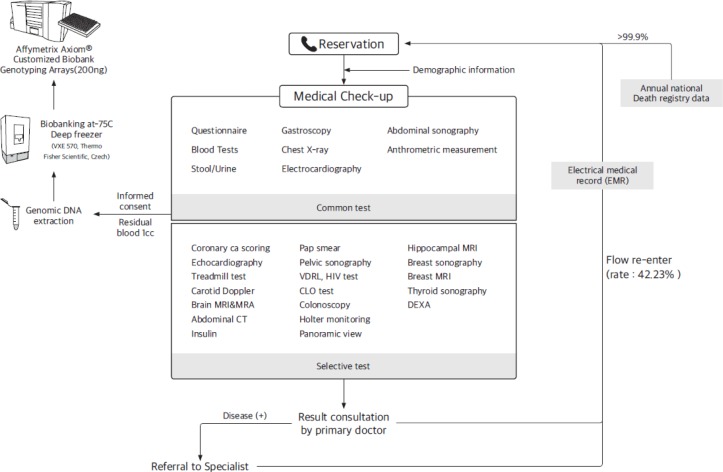
The baseline and follow-up information collected in the predisease stage of NCDs allows for evaluation of an individual's potential NCD risk, which is necessary for establishing personalised prevention strategies. A total of 91 336 health examinees were included in the cohort, and we repeatedly measured and collected information for 50.9% (n=46 484) of the cohort members. All participants completed structured questionnaires (lifestyle, medical history, mini-dietary assessment index, sex-specific variables and psychiatric assessment), doctors' physical examinations, laboratory blood and urine tests and digital chest X-ray imaging. For participants with available data, we also obtained information on specific diagnostic variables using advanced diagnostic tests, including coronary CT for coronary calcium scores, colonoscopy and brain MRI. Furthermore, 17 455 of the participants who provided informed consent and donated blood samples were enrolled into the Gene-environmental interaction and phenotype study, a subcohort of the H-PEACE, from October 2013, and we analysed genome-wide single-nucleotide polymorphism array data for 6579 of these blood samples.
The data obtained from this cohort will be used to facilitate advanced and accurate diagnostic techniques related to NCDs while considering various phenotypes. Potential collaborators can access the dataset after receiving approval from our institutional review board. Applications can be submitted on the study homepage (http://en-healthcare.snuh.org/HPEACEstudy).
健康与预防强化(H-PEACE)研究旨在调查韩国普通风险人群中诊断成像结果、生物标志物与非传染性疾病(如恶性肿瘤和代谢性疾病)疾病前期阶段之间的关联。
本研究于2003年10月至2014年12月在首尔国立大学医院江南医疗中心招募了一个大规模回顾性队列。
在非传染性疾病疾病前期阶段收集的基线和随访信息有助于评估个体患非传染性疾病的潜在风险,这对于制定个性化预防策略至关重要。该队列共纳入91336名健康体检者,我们对队列成员中的50.9%(n = 46484)进行了反复测量和信息收集。所有参与者均完成了结构化问卷(生活方式、病史、小型饮食评估指数、性别特异性变量和精神评估)、医生体格检查、实验室血液和尿液检测以及数字化胸部X光成像。对于有可用数据的参与者,我们还使用先进的诊断测试获取了特定诊断变量的信息,包括用于冠状动脉钙化评分的冠状动脉CT、结肠镜检查和脑部MRI。此外,从2013年10月起,17455名提供知情同意并捐献血液样本的参与者被纳入H-PEACE的一个子队列——基因-环境相互作用与表型研究,我们对其中6579份血液样本进行了全基因组单核苷酸多态性阵列数据分析。
从该队列获得的数据将用于促进与非传染性疾病相关的先进且准确的诊断技术,同时考虑各种表型。潜在合作者在获得我们机构审查委员会的批准后可以访问数据集。申请可在研究主页(http://en-healthcare.snuh.org/HPEACEstudy)上提交。