Beyer Katharina, Stollhof Laura, Poetschke Christian, von Bernstorff Wolfram, Partecke Lars Ivo, Diedrich Stephan, Maier Stefan, Bröker Barbara M, Heidecke Claus-Dieter
Department of General, Visceral, Thoracic, and Vascular Surgery, University of Greifswald, Greifswald, Germany.
Institute of Immunology, University of Greifswald, Greifswald, Germany.
J Inflamm Res. 2016 Jun 16;9:103-13. doi: 10.2147/JIR.S99887. eCollection 2016.
Apart from inducing apoptosis in tumor cells, tumor necrosis factor (TNF)-related apoptosis-inducing ligand (TRAIL) influences inflammatory reactions. Murine colon ascendens stent peritonitis (CASP) represents a model of diffuse peritonitis. Recently, it has been demonstrated that administration of exogenous TRAIL not only induces apoptosis in neutrophils but also enhances survival in this model. The aim of this study was to examine the impact of genetic TRAIL deficiency on the course of CASP.
Peritonitis was induced in 6- to 8-week-old female TRAIL (-/-) mice as well as in wild-type mice. The sepsis severity score and survival of mice were monitored. Bacterial loads in blood as well as in the lymphoid organs were examined. Additionally, the number of apoptotic cells within the lymphoid organs was determined.
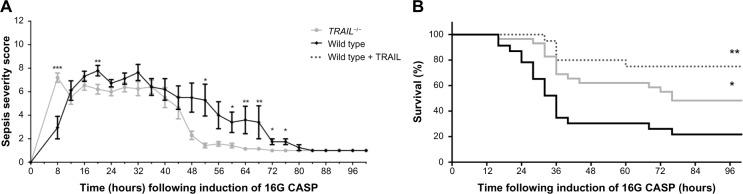
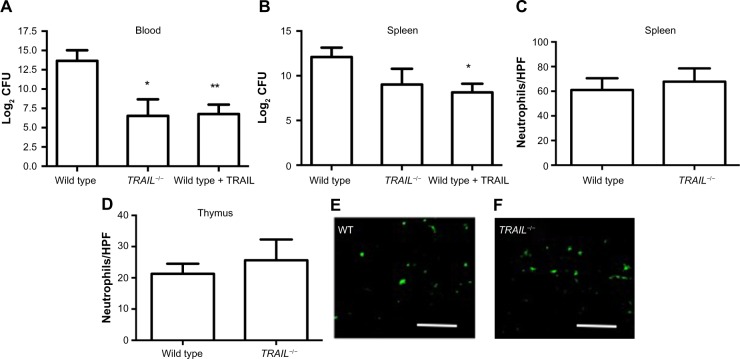
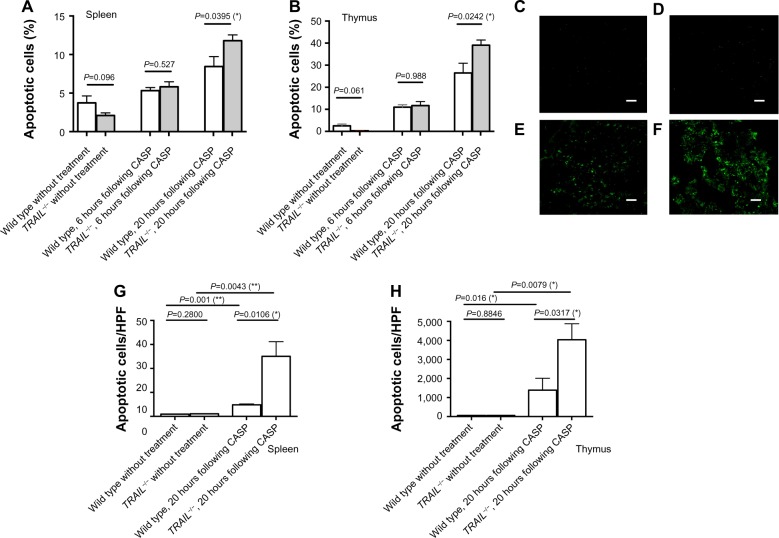
As early as 8 hours postinduction of CASP, TRAIL (-/-) mice were significantly more affected by sepsis than wild-type mice, as measured by the sepsis severity score. However, during the further course of sepsis, TRAIL deficiency led to significantly decreased sepsis severity scores, resulting in an enhanced overall survival in TRAIL (-/-) mice. The better survival of TRAIL (-/-) mice was accompanied by a decreased bacterial load within the blood. In marked contrast, the number of apoptotic cells within the lymphoid organs was highly increased in TRAIL (-/-) mice 20 hours after induction of CASP.
Hence, exogenous and endogenous TRAIL is protective during the early phase of sepsis, while endogenous TRAIL appears to be detrimental in the later course of this disease.
肿瘤坏死因子(TNF)相关凋亡诱导配体(TRAIL)除了诱导肿瘤细胞凋亡外,还会影响炎症反应。小鼠升结肠支架性腹膜炎(CASP)是一种弥漫性腹膜炎模型。最近有研究表明,外源性TRAIL的给药不仅能诱导中性粒细胞凋亡,还能提高该模型中的存活率。本研究的目的是探讨遗传性TRAIL缺陷对CASP病程的影响。
对6至8周龄的雌性TRAIL(-/-)小鼠和野生型小鼠诱导腹膜炎。监测小鼠的脓毒症严重程度评分和存活率。检测血液以及淋巴器官中的细菌载量。此外,还测定了淋巴器官内凋亡细胞的数量。
早在诱导CASP后8小时,通过脓毒症严重程度评分测定,TRAIL(-/-)小鼠比野生型小鼠受脓毒症的影响更大。然而,在脓毒症的进一步病程中,TRAIL缺陷导致脓毒症严重程度评分显著降低,从而使TRAIL(-/-)小鼠的总体存活率提高。TRAIL(-/-)小鼠更好的存活率伴随着血液中细菌载量的降低。与之形成鲜明对比的是,在诱导CASP后20小时,TRAIL(-/-)小鼠淋巴器官内的凋亡细胞数量大幅增加。
因此,外源性和内源性TRAIL在脓毒症早期具有保护作用,而内源性TRAIL在该疾病的后期似乎具有有害作用。