Wong Weng Kin, Foo Phiaw Chong, Roze Mohamad Noor Mohamad, Pim Chau Dam, Subramaniam Puvaneswari, Lim Boon Huat
School of Health Sciences, Universiti Sains Malaysia, 16150 Kubang Kerian, Malaysia.
Tuberculosis and Leprosy Control Unit, Perak State Health Department, Ministry of Health, Jalan Panglima Bukit Gantang Wahab, 30590 Ipoh, Perak, Malaysia.
Can J Infect Dis Med Microbiol. 2016;2016:1326085. doi: 10.1155/2016/1326085. Epub 2016 May 30.
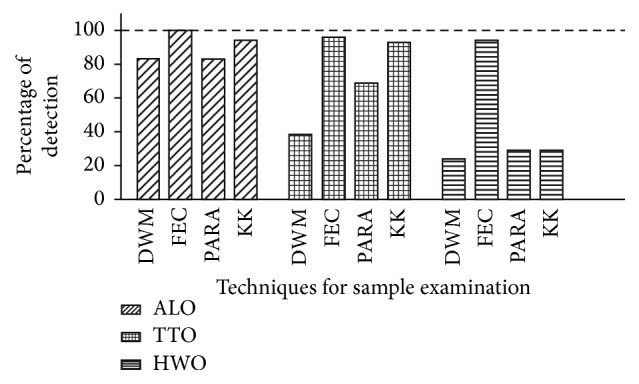
Background. Orang Asli (aborigine) children are susceptible to soil-transmitted helminth (STH) infections due to their lifestyle and substandard sanitation system. Objectives. This study aimed to examine the helminthic and nutritional status of Orang Asli school children in Sekolah Kebangsaan Pos Legap, a remote primary school at Kuala Kangsar District in the state of Perak, Malaysia. In addition, the sensitivities of four STH stool examination techniques were also compared. Methods. Demography and anthropometry data were collected by one-to-one interview session. Collected stools were examined with four microscopy techniques, namely, direct wet mount, formalin ether concentration (FEC), Kato-Katz (KK), and Parasep™. Results. Anthropometry analysis showed that 78% (26/33) of children in SK Pos Legap were malnourished and 33% (11/33) of them were stunted. Stool examinations revealed almost all children (97%) were infected by either one of the three commonest STHs. FEC was the most sensitive method in detection of the three helminth species. Conclusion. This study revealed that STH infections and nutritional status still remain a health concern among the Orang Asli children. These communal problems could be effectively controlled by regular monitoring of STH infection loads, administration of effective antihelminthic drug regimen, and also implementation of effective school nutritional programs.
背景。由于生活方式和卫生条件不达标的原因,原住民族(原住民)儿童易感染土源性蠕虫(STH)。目的。本研究旨在调查马来西亚霹雳州瓜拉江沙区一所偏远小学——波斯拉加国民学校的原住民族学童的蠕虫感染情况和营养状况。此外,还比较了四种STH粪便检测技术的敏感性。方法。通过一对一访谈收集人口统计学和人体测量学数据。收集的粪便采用四种显微镜检查技术进行检测,即直接湿涂片法、甲醛乙醚浓缩法(FEC)、加藤厚涂片法(KK)和Parasep™法。结果。人体测量学分析显示,波斯拉加国民学校78%(26/33)的儿童营养不良,其中33%(11/33)发育迟缓。粪便检查显示,几乎所有儿童(97%)感染了三种最常见的STH中的一种。FEC是检测这三种蠕虫的最敏感方法。结论。本研究表明,STH感染和营养状况仍是原住民族儿童的健康问题。通过定期监测STH感染负荷、给予有效的抗蠕虫药物治疗方案以及实施有效的学校营养计划,可以有效控制这些公共卫生问题。