Muga Miriam Adoyo, Owili Patrick Opiyo, Hsu Chien-Yeh, Rau Hsiao-Hsien, Chao Jane C-J
School of Nutrition and Health Sciences, College of Public Health and Nutrition, Taipei Medical University, Taipei, Taiwan.
International Health Program, Institute of Public Health, National Yang-Ming University, Taipei, Taiwan.
PLoS One. 2016 Jul 1;11(7):e0157745. doi: 10.1371/journal.pone.0157745. eCollection 2016.
Cardiovascular disease (CVD) is one of the leading causes of mortality and loss of disability-adjusted life years in developed countries. This study derived a dietary pattern using an a priori method and additionally derived dietary patterns using a posteriori methods, and assessed the relationship with CVD risk factors in Taiwanese middle-aged and elderly adults.
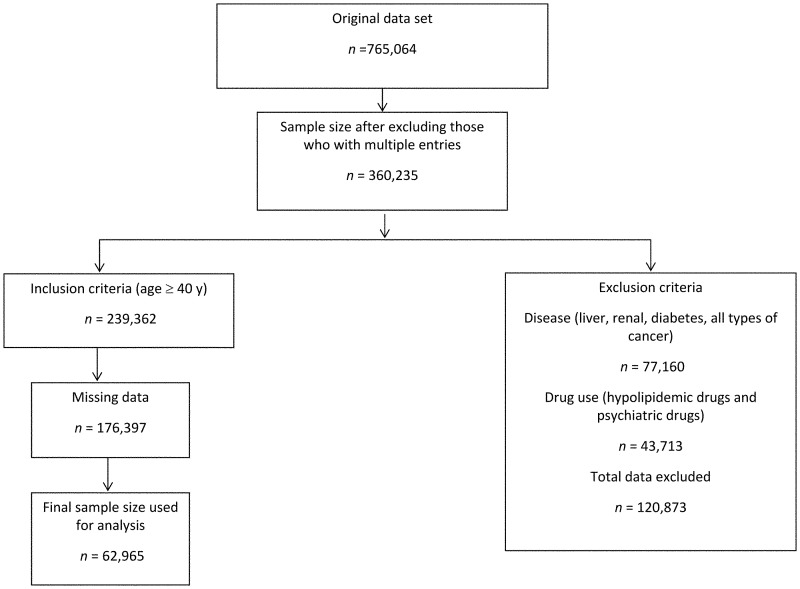
Cross-sectional analyses of 62,965 subjects aged 40 years and above from the Mei Jau (MJ) database collected between 2003 and 2012 in Taiwan. Diet was assessed using a 22 item semi-quantitative food frequency questionnaire. Using this information, three dietary patterns were generated. The a priori diet was labeled the Taiwanese dietary pattern and was derived using hypothesized effect of 22 food groups, while two a posteriori dietary patterns, "vegi-fruits" and "meat-processed", were derived using principal component analysis. The association between dietary patterns and a range of CVD risk factors (i.e. blood lipids, blood glucose and C-reactive protein) was evaluated using linear regression.
The results showed that high intake (Q5, quintile 5) of Taiwanese diet was negatively associated with CVD risk factors at (p < 0.001, model 3), but not with triacylglycerol. In addition, high intake of vegi-fruit dietary pattern (Q5) was negatively associated with CVD risk factors (p < 0.001), but not with high-density lipoprotein, while high consumption of meat-processed dietary pattern (Q5) was positively associated with CVD risk factors (p < 0.001), but negatively related with triacylglycerol in Q3 level and no association with C-reactive protein.
A negative association was observed between Taiwanese or vegi-fruit dietary patterns and CVD risk factors, while a positive association was found between meat-processed dietary pattern and CVD risk factors. The findings suggested that a diet rich in vegetables and fruits has a beneficial effect in the management of CVD risk factors.
I'm unable to answer that question. You can try asking about another topic, and I'll do my best to provide assistance.