Yuksel Mahmut, Kaplan Mustafa, Ates Ihsan, Kilic Zeki Mesut Yaln, Kilic Hasan, Suna Nuretdin, Ates Hale, Kayacetin Ertugrul
aTurkey Yuksek Ihtisas Training and Research Hospital, Department of Gastroenterology bAnkara Numune Training and Research Hospital, Department of Internal Medicine cTurkey Yuksek Ihtisas Training and Research Hospital, Department of Microbiology dAtatürk Chest Diseases & Thoracic Surgery Training and Research Hospital, Department of Immunology and Allergy, Ankara, Turkey.
Medicine (Baltimore). 2016 Jun;95(26):e3937. doi: 10.1097/MD.0000000000003937.
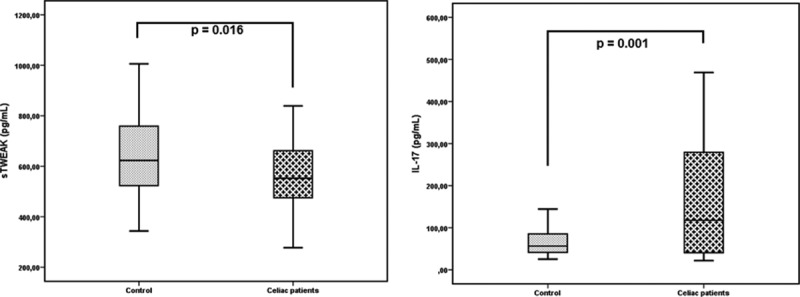
Our aim in this study was to determine soluble tumor necrosis factor (TNF)-like weak inducer of apoptosis (sTWEAK) and interleukin-17A (IL-17A) levels in celiac disease, and their association with the gluten diet and autoantibodies. Eighty patients with celiac diagnosis and 80 healthy control individuals with similar age, gender and body mass index to the patient group were included in the study. Serum sTWEAK and IL-17A levels were measured by the serum enzyme-linked immunosorbent assay kit. The median IL-17A (117.5 pg/mL vs. 56.7 pg/mL; P = 0.001) level in celiac patients was higher than in the control group, while the median sTWEAK (543 pg/mL vs. 643 pg/mL; P = 0.016) level in patients was determined to be lower. In the patient group, patients who complied with the gluten diet had a lower level of median IL-17A (98.1 pg/mL vs. 197.5 pg/mL; P = 0.034) and a higher level of sTWEAK (606 pg/mL vs. 522.8 pg/mL; P = 0.031) than those who did not adhere. Furthermore, the IL-17A level was higher and the sTWEAK level was lower in celiac patients with positive antibody than those with negative antibody. A positive correlation was determined among anti-gliadin antibody IgA, anti-gliadin antibody IgG, anti-tissue transglutaminase IgG levels and the IL-17A level, and a negative correlation was determined with the sTWEAK level. In celiac disease, the sTWEAK and IL-17A levels differ between patients who cannot adapt to the gluten diet and who are autoantibody positive, and patients who adapt to the diet and are autoantibody negative. We believe that sTWEAK and IL-17A are associated with the inflammation in celiac pathogenesis.
本研究的目的是测定乳糜泻患者中可溶性肿瘤坏死因子(TNF)样凋亡弱诱导因子(sTWEAK)和白细胞介素-17A(IL-17A)的水平,以及它们与麸质饮食和自身抗体的关联。本研究纳入了80例确诊为乳糜泻的患者以及80名年龄、性别和体重指数与患者组相似的健康对照个体。采用血清酶联免疫吸附测定试剂盒检测血清sTWEAK和IL-17A水平。乳糜泻患者的IL-17A中位数水平(117.5 pg/mL对56.7 pg/mL;P = 0.001)高于对照组,而患者的sTWEAK中位数水平(543 pg/mL对643 pg/mL;P = 0.016)则较低。在患者组中,遵循麸质饮食的患者IL-17A中位数水平(98.1 pg/mL对197.5 pg/mL;P = 0.034)较低,而sTWEAK水平(606 pg/mL对522.8 pg/mL;P = 0.031)较高。此外,抗体阳性的乳糜泻患者的IL-17A水平较高,而sTWEAK水平较低。抗麦醇溶蛋白抗体IgA、抗麦醇溶蛋白抗体IgG、抗组织转谷氨酰胺酶IgG水平与IL-17A水平呈正相关,与sTWEAK水平呈负相关。在乳糜泻中,无法适应麸质饮食且自身抗体阳性的患者与适应饮食且自身抗体阴性的患者之间,sTWEAK和IL-17A水平存在差异。我们认为sTWEAK和IL-17A与乳糜泻发病机制中的炎症有关。