Lee Junmin, Abdeen Amr A, Tang Xin, Saif Taher A, Kilian Kristopher A
Department of Materials Science and Engineering, University of Illinois at Urbana-Champaign, Urbana, IL 61801, USA; Micro and Nanotechnology Laboratory, University of Illinois at Urbana-Champaign, Urbana, IL 61801, USA.
Micro and Nanotechnology Laboratory, University of Illinois at Urbana-Champaign, Urbana, IL 61801, USA; Department of Mechanical Science and Engineering, University of Illinois at Urbana-Champaign, Urbana, IL 61801, USA.
Acta Biomater. 2016 Sep 15;42:46-55. doi: 10.1016/j.actbio.2016.06.037. Epub 2016 Jun 29.
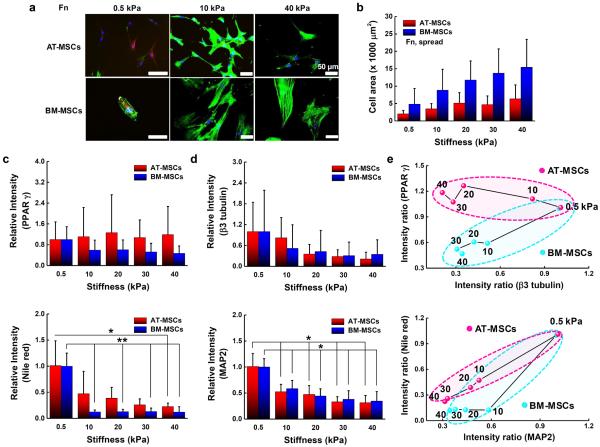
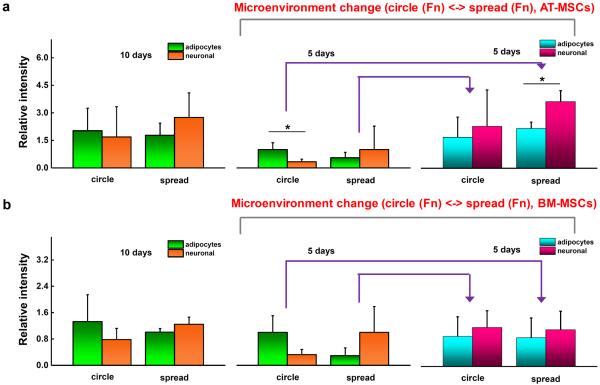
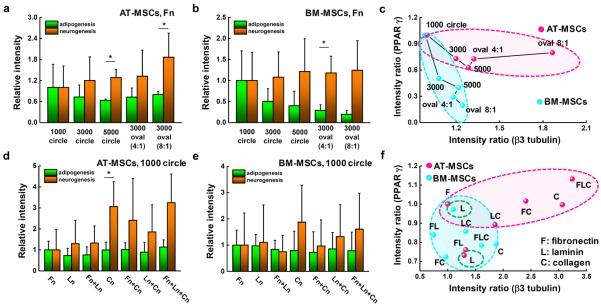
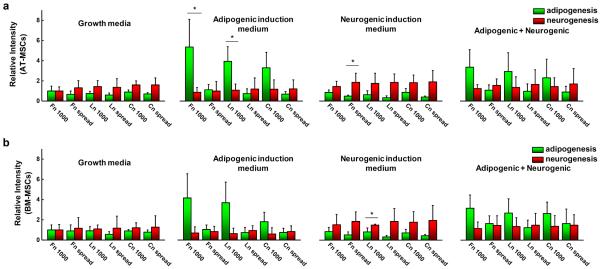
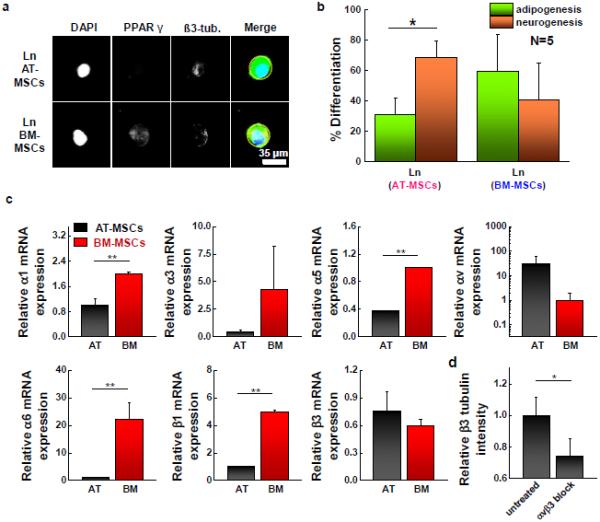
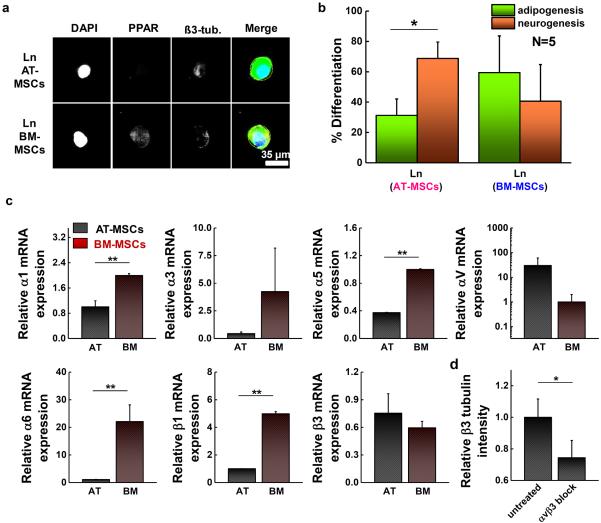
Mesenchymal stem cells (MSCs) can differentiate into multiple lineages through guidance from the biophysical and biochemical properties of the extracellular matrix. In this work we conduct a combinatorial study of matrix properties that influence adipogenesis and neurogenesis including: adhesion proteins, stiffness, and cell geometry, for mesenchymal stem cells derived from adipose tissue (AT-MSCs) and bone marrow (BM-MSCs). We uncover distinct differences in integrin expression, the magnitude of traction stress, and lineage specification to adipocytes and neuron-like cells between cell sources. In the absence of media supplements, adipogenesis in AT-MSCs is not significantly influenced by matrix properties, while the converse is true in BM-MSCs. Both cell types show changes in the expression of neurogenesis markers as matrix cues are varied. When cultured on laminin conjugated microislands of the same adhesive area, BM-MSCs display elevated adipogenesis markers, while AT-MSCs display elevated neurogenesis markers; integrin analysis suggests neurogenesis in AT-MSCs is guided by adhesion through integrin αvβ3. Overall, the properties of the extracellular matrix guides MSC adhesion and lineage specification to different degrees and outcomes, in spite of their similarities in general characteristics. This work will help guide the selection of MSCs and matrix components for applications where high fidelity of differentiation outcome is desired.
Mesenchymal stem cells (MSCs) are an attractive cell type for stem cell therapies; however, in order for these cells to be useful in medicine, we need to understand how they respond to the physical and chemical environments of tissue. Here, we explore how two promising sources of MSCs-those derived from bone marrow and from adipose tissue-respond to the compliance and composition of tissue using model extracellular matrices. Our results demonstrate a source-specific propensity to undergo adipogenesis and neurogenesis, and uncover a role for adhesion, and the degree of traction force exerted on the substrate in guiding these lineage outcomes.
间充质干细胞(MSC)可通过细胞外基质的生物物理和生化特性引导分化为多种细胞谱系。在本研究中,我们对影响脂肪生成和神经生成的基质特性进行了组合研究,这些特性包括:黏附蛋白、硬度和细胞几何形状,研究对象为源自脂肪组织的间充质干细胞(AT-MSC)和骨髓间充质干细胞(BM-MSC)。我们发现,不同细胞来源在整合素表达、牵引应力大小以及向脂肪细胞和神经元样细胞的谱系分化方面存在明显差异。在没有培养基补充剂的情况下,AT-MSC的脂肪生成不受基质特性的显著影响,而BM-MSC则相反。随着基质线索的变化,两种细胞类型的神经生成标志物表达均发生改变。当在相同黏附面积的层粘连蛋白偶联微岛上培养时,BM-MSC显示出升高的脂肪生成标志物,而AT-MSC显示出升高的神经生成标志物;整合素分析表明,AT-MSC中的神经生成通过整合素αvβ3介导的黏附来引导。总体而言,尽管细胞外基质的一般特征相似,但其特性在不同程度上引导着MSC的黏附及谱系分化,并产生不同结果。这项工作将有助于指导在需要高保真分化结果的应用中选择MSC和基质成分。
间充质干细胞(MSC)是干细胞治疗中一种有吸引力的细胞类型;然而,为了使这些细胞在医学中发挥作用,我们需要了解它们如何响应组织的物理和化学环境。在这里,我们使用模型细胞外基质探索了两种有前景的MSC来源——源自骨髓和脂肪组织的MSC——如何响应组织的顺应性和组成。我们的结果证明了脂肪生成和神经生成存在来源特异性倾向,并揭示了黏附以及施加在底物上的牵引力大小在引导这些谱系结果中的作用。