Kusunoki Yoshihiro, Nakazawa Daigo, Shida Haruki, Hattanda Fumihiko, Miyoshi Arina, Masuda Sakiko, Nishio Saori, Tomaru Utano, Atsumi Tatsuya, Ishizu Akihiro
Division of Rheumatology, Endocrinology and Nephrology, Hokkaido University Graduate School of Medicine , Sapporo , Japan.
Faculty of Health Sciences, Hokkaido University , Sapporo , Japan.
Front Immunol. 2016 Jun 8;7:227. doi: 10.3389/fimmu.2016.00227. eCollection 2016.
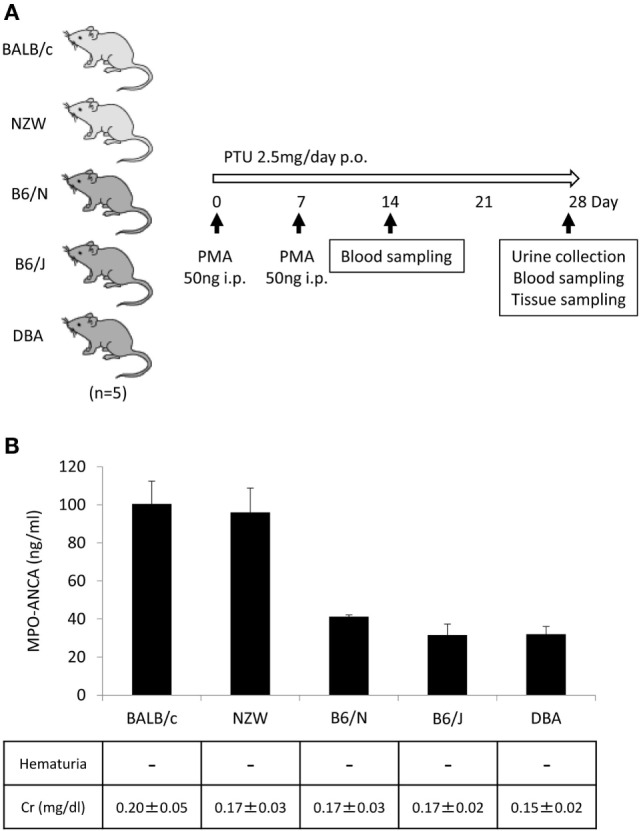
Myeloperoxidase-antineutrophil cytoplasmic antibody (MPO-ANCA)-associated vasculitis is a systemic small-vessel vasculitis, wherein, MPO-ANCA plays a critical role in the pathogenesis. Neutrophil extracellular traps (NETs) released from activated neutrophils are composed of extracellular web-like DNA and antimicrobial proteins, including MPO. Diverse stimuli, such as phorbol myristate acetate (PMA) and ligands of toll-like receptors (TLR), induce NETs. Although TLR-mediated NET formation can occur with preservation of living neutrophilic functions (called vital NETosis), PMA-stimulated neutrophils undergo cell death with NET formation (called suicidal NETosis). In the process of suicidal NETosis, histones are citrullinated by peptidylarginine deiminase 4 (PAD4). Since this step is necessary for decondensation of DNA, PAD4 plays a pivotal role in suicidal NETosis. Although NETs are essential for elimination of microorganisms, excessive formation of NETs has been suggested to be implicated in MPO-ANCA production. This study aimed to determine if pan-PAD inhibitors could suppress MPO-ANCA production in vivo. At first, NETs were induced in peripheral blood neutrophils derived from healthy donors (1 × 10(6)/ml) by stimulation with 20 nM PMA with or without 20 μM propylthiouracil (PTU), an anti-thyroid drug. We then determined that the in vitro NET formation was inhibited completely by 200 μM Cl-amidine, a pan-PAD inhibitor. Next, we established mouse models with MPO-ANCA production. BALB/c mice were given intraperitoneal (i.p.) injection of PMA (50 ng at days 0 and 7) and oral PTU (2.5 mg/day) for 2 weeks. These mice were divided into two groups; the first group was given daily i.p. injection of PBS (200 μl/day) (n = 13) and the other group with daily i.p. injection of Cl-amidine (0.3 mg/200 μl PBS/day) (n = 7). Two weeks later, citrullination as an indicator of NET formation in the peritoneum and serum MPO-ANCA titer was compared between the two groups. Results demonstrated that citrullination in the peritoneum was significantly reduced in the Cl-amidine-treated mice compared with the vehicle-injected control mice (38% reduction). Additionally, the serum MPO-ANCA titer of the Cl-amidine-treated mice (32.3 ± 31.0 ng/ml) was significantly lower than that in the vehicle-injected mice (132.1 ± 41.6 ng/ml). The collective findings indicate that excessive formation of NETs may be implicated in MPO-ANCA production in vivo.
髓过氧化物酶-抗中性粒细胞胞浆抗体(MPO-ANCA)相关血管炎是一种系统性小血管炎,其中MPO-ANCA在发病机制中起关键作用。活化的中性粒细胞释放的中性粒细胞胞外诱捕网(NETs)由细胞外网状DNA和包括MPO在内的抗菌蛋白组成。多种刺激因素,如佛波酯(PMA)和Toll样受体(TLR)的配体,可诱导NETs形成。虽然TLR介导的NET形成可在保留活嗜中性粒细胞功能的情况下发生(称为存活NETosis),但PMA刺激的中性粒细胞会伴随NET形成而发生细胞死亡(称为自杀性NETosis)。在自杀性NETosis过程中,组蛋白被肽基精氨酸脱亚氨酶4(PAD4)瓜氨酸化。由于这一步骤对于DNA解聚是必需的,因此PAD4在自杀性NETosis中起关键作用。虽然NETs对于消除微生物至关重要,但过量形成的NETs被认为与MPO-ANCA的产生有关。本研究旨在确定泛PAD抑制剂是否能在体内抑制MPO-ANCA的产生。首先,用20 nM PMA加或不加20 μM丙硫氧嘧啶(PTU,一种抗甲状腺药物)刺激健康供体来源的外周血中性粒细胞(1×10⁶/ml),诱导NETs形成。然后我们确定200 μM Cl-脒(一种泛PAD抑制剂)可完全抑制体外NET形成。接下来,我们建立了产生MPO-ANCA的小鼠模型。给BALB/c小鼠腹腔注射PMA(第0天和第7天各50 ng)并口服PTU(2.5 mg/天),持续2周。将这些小鼠分为两组;第一组每天腹腔注射PBS(200 μl/天)(n = 13),另一组每天腹腔注射Cl-脒(0.3 mg/200 μl PBS/天)(n = 7)。两周后,比较两组小鼠腹膜中作为NET形成指标的瓜氨酸化程度和血清MPO-ANCA滴度。结果表明,与注射载体的对照小鼠相比,Cl-脒处理的小鼠腹膜中的瓜氨酸化程度显著降低(降低38%)。此外,Cl-脒处理的小鼠血清MPO-ANCA滴度(32.3±31.0 ng/ml)显著低于注射载体的小鼠(132.1±41.6 ng/ml)。这些共同发现表明,NETs的过量形成可能与体内MPO-ANCA的产生有关。