Carvalho Sabrina, van der Putten Wim H, Hol W H G
Department of Terrestrial Ecology, NIOO-KNAW, Netherlands Institute of Ecology Wageningen, Netherlands.
Department of Terrestrial Ecology, NIOO-KNAW, Netherlands Institute of EcologyWageningen, Netherlands; Laboratory of Nematology, Wageningen UniversityWageningen, Netherlands.
Front Plant Sci. 2016 Jun 9;7:759. doi: 10.3389/fpls.2016.00759. eCollection 2016.
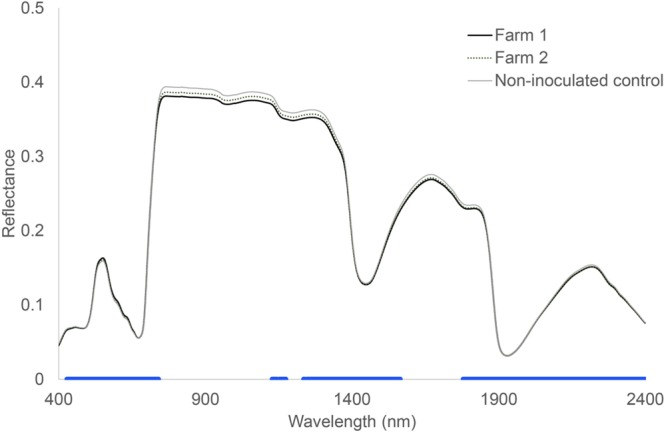
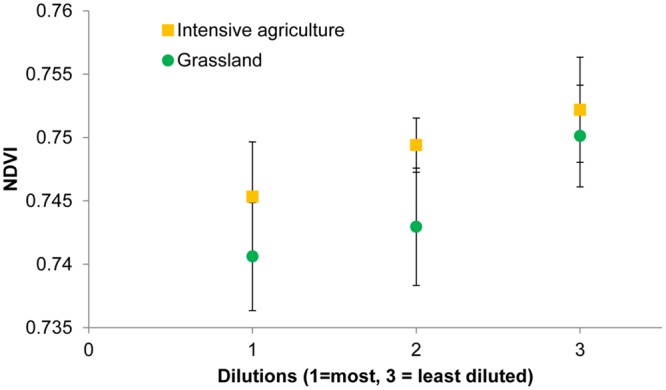
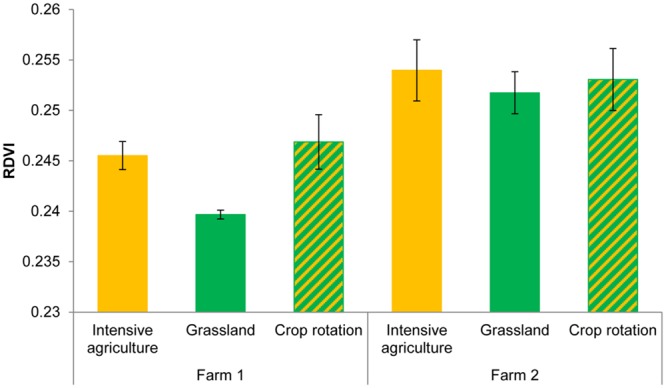
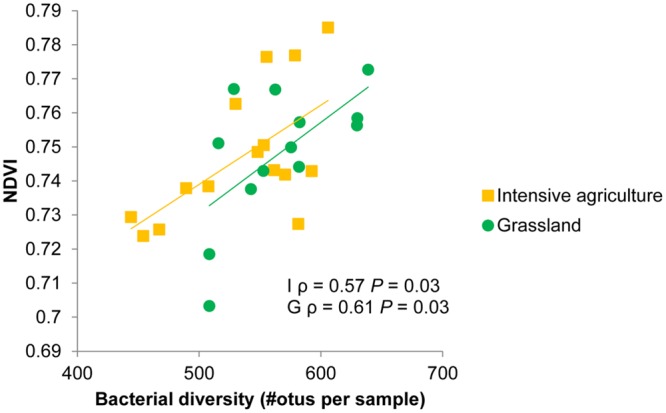
Reliable information on soil status and crop health is crucial for detecting and mitigating disasters like pollution or minimizing impact from soil-borne diseases. While infestation with an aggressive soil pathogen can be detected via reflected light spectra, it is unknown to what extent hyperspectral reflectance could be used to detect overall changes in soil biodiversity. We tested the hypotheses that spectra can be used to (1) separate plants growing with microbial communities from different farms; (2) to separate plants growing in different microbial communities due to different land use; and (3) separate plants according to microbial species loss. We measured hyperspectral reflectance patterns of winter wheat plants growing in sterilized soils inoculated with microbial suspensions under controlled conditions. Microbial communities varied due to geographical distance, land use and microbial species loss caused by serial dilution. After 3 months of growth in the presence of microbes from the two different farms plant hyperspectral reflectance patterns differed significantly from each other, while within farms the effects of land use via microbes on plant reflectance spectra were weak. Species loss via dilution on the other hand affected a number of spectral indices for some of the soils. Spectral reflectance can be indicative of differences in microbial communities, with the Renormalized Difference Vegetation Index the most common responding index. Also, a positive correlation was found between the Normalized Difference Vegetation Index and the bacterial species richness, which suggests that plants perform better with higher microbial diversity. There is considerable variation between the soil origins and currently it is not possible yet to make sufficient reliable predictions about the soil microbial community based on the spectral reflectance. We conclude that measuring plant hyperspectral reflectance has potential for detecting changes in microbial communities yet due to its sensitivity high replication is necessary and a strict sampling design to exclude other 'noise' factors.
关于土壤状况和作物健康的可靠信息对于检测和减轻污染等灾害或最小化土壤传播疾病的影响至关重要。虽然可以通过反射光谱检测到侵袭性土壤病原体的侵染,但尚不清楚高光谱反射率在多大程度上可用于检测土壤生物多样性的整体变化。我们测试了以下假设:光谱可用于(1)区分在不同农场的微生物群落中生长的植物;(2)区分因不同土地利用而在不同微生物群落中生长的植物;(3)根据微生物物种损失区分植物。我们在受控条件下测量了在接种了微生物悬浮液的无菌土壤中生长的冬小麦植株的高光谱反射模式。微生物群落因地理距离、土地利用和连续稀释导致的微生物物种损失而有所不同。在存在来自两个不同农场的微生物的情况下生长3个月后,植物的高光谱反射模式彼此有显著差异,而在农场内部,通过微生物的土地利用对植物反射光谱的影响较弱。另一方面,通过稀释造成的物种损失影响了某些土壤的一些光谱指数。光谱反射率可以指示微生物群落的差异,重归一化差异植被指数是最常见的响应指数。此外,还发现归一化差异植被指数与细菌物种丰富度之间存在正相关,这表明植物在微生物多样性较高时表现更好。土壤来源之间存在相当大的差异,目前还无法根据光谱反射率对土壤微生物群落做出足够可靠的预测。我们得出结论,测量植物高光谱反射率有检测微生物群落变化的潜力,但由于其敏感性,需要高重复次数并且要有严格的采样设计以排除其他“噪声”因素。