Chiu Hui-Fang, Wu Ying-Hua, Shen You-Cheng, Wang Shing-Jung, Venkatakrishnan Kamesh, Wang Chin-Kun
Department of Chinese Medicine, Taichung Hospital Ministry of Health and Well-being, Taichung, Taiwan.
School of Nutrition, Chung Shan Medical University, Taichung, Taiwan.
Chin Med. 2016 Jun 30;11:30. doi: 10.1186/s13020-016-0102-0. eCollection 2016.
Si-Wu-Tang (SWT) is used to treat various gynecological disorders in Chinese medicine. This study investigated the antioxidant and physiological effects of SWT on the skin and liver in healthy adults.
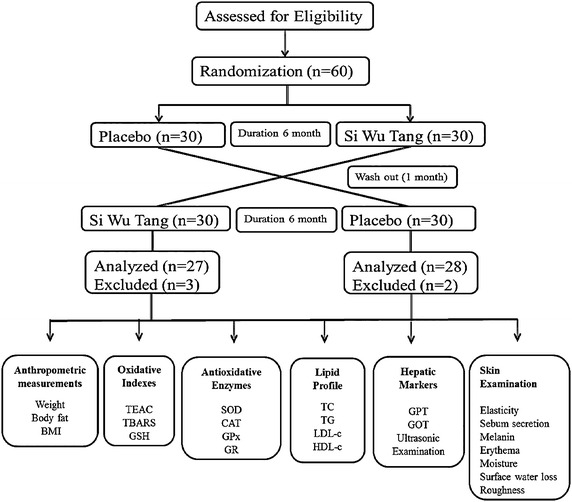
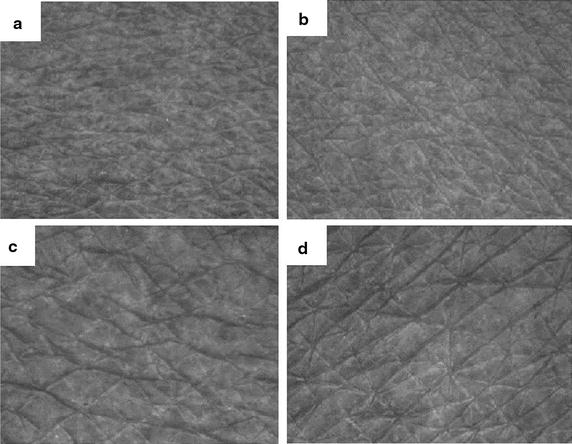
This randomized, crossover, double-blind, placebo-controlled clinical trial was conducted at Chung Shan Medical University Hospital in December 2008. Participants with uncontrolled diabetes, heart disease, liver disease, kidney disease, cancer, and pregnancy were excluded. Sixty healthy volunteers taking no medications were recruited from the community based on the results of their medical history questionnaires and biochemical analyses to confirm their health status. The participants were assigned to two groups: one group drank 125 mL of placebo (n = 30) and the other drank SWT (n = 30) for six continuous days per month for 6 months. The placebo and SWT were then switched between the groups after a 1-month washout period. Anthropometric measurements (body weight, body fat, and body mass index) were performed and fasting blood samples were drawn for various biochemical assays at 1, 3, 6, 10 and 13 months. Abdominal ultrasound and skin examinations were performed at 1, 6 and 13 months. The skin examinations involved assessment of skin roughness, sebum content, hydration, surface water loss, erythema, melanin index, and elasticity on the face (sunlight-exposed sites: middle of ear and nose) and inner arm (sunlight-unexposed sites: center of wrist and elbow joint).
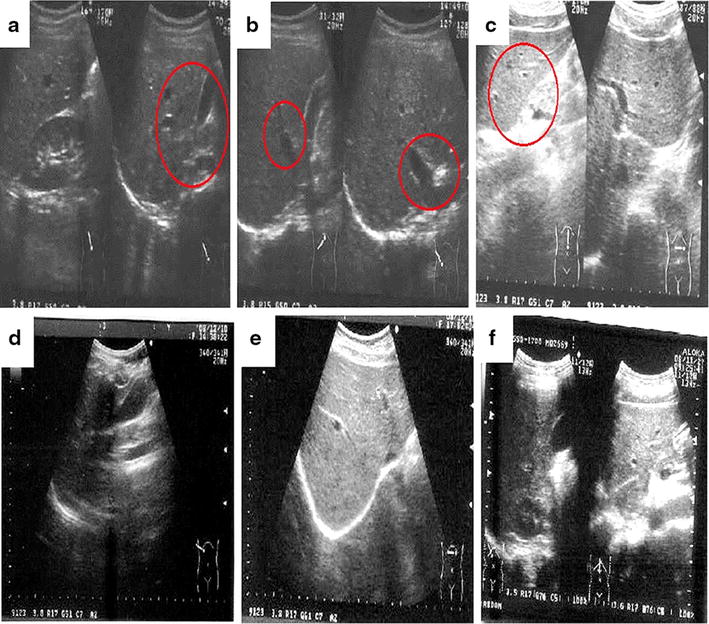
Administration of SWT significantly increased the antioxidant index (P = 0.001) and antioxidant enzymes activities (P = 0.001) from baseline to month 6. SWT also suppressed the concentration of serum lipids (triglycerides, P = 0.01; high-density lipoprotein cholesterol, P = 0.23; low-density lipoprotein cholesterol, P = 0.48) and hepatic marker enzymes (glutamic pyruvic transaminase, P = 0.76; glutamic oxaloacetic transaminase, P = 0.65) when compared with the placebo group. Abdominal ultrasound in the SWT group revealed a positive impact of SWT on mild fatty liver, gallstones, and mild splenomegaly. Moreover, SWT intake concomitantly elevated erythema (P = 0.011) and markedly lowered skin surface water loss (P = 0.016), sebum content (P = 0.021), and wrinkles (P = 0.024).
Oral administration of SWT for 6 months improved the antioxidant level and positively regulated the lipid profile, liver function, and skin integrity and texture.
四物汤在中医中用于治疗多种妇科疾病。本研究调查了四物汤对健康成年人皮肤和肝脏的抗氧化及生理作用。
本随机、交叉、双盲、安慰剂对照临床试验于2008年12月在中山医学大学附设医院进行。排除患有未控制的糖尿病、心脏病、肝病、肾病、癌症及妊娠的参与者。根据病史问卷结果和生化分析从社区招募60名未服用药物的健康志愿者,以确认其健康状况。参与者被分为两组:一组每月连续6天饮用125毫升安慰剂(n = 30),另一组饮用四物汤(n = 30),共6个月。在1个月的洗脱期后,两组交换安慰剂和四物汤。在第1、3、6、10和13个月进行人体测量(体重、体脂和体重指数),并抽取空腹血样进行各种生化检测。在第1、6和13个月进行腹部超声和皮肤检查。皮肤检查包括对面部(阳光暴露部位:耳中和鼻中部)和上臂内侧(阳光未暴露部位:手腕中心和肘关节)的皮肤粗糙度、皮脂含量、水分含量、表面水分流失、红斑、黑色素指数和弹性进行评估。
与基线相比,服用四物汤6个月后抗氧化指数(P = 0.001)和抗氧化酶活性显著增加(P = 0.001)。与安慰剂组相比,四物汤还抑制了血脂浓度(甘油三酯,P = 0.01;高密度脂蛋白胆固醇,P = 0.23;低密度脂蛋白胆固醇,P = 0.48)和肝脏标志物酶(谷丙转氨酶,P = 0.76;谷草转氨酶,P = 0.65)。四物汤组的腹部超声显示四物汤对轻度脂肪肝、胆结石和轻度脾肿大有积极影响。此外,服用四物汤可使红斑增加(P = 0.011),并显著降低皮肤表面水分流失(P = 0.016)、皮脂含量(P = 0.021)和皱纹(P = 0.024)。
口服四物汤6个月可提高抗氧化水平,并对血脂、肝功能以及皮肤完整性和质地产生积极调节作用。