Zambanini Thiemo, Kleineberg Wiebke, Sarikaya Eda, Buescher Joerg M, Meurer Guido, Wierckx Nick, Blank Lars M
Institute of Applied Microbiology - iAMB, Aachen Biology and Biotechnology - ABBt, RWTH Aachen University, Worringerweg 1, Aachen, 52074 Germany.
BRAIN AG, Zwingenberg, 64673 Germany.
Biotechnol Biofuels. 2016 Jul 2;9:135. doi: 10.1186/s13068-016-0553-7. eCollection 2016.
In order to establish a cost-efficient biodiesel biorefinery, valorization of its main by-product, crude glycerol, is imperative. Recently, Ustilago trichophora TZ1 was found to efficiently produce malic acid from glycerol. By adaptive laboratory evolution and medium optimization, titer and rate could be improved significantly.
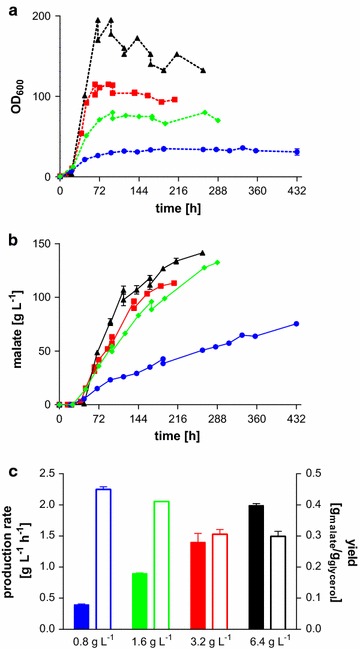
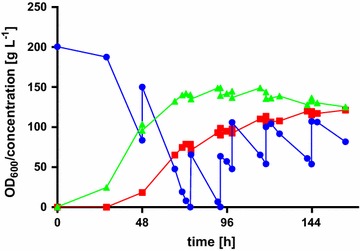
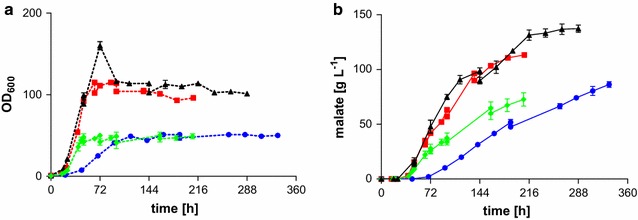
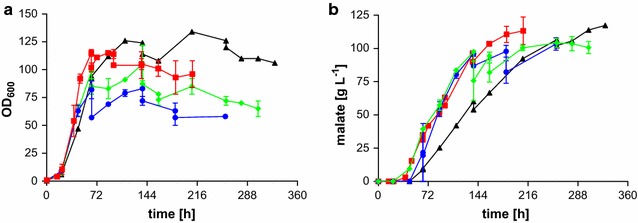
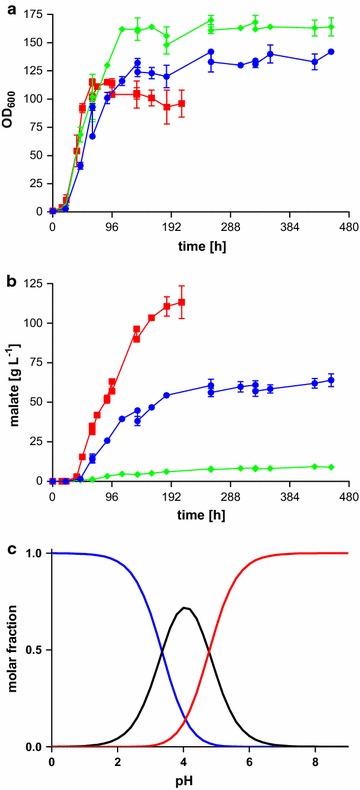
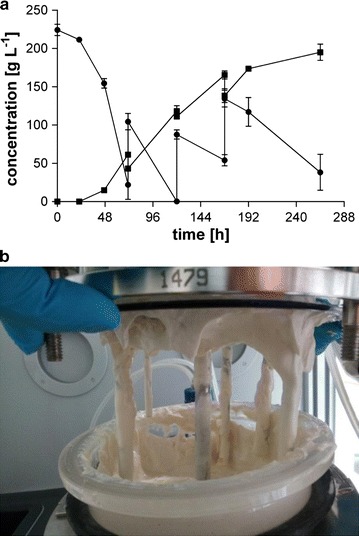
Here we report on the investigation of this strain in fed-batch bioreactors. With pH controlled at 6.5 (automatic NaOH addition), a titer of 142 ± 1 g L(-1) produced at an overall rate of 0.54 ± 0.00 g L(-1) h(-1) was reached by optimizing the initial concentrations of ammonium and glycerol. Combining the potential of bioreactors and CaCO3 as buffer system, we were able to increase the overall production rate to 0.74 ± 0.06 g L(-1) h(-1) with a maximum production rate of 1.94 ± 0.32 g L(-1) reaching a titer of 195 ± 15 g L(-1). The initial purification strategy resulted in 90 % pure calcium malate as solid component. Notably, the fermentation is not influenced by an increased temperature of up to 37 °C, which reduces the energy required for cooling. However, direct acid production is not favored as at a lowered pH value of pH 4.5 the malic acid titer decreased to only 9 ± 1 g L(-1). When using crude glycerol as substrate, only the product to substrate yield is decreased. The results are discussed in the context of valorizing glycerol with Ustilaginaceae.
Combining these results reveals the potential of U. trichophora TZ1 to become an industrially applicable production host for malic acid from biodiesel-derived glycerol, thus making the overall biodiesel production process economically and ecologically more feasible.
为建立一个具有成本效益的生物柴油生物精炼厂,其主要副产物粗甘油的增值利用势在必行。最近,发现毛木耳黑粉菌TZ1能有效地从甘油中生产苹果酸。通过适应性实验室进化和培养基优化,产量和产率可显著提高。
在此,我们报告了该菌株在补料分批生物反应器中的研究情况。将pH值控制在6.5(自动添加氢氧化钠),通过优化铵和甘油的初始浓度,达到了142±1 g L⁻¹的产量,总产率为0.54±0.00 g L⁻¹ h⁻¹。结合生物反应器和碳酸钙作为缓冲系统的潜力,我们能够将总生产率提高到0.74±0.06 g L⁻¹ h⁻¹,最大生产率为1.94±0.32 g L⁻¹,产量达到195±15 g L⁻¹。初步的纯化策略得到了纯度为90%的苹果酸钙固体成分。值得注意的是,发酵不受高达37°C的温度升高的影响,这降低了冷却所需的能量。然而,直接产酸并不有利,因为在pH值降至4.5时,苹果酸产量仅降至9±1 g L⁻¹。当使用粗甘油作为底物时,仅产物与底物的产率降低。在利用黑粉菌科对甘油进行增值利用的背景下对结果进行了讨论。
综合这些结果表明,毛木耳黑粉菌TZ1有潜力成为从生物柴油衍生甘油生产苹果酸的工业适用生产宿主,从而使整个生物柴油生产过程在经济和生态上更可行。