Katz Leor N, Yates Jacob L, Pillow Jonathan W, Huk Alexander C
Center for Perceptual Systems, Departments of Neuroscience &Psychology, The University of Texas at Austin, Austin, Texas 78712, USA.
Princeton Neuroscience Institute &Department of Psychology, Princeton University, Princeton, New Jersey 08540, USA.
Nature. 2016 Jul 14;535(7611):285-8. doi: 10.1038/nature18617. Epub 2016 Jul 4.
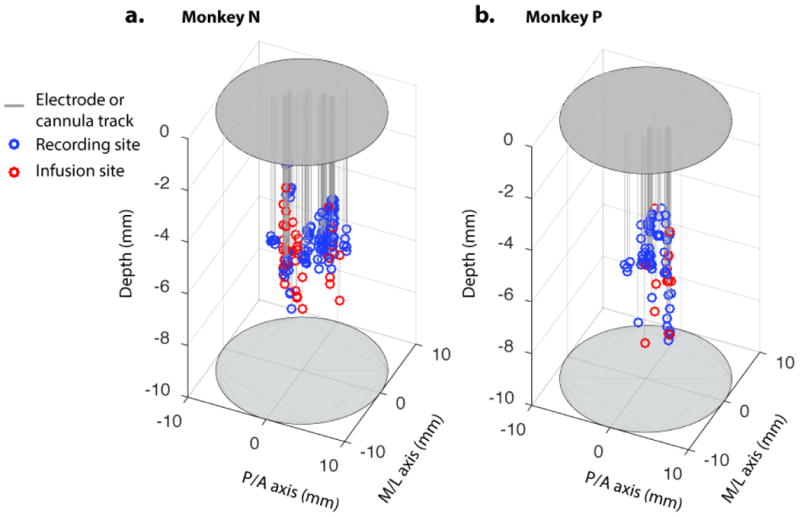
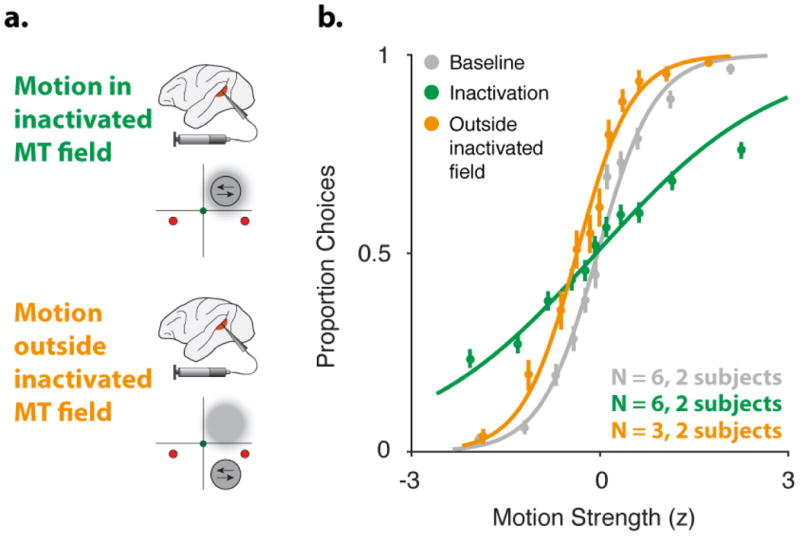
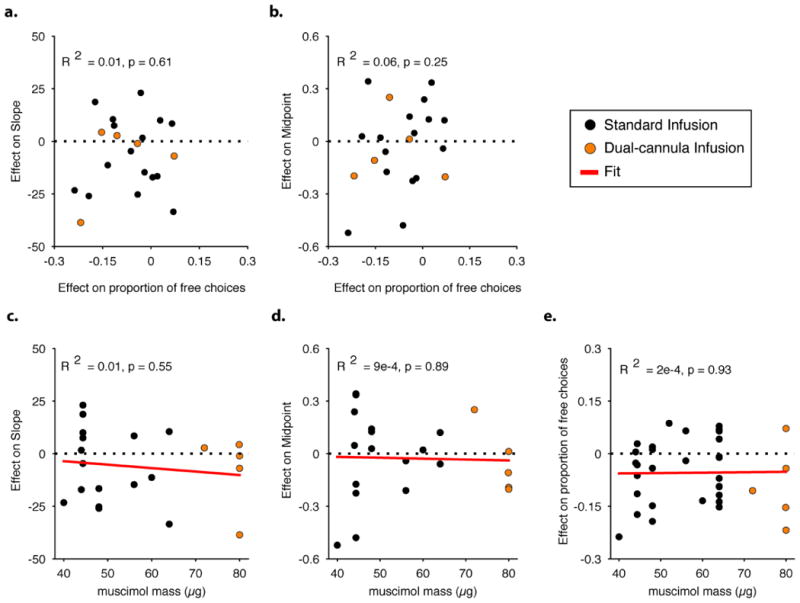
During decision making, neurons in multiple brain regions exhibit responses that are correlated with decisions. However, it remains uncertain whether or not various forms of decision-related activity are causally related to decision making. Here we address this question by recording and reversibly inactivating the lateral intraparietal (LIP) and middle temporal (MT) areas of rhesus macaques performing a motion direction discrimination task. Neurons in area LIP exhibited firing rate patterns that directly resembled the evidence accumulation process posited to govern decision making, with strong correlations between their response fluctuations and the animal's choices. Neurons in area MT, in contrast, exhibited weak correlations between their response fluctuations and choices, and had firing rate patterns consistent with their sensory role in motion encoding. The behavioural impact of pharmacological inactivation of each area was inversely related to their degree of decision-related activity: while inactivation of neurons in MT profoundly impaired psychophysical performance, inactivation in LIP had no measurable impact on decision-making performance, despite having silenced the very clusters that exhibited strong decision-related activity. Although LIP inactivation did not impair psychophysical behaviour, it did influence spatial selection and oculomotor metrics in a free-choice control task. The absence of an effect on perceptual decision making was stable over trials and sessions and was robust to changes in stimulus type and task geometry, arguing against several forms of compensation. Thus, decision-related signals in LIP do not appear to be critical for computing perceptual decisions, and may instead reflect secondary processes. Our findings highlight a dissociation between decision correlation and causation, showing that strong neuron-decision correlations do not necessarily offer direct access to the neural computations underlying decisions.
在决策过程中,多个脑区的神经元会表现出与决策相关的反应。然而,各种形式的决策相关活动是否与决策存在因果关系仍不明确。在这里,我们通过记录和可逆性失活恒河猴执行运动方向辨别任务时的顶内沟外侧(LIP)和颞中区(MT)来解决这个问题。LIP区的神经元表现出的放电率模式直接类似于被认为用于控制决策的证据积累过程,其反应波动与动物的选择之间存在很强的相关性。相比之下,MT区的神经元其反应波动与选择之间的相关性较弱,并且其放电率模式与其在运动编码中的感觉作用一致。每个区域药理学失活的行为影响与其决策相关活动的程度呈负相关:虽然MT区神经元的失活严重损害了心理物理学表现,但LIP区的失活对决策表现没有可测量的影响,尽管已经使那些表现出强烈决策相关活动的细胞簇沉默了。尽管LIP区失活没有损害心理物理学行为,但它确实在自由选择控制任务中影响了空间选择和眼动指标。对知觉决策没有影响在各次试验和各阶段都是稳定的,并且对刺激类型和任务几何形状的变化具有鲁棒性,这排除了几种形式的补偿。因此,LIP区中与决策相关的信号似乎对计算知觉决策并不关键,而可能反映的是次级过程。我们的研究结果突出了决策相关性与因果关系之间的分离,表明神经元与决策之间的强相关性不一定能直接揭示决策背后的神经计算过程。