Yun Seok Joong, Jeong Pildu, Kang Ho Won, Shinn Helen Ki, Kim Ye-Hwan, Yan Chunri, Choi Young-Ki, Kim Dongho, Ryu Dong Hee, Ha Yun-Sok, Kim Tae-Hwan, Kwon Tae Gyun, Kim Jung Min, Suh Sang Heon, Kim Seon-Kyu, Kim Seon-Young, Kim Sang Tae, Kim Won Tae, Lee Ok-Jun, Moon Sung-Kwon, Kim Nam-Hyung, Kim Isaac Yi, Kim Jayoung, Cha Hee-Jae, Choi Yung-Hyun, Cha Eun-Jong, Kim Wun-Jae
Department of Urology, Chungbuk National University College of Medicine, Cheongju, Korea.
Department of Anesthesiology and Pain Medicine, Inha University College of Medicine, Incheon, Korea.
Int Neurourol J. 2016 Jun;20(2):122-30. doi: 10.5213/inj.1632552.276. Epub 2016 Jun 24.
Previously, we reported the presence of virus-encoded microRNAs (miRNAs) in the urine of prostate cancer (CaP) patients. In this study, we investigated the expression of two herpes virus-encoded miRNAs in prostate tissue.
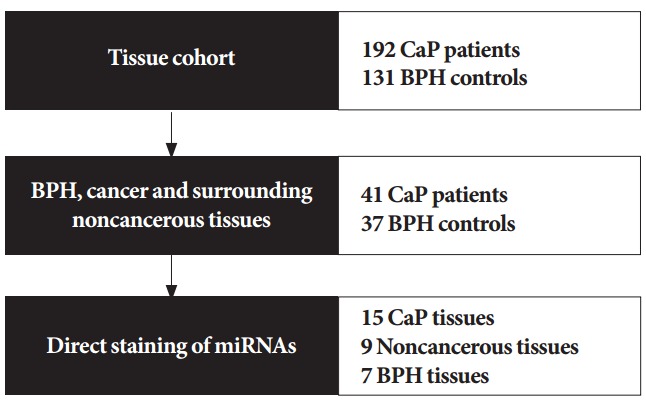
A total of 175 tissue samples from noncancerous benign prostatic hyperplasia (BPH), 248 tissue samples from patients with CaP and BPH, and 50 samples from noncancerous surrounding tissues from these same patients were analyzed for the expression of two herpes virus-encoded miRNAs by real-time polymerase chain reaction (PCR) and immunocytochemistry using nanoparticles as molecular beacons.
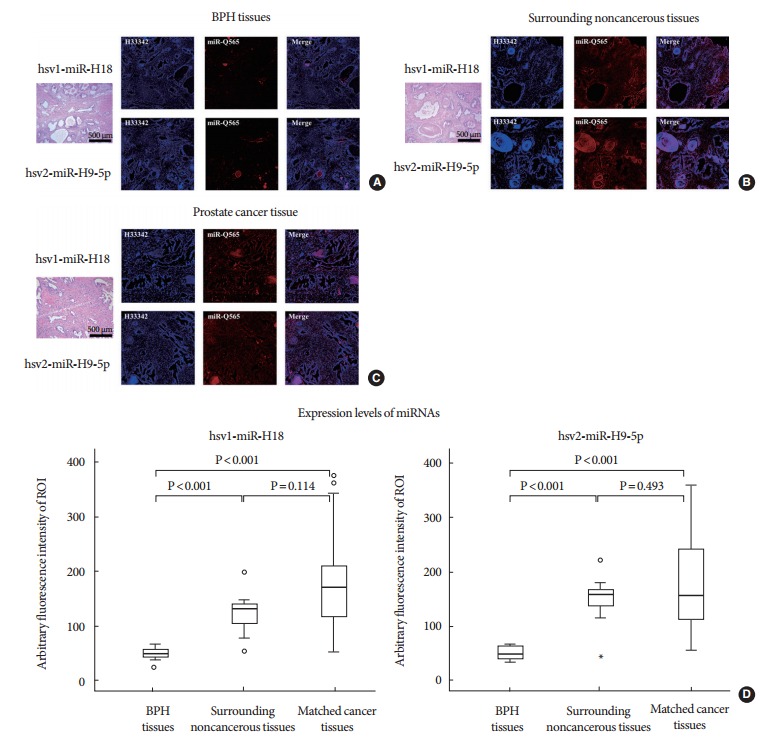
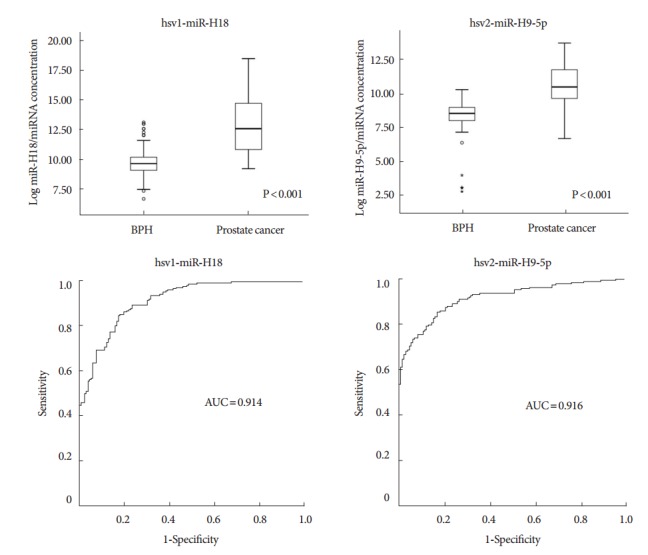
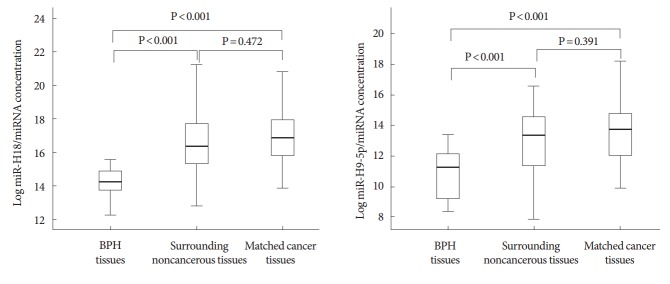
Real-time reverse transcription-PCR results revealed significantly higher expression of hsv1-miR-H18 and hsv2-miRH9- 5p in surrounding noncancerous and CaP tissues than that in BPH tissue (each comparison, P<0.001). Of note, these miRNA were expressed equivalently in the CaP tissues and surrounding noncancerous tissues. Moreover, immunocytochemistry clearly demonstrated a significant enrichment of both hsv1-miR-H18 and hsv2-miR-H9 beacon-labeled cells in CaP and surrounding noncancerous tissue compared to that in BPH tissue (each comparison, P<0.05 for hsv1-miR-H18 and hsv2- miR-H9).
These results suggest that increased expression of hsv1-miR-H18 and hsv2-miR-H95p might be associated with tumorigenesis in the prostate. Further studies will be required to elucidate the role of these miRNAs with respect to CaP and herpes viral infections.
此前,我们报道了前列腺癌(CaP)患者尿液中存在病毒编码的微小RNA(miRNA)。在本研究中,我们调查了两种疱疹病毒编码的miRNA在前列腺组织中的表达情况。
通过实时聚合酶链反应(PCR)和使用纳米颗粒作为分子信标的免疫细胞化学方法,对175份来自非癌性良性前列腺增生(BPH)的组织样本、248份来自CaP合并BPH患者的组织样本以及来自这些患者相同的非癌性周围组织的50份样本进行分析,以检测两种疱疹病毒编码的miRNA的表达。
实时逆转录PCR结果显示,与BPH组织相比,hsv1-miR-H18和hsv2-miRH9-5p在周围非癌性组织和CaP组织中的表达显著更高(每次比较,P<0.001)。值得注意的是,这些miRNA在CaP组织和周围非癌性组织中的表达相当。此外,免疫细胞化学清楚地表明,与BPH组织相比,CaP组织和周围非癌性组织中hsv1-miR-H18和hsv2-miR-H9信标标记的细胞均显著富集(hsv1-miR-H18和hsv2-miR-H9的每次比较,P<0.05)。
这些结果表明,hsv1-miR-H18和hsv2-miR-H95p表达增加可能与前列腺肿瘤发生有关。需要进一步研究以阐明这些miRNA在CaP和疱疹病毒感染方面的作用。