Department of Neurology Nagoya University Graduate School of Medicine Nagoya Japan.
Department of Neurology Nagoya University Graduate School of Medicine Nagoya Japan; Innovation Center for Clinical Research National Center for Geriatrics and Gerontology Obu Japan.
Ann Clin Transl Neurol. 2016 Jun 23;3(7):537-46. doi: 10.1002/acn3.324. eCollection 2016 Jul.
The aim of this study was to explore the pathomechanism underlying the reduction of serum creatinine (Cr) concentrations in spinal and bulbar muscular atrophy (SBMA).
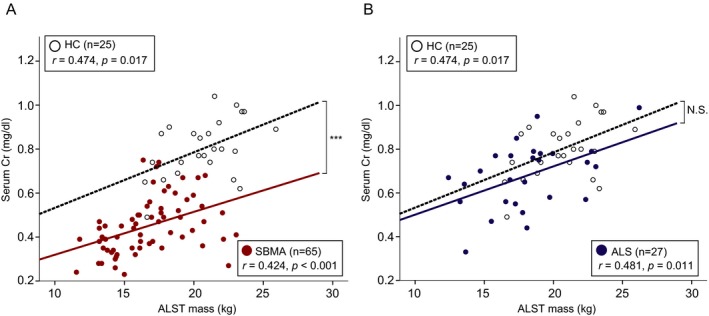
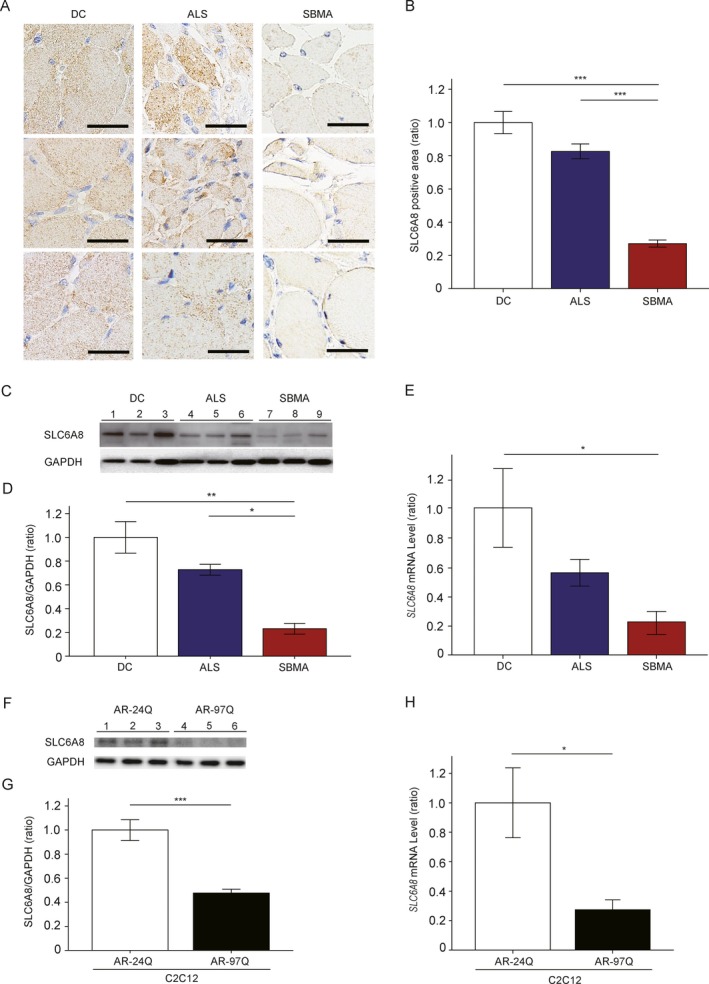
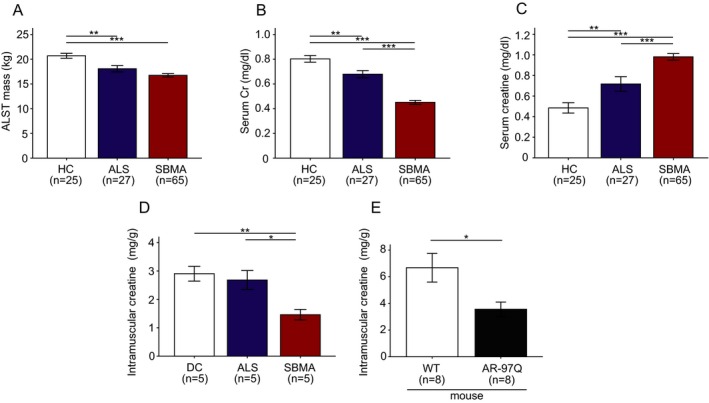
We evaluated blood chemistries, motor function, and muscle mass measured by dual-energy X-ray absorptiometry in male subjects with SBMA (n = 65), amyotrophic lateral sclerosis (ALS; n = 27), and healthy controls (n = 25). We also examined the intramuscular concentrations of creatine, a precursor of Cr, as well as the protein and mRNA expression levels of the creatine transporter (SLC6A8) in autopsy specimens derived from subjects who had SBMA and ALS and disease controls. Furthermore, we measured the mRNA expression levels of SLC6A8 in cultured muscle cells (C2C12) transfected with the polyglutamine-expanded androgen receptor (AR-97Q).
Serum Cr concentrations were significantly lower in subjects with SBMA than in those with ALS (P < 0.001), despite similar muscle mass values. Intramuscular creatine concentrations were also lower in with the autopsied specimen of SBMA subjects than in those with ALS subjects (P = 0.018). Moreover, the protein and mRNA expression levels of muscle SLC6A8 were suppressed in subjects with SBMA. The mRNA levels of SLC6A8 were also suppressed in C2C12 cells bearing AR-97Q.
These results suggest that low serum Cr concentration in subjects with SBMA is caused by impaired muscle uptake of creatine in addition to being caused by neurogenic atrophy. Given that creatine serves as an energy source in skeletal muscle, increasing muscle creatine uptake is a possible therapeutic approach for treating SBMA.
本研究旨在探讨脊髓延髓肌萎缩症(SBMA)患者血清肌酐(Cr)浓度降低的发病机制。
我们评估了 65 例 SBMA 男性患者、27 例肌萎缩侧索硬化症(ALS)患者和 25 名健康对照者的血液化学、运动功能和双能 X 线吸收法测量的肌肉质量。我们还检测了肌内肌酸浓度,肌酸是 Cr 的前体,以及源自 SBMA 和 ALS 患者和疾病对照者的尸检标本中肌氨酸转运蛋白(SLC6A8)的蛋白和 mRNA 表达水平。此外,我们测量了转染聚谷氨酰胺扩增雄激素受体(AR-97Q)的培养肌肉细胞(C2C12)中 SLC6A8 的 mRNA 表达水平。
尽管肌肉质量相似,但 SBMA 患者的血清 Cr 浓度明显低于 ALS 患者(P < 0.001)。SBMA 患者的肌肉内肌酸浓度也低于 ALS 患者(P = 0.018)。此外,SBMA 患者的肌肉 SLC6A8 蛋白和 mRNA 表达水平受到抑制。携带 AR-97Q 的 C2C12 细胞的 SLC6A8 mRNA 水平也受到抑制。
这些结果表明,SBMA 患者的低血清 Cr 浓度除了神经源性萎缩外,还与肌肉摄取肌酸受损有关。鉴于肌酸是骨骼肌的能量来源,增加肌肉肌酸摄取可能是治疗 SBMA 的一种潜在治疗方法。