Meyer Steiger Dagmar B, Ritchie Scott A, Laurance Susan G W
Centre for Tropical Environmental and Sustainability Studies (TESS) and College of Marine and Environmental Sciences, James Cook University, 4870, Cairns, Queensland, Australia.
School of Public Health, Tropical Medicine and Rehabilitative Sciences, James Cook University, 4870, Cairns, Queensland, Australia.
Parasit Vectors. 2016 Jul 7;9(1):387. doi: 10.1186/s13071-016-1675-2.
Anthropogenic land use changes have contributed considerably to the rise of emerging and re-emerging mosquito-borne diseases. These diseases appear to be increasing as a result of the novel juxtapositions of habitats and species that can result in new interchanges of vectors, diseases and hosts. We studied whether the mosquito community structure varied between habitats and seasons and whether known disease vectors displayed habitat preferences in tropical Australia.
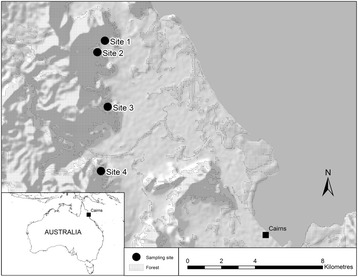
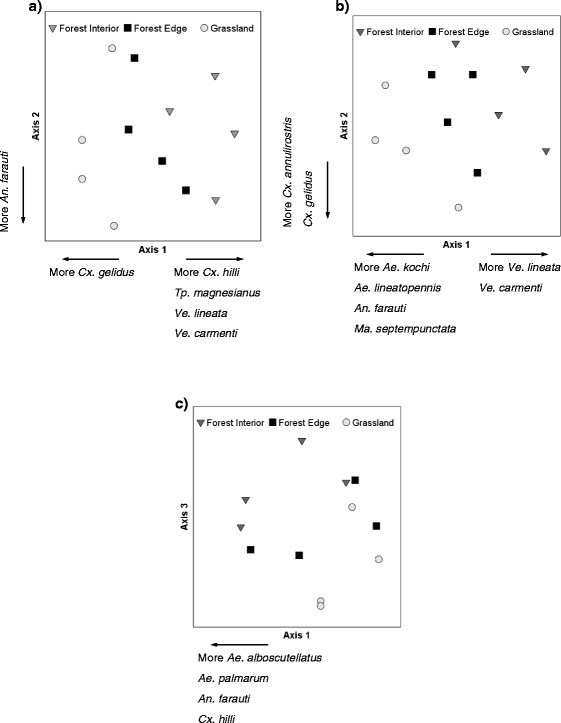
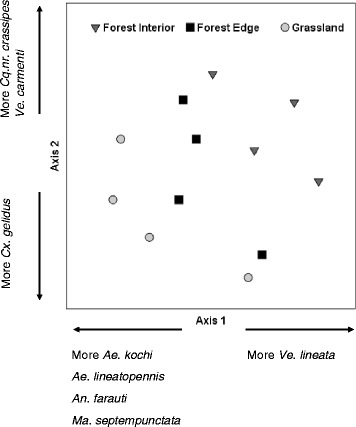
Using CDC model 512 traps, adult mosquitoes were sampled across an anthropogenic disturbance gradient of grassland, rainforest edge and rainforest interior habitats, in both the wet and dry seasons. Nonmetric multidimensional scaling (NMS) ordinations were applied to examine major gradients in the composition of mosquito and vector communities.
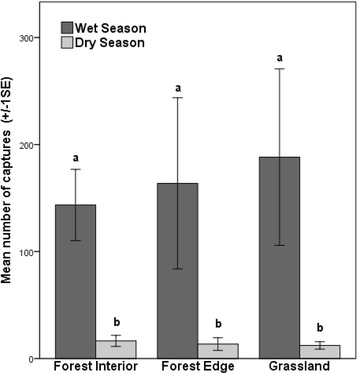
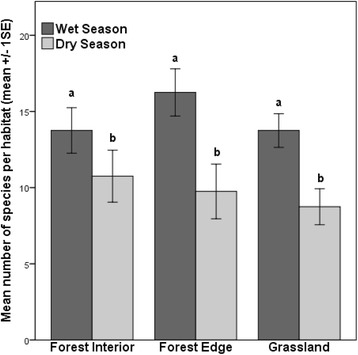
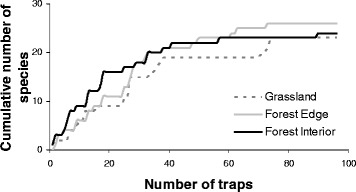
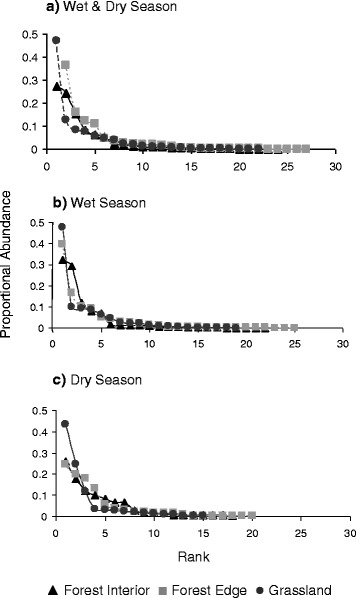
We captured ~13,000 mosquitoes from 288 trap nights across four study sites. A community analysis identified 29 species from 7 genera. Even though mosquito abundance and richness were similar between the three habitats, the community composition varied significantly in response to habitat type. The mosquito community in rainforest interiors was distinctly different to the community in grasslands, whereas forest edges acted as an ecotone with shared communities from both forest interiors and grasslands. We found two community patterns that will influence disease risk at out study sites, first, that disease vectoring mosquito species occurred all year round. Secondly, that anthropogenic grasslands adjacent to rainforests may increase the probability of novel disease transmission through changes to the vector community on rainforest edges, as most disease transmitting species predominantly occurred in grasslands.
Our results indicate that the strong influence of anthropogenic land use change on mosquito communities could have potential implications for pathogen transmission to humans and wildlife.
人为土地利用变化在很大程度上促成了新出现和再次出现的蚊媒疾病的增加。由于栖息地和物种的新组合可能导致病媒、疾病和宿主的新交换,这些疾病似乎正在增加。我们研究了澳大利亚热带地区蚊子群落结构在不同栖息地和季节之间是否存在差异,以及已知的病媒是否表现出栖息地偏好。
使用疾控中心512型诱捕器,在雨季和旱季,在草原、雨林边缘和雨林内部栖息地的人为干扰梯度上对成年蚊子进行采样。应用非度量多维标度(NMS)排序来检查蚊子和病媒群落组成的主要梯度。
我们在四个研究地点的288个诱捕夜捕获了约13000只蚊子。群落分析确定了7个属中的29个物种。尽管三个栖息地之间蚊子的丰度和丰富度相似,但群落组成因栖息地类型而有显著差异。雨林内部的蚊子群落与草原上的群落明显不同,而森林边缘则作为一个生态交错带,拥有来自森林内部和草原的共享群落。我们发现了两种会影响我们研究地点疾病风险的群落模式,第一,携带疾病的蚊子物种全年都有。其次,与雨林相邻的人为草原可能会通过改变雨林边缘的病媒群落增加新疾病传播的可能性,因为大多数传播疾病的物种主要出现在草原上。
我们的结果表明,人为土地利用变化对蚊子群落的强烈影响可能对病原体向人类和野生动物的传播具有潜在影响