Laboratory of Entomology, Wageningen University and Research Centre, P.O. Box 16, 6700, AA, Wageningen, The Netherlands.
IFM Theory and Modelling, Linköping University, 581 83, Linköping, Sweden.
Parasit Vectors. 2017 Oct 23;10(1):510. doi: 10.1186/s13071-017-2481-1.
Studies on mosquito species diversity in Europe often focus on a specific habitat, region or country. Moreover, different trap types are used for these sampling studies, making it difficult to compare and validate results across Europe. To facilitate comparisons of trapping sites and community analysis, the present study used two trap types for monitoring mosquito species diversity in three habitat types for three different countries in Europe.
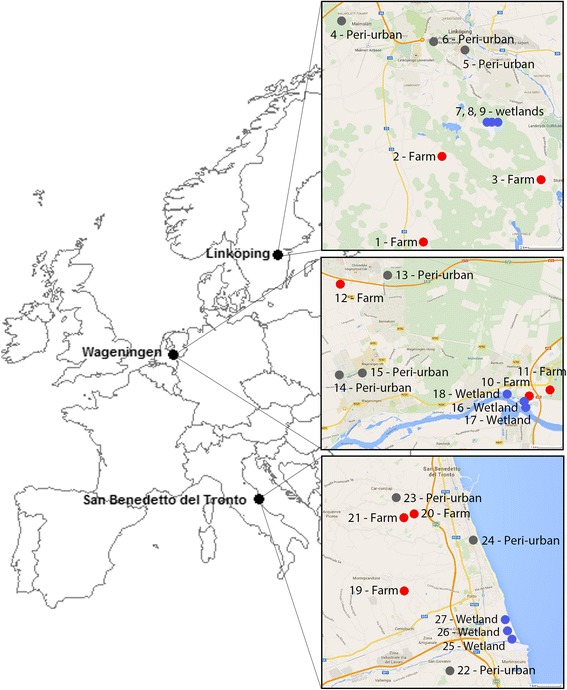
Mosquitoes were trapped using Biogents Sentinel (BGS), and Mosquito Magnet Liberty Plus (MMLP) traps at a total of 27 locations in Sweden, the Netherlands and Italy, comprising farm, peri-urban and wetland habitats. From July 2014 to June 2015 all locations were sampled monthly, except for the winter months. Indices of species richness, evenness and diversity were calculated, and community analyses were carried out with non-metric multidimensional scaling (NMDS) techniques.
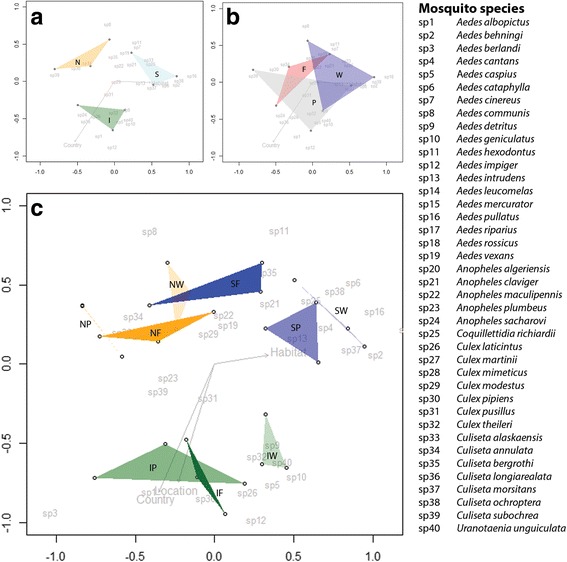
A total of 11,745 female mosquitoes were trapped during 887 collections. More than 90% of the mosquitoes belonged to the genera Culex and Aedes, with Culex pipiens being the most abundant species. The highest mosquito diversity was found in Sweden. Within Sweden, species diversity was highest in wetland habitats, whereas in the Netherlands and Italy this was highest at farms. The NMDS analyses showed clear differences in mosquito communities among countries, but not among habitat types. The MMLP trapped a higher diversity of mosquito species than the BGS traps. Also, MMLP traps trapped higher numbers of mosquitoes, except for the genera Culex and Culiseta in Italy.
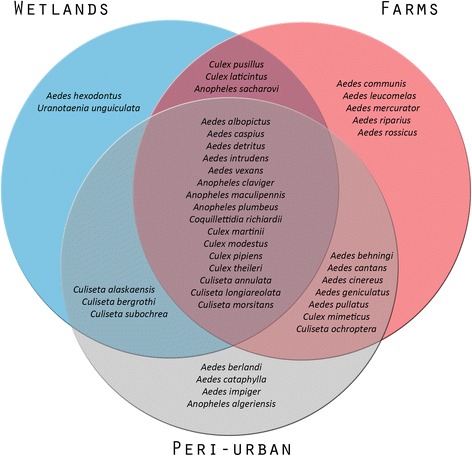
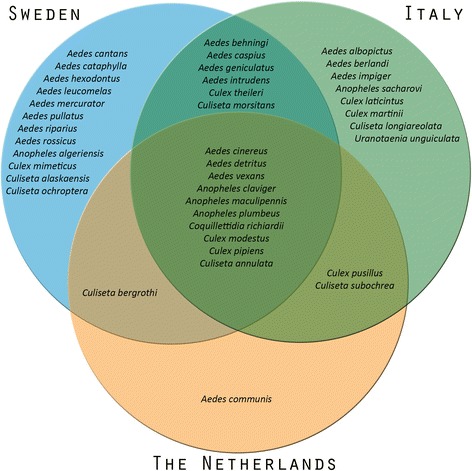
A core mosquito community could be identified for the three countries, with Culex pipiens as the most abundant species. Differences in mosquito species communities were more defined by the three countries included in the study than by the three habitat types. Differences in mosquito community composition across countries may have implications for disease emergence and further spread throughout Europe. Future research should, therefore, focus on how field data of vector communities can be incorporated into models, to better assess the risk of mosquito-borne disease outbreaks.
欧洲的蚊子物种多样性研究通常集中在特定的栖息地、地区或国家。此外,这些采样研究使用不同的诱捕器类型,使得难以在整个欧洲进行比较和验证结果。为了便于比较诱捕地点和群落分析,本研究在欧洲三个国家的三种不同生境类型中使用两种诱捕器类型监测蚊子物种多样性。
使用 Biogents Sentinel(BGS)和 Mosquito Magnet Liberty Plus(MMLP)诱捕器在瑞典、荷兰和意大利的 27 个地点共捕获了蚊子。这些地点包括农场、城郊和湿地生境。从 2014 年 7 月至 2015 年 6 月,除冬季外,所有地点每月进行一次采样。计算了物种丰富度、均匀度和多样性指数,并使用非度量多维标度(NMDS)技术进行了群落分析。
在 887 次采集中共捕获了 11745 只雌性蚊子。超过 90%的蚊子属于库蚊属和伊蚊属,其中库蚊属是最丰富的物种。瑞典的蚊子多样性最高。在瑞典,湿地生境的物种多样性最高,而在荷兰和意大利,农场的物种多样性最高。NMDS 分析表明,国家之间的蚊子群落存在明显差异,但生境类型之间没有差异。MMLP 诱捕的蚊子种类多样性高于 BGS 诱捕器。此外,MMLP 诱捕器除了意大利的库蚊属和库蚊属外,还诱捕了更多的蚊子。
可以确定三个国家的核心蚊子群落,其中库蚊属是最丰富的物种。蚊子群落的差异更多地取决于研究中包括的三个国家,而不是三种生境类型。国家间蚊子群落组成的差异可能对疾病的出现和在整个欧洲的进一步传播产生影响。因此,未来的研究应重点关注如何将蚊虫群落的实地数据纳入模型,以更好地评估蚊媒疾病暴发的风险。