Zhang Guang, Gong Yuhan, Wang Qixing, Deng Ling, Zhang Shize, Liao Qiang, Yu Gang, Wang Ke, Wang Ju, Ye Shaodong, Liu Zhongfu
National Center for AIDS/STD Control and Prevention, China CDC, Beijing Liangshan Prefecture Center for Disease Control and Prevention, Xichang Fengtai District Center for Disease Control and Prevention, Beijing, China.
Medicine (Baltimore). 2016 Jul;95(27):e3969. doi: 10.1097/MD.0000000000003969.
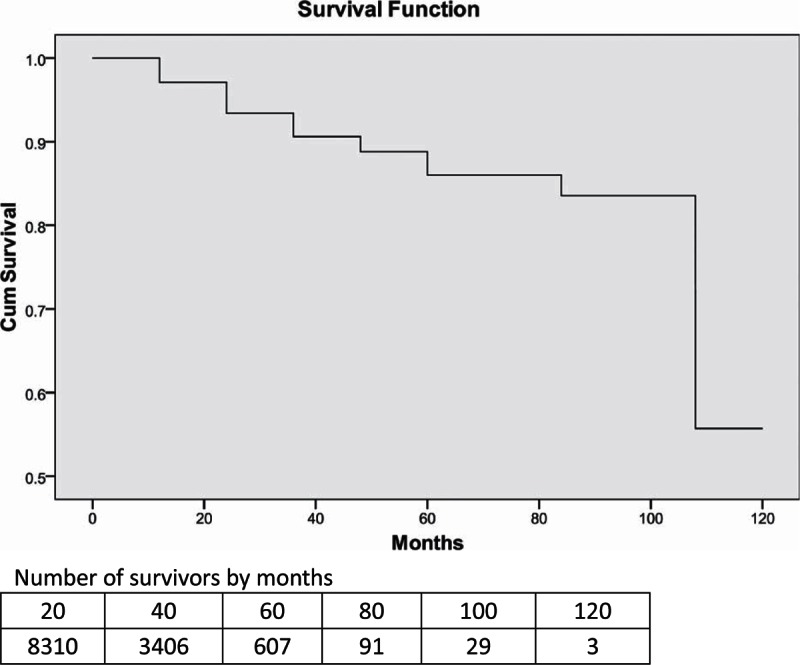
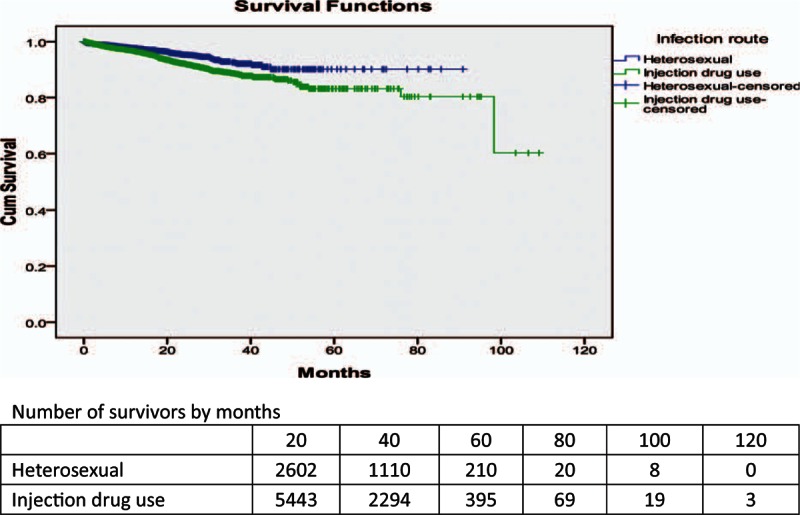
Human immunodeficiency virus (HIV)-positive cases have been reported among people who injected drugs in Liangshan Prefecture in southwest of China since 1995 and Liangshan has become one of the most seriously affected epidemic areas in China. In 2004, several patients with HIV/acquired immunodeficiency syndrome (AIDS) initiated antiretroviral treatment (ART) at the Central Hospital of Liangshan Prefecture. From 2005 to 2013, the number of patients receiving ART dramatically increased.We conducted a retrospective cohort study to analyze the long-term survival time and associated factors among patients with HIV/AIDS who received ART in Liangshan Prefecture for the first time. Data were collected from the Chinese AIDS Antiretroviral Therapy DATAFax Information System. A life table and the Kaplan-Meier and Cox proportion hazard regression were used to calculate the survival time and its associated factors, respectively.Among 8310 ART-naïve patients with HIV/AIDS who initiated ART, 436 patients died of AIDS-related diseases, and their median time of receiving ART was 15.0 ± 12.3 months, whereas 28.7% of them died within the first 6 months after treatment. The cumulative survival rates of those receiving ART in 1, 2, 3, 4, and 5 years were 97.1%, 93.4%, 90.6%, 88.8%, and 86.0%, respectively. Multivariate Cox regression analysis showed that male patients on ART were at a higher risk of death from AIDS-related diseases (adjusted hazard ratio [AHR] = 1.5, 95% confidence interval [CI]: 1.1-2.1) than female patients. Patients infected with HIV through injection drug use (IDU) were at a higher risk of death (AHR = 1.6, 95% CI: 1.2-2.2) than those infected through heterosexual transmission. Patients with a baseline CD4 cell count <50/mm (AHR = 9.8, 95% CI: 6.0-15.9), 50-199/mm (AHR = 3.3, 95% CI: 2.3-4.6), and 200-349/mm (AHR = 1.7, 95% CI: 1.2-2.3) were at a higher risk of death than those with a CD4 cell count ≥350/mm.ART prolonged survival time of patients with HIV/AIDS and improved their survival probability. Patients with HIV/AIDS should be consistently followed up and the CD4 T-cell count regularly monitored, and timely and early antiretroviral therapy initiated in order to achieve a better survival rate.
自1995年以来,中国西南部凉山州已报告在注射毒品人群中有人类免疫缺陷病毒(HIV)阳性病例,凉山已成为中国受影响最严重的流行地区之一。2004年,几名HIV/获得性免疫缺陷综合征(AIDS)患者在凉山州中心医院开始接受抗逆转录病毒治疗(ART)。从2005年到2013年,接受ART的患者数量急剧增加。我们进行了一项回顾性队列研究,以分析凉山州首次接受ART的HIV/AIDS患者的长期生存时间及相关因素。数据来自中国艾滋病抗病毒治疗数据传真信息系统。分别使用生命表、Kaplan-Meier法和Cox比例风险回归来计算生存时间及其相关因素。在8310例开始接受ART的未接受过ART的HIV/AIDS患者中,436例死于艾滋病相关疾病,他们接受ART的中位时间为15.0±12.3个月,其中28.7%在治疗后的前6个月内死亡。接受ART的患者在1年、2年、3年、4年和5年的累积生存率分别为97.1%、93.4%、90.6%、88.8%和86.0%。多因素Cox回归分析显示,接受ART的男性患者死于艾滋病相关疾病的风险高于女性患者(调整后风险比[AHR]=1.5,95%置信区间[CI]:1.1-2.1)。通过注射毒品使用(IDU)感染HIV的患者死亡风险高于通过异性传播感染的患者(AHR=1.6,95%CI:1.2-2.2)。基线CD4细胞计数<50/mm³(AHR=9.8,95%CI:6.0-15.9)、50-199/mm³(AHR=3.3,95%CI:2.3-4.6)和200-349/mm³(AHR=1.7,95%CI:1.2-2.3)的患者死亡风险高于CD4细胞计数≥350/mm³的患者。ART延长了HIV/AIDS患者的生存时间并提高了他们的生存概率。应对HIV/AIDS患者进行持续随访并定期监测CD4 T细胞计数,并及时尽早开始抗逆转录病毒治疗,以获得更好的生存率。