Sanosyan Armen, Rutagwera David G, Molès Jean-Pierre, Bollore Karine, Peries Marianne, Kankasa Chipepo, Mwiya Mwiya, Tylleskär Thorkild, Nagot Nicolas, Van De Perre Philippe, Tuaillon Edouard
UMR 1058, INSERM, Etablissement Français du Sang, Université de Montpellier, Montpellier, France Centre for International Health, University of Bergen, Bergen, Norway Department of Paediatrics and Child health, University Teaching Hospital, School of Medicine, University of Zambia, Lusaka, Zambia CHU Montpellier, Montpellier, France.
Medicine (Baltimore). 2016 Jul;95(27):e4005. doi: 10.1097/MD.0000000000004005.
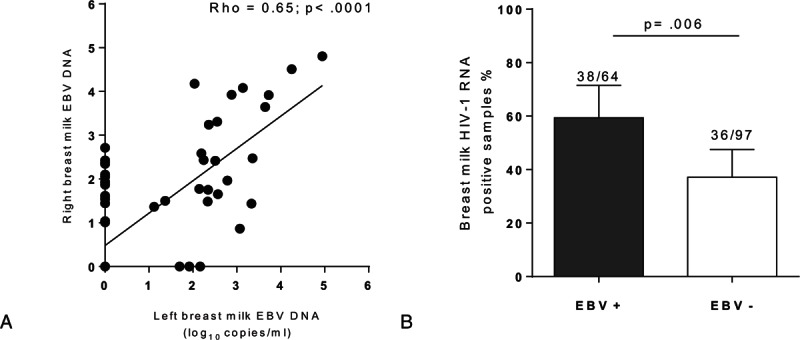
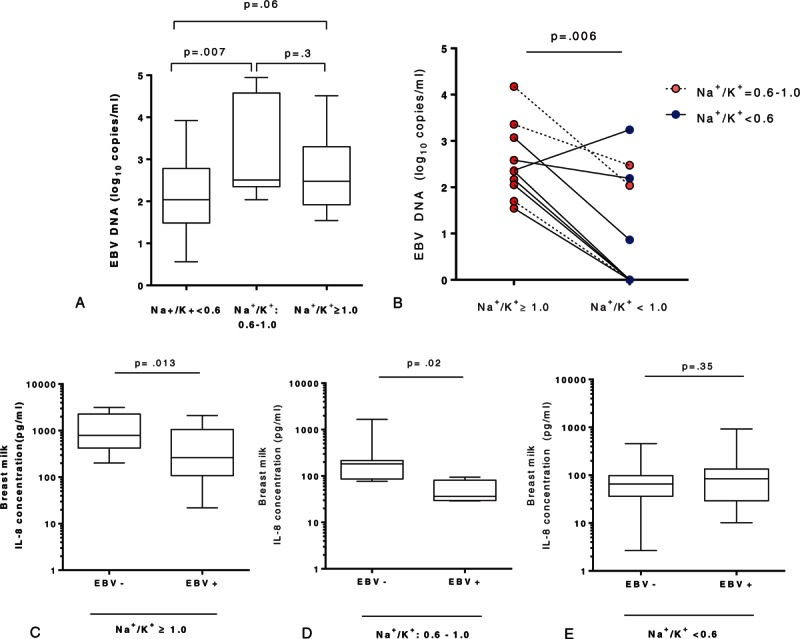
Epstein-Barr virus (EBV) in breast milk and subclinical mastitis (SCM) are both associated with human immunodeficiency virus (HIV) shedding and possibly with postnatal HIV transmission. The objective of this nested case-control study was to investigate the interplay between SCM and EBV replication in breast milk of HIV-infected mothers.The relationships between EBV deoxyribonucleic acid (DNA) shedding, HIV-1 ribonucleic acid (RNA) level, and SCM were explored in breast milk samples of Zambian mothers participating in the ANRS 12174 trial. Mammary gland inflammation was defined as a breast milk sodium to potassium ratio (Na/K) greater than 0.6 and further subclassified as either "possible SCM" (Na/K ratio 0.6-1.0) or SCM (Na/K ratio ≥ 1.0). Breast milk interleukin 8 (IL-8) was measured as a surrogate marker of mammary gland inflammation.EBV DNA was detected in breast milk samples from 42 out of 83 (51%) participants and was associated with HIV-1 shedding in breast milk (P = 0.006). EBV DNA levels were higher in samples with SCM and "possible SCM" compared to non-SCM breast milk samples (P = 0.06; P = 0.007). An EBV DNA level of >200 copies/mL was independently associated with SCM and "possible SCM" (OR: 2.62; 95%: 1.13-6.10). In patients with SCM, higher EBV replication in the mammary gland was associated with a lower induction of IL-8 (P = 0.013). Resistance to DNase treatment suggests that EBV DNA in lactoserum is encapsidated.SCM and decreased IL-8 responses are associated with an increased EBV shedding in breast milk which may in turn facilitate HIV replication in the mammary gland.
母乳中的爱泼斯坦-巴尔病毒(EBV)和亚临床乳腺炎(SCM)均与人类免疫缺陷病毒(HIV)脱落有关,并且可能与产后HIV传播有关。这项巢式病例对照研究的目的是调查HIV感染母亲母乳中SCM与EBV复制之间的相互作用。在参与ANRS 12174试验的赞比亚母亲的母乳样本中,探讨了EBV脱氧核糖核酸(DNA)脱落、HIV-1核糖核酸(RNA)水平与SCM之间的关系。乳腺炎症定义为母乳钠钾比(Na/K)大于0.6,并进一步细分为“可能的SCM”(Na/K比0.6 - 1.0)或SCM(Na/K比≥1.0)。测量母乳白细胞介素8(IL-8)作为乳腺炎症的替代标志物。83名参与者中有42名(51%)的母乳样本中检测到EBV DNA,并且与母乳中HIV-1脱落有关(P = 0.006)。与非SCM母乳样本相比,SCM和“可能的SCM”样本中的EBV DNA水平更高(P = 0.06;P = 0.007)。EBV DNA水平>200拷贝/mL与SCM和“可能的SCM”独立相关(OR:2.62;95%:1.13 - 6.10)。在SCM患者中,乳腺中较高的EBV复制与较低的IL-8诱导有关(P = 0.013)。对脱氧核糖核酸酶处理的抗性表明,乳清中的EBV DNA被包裹。SCM和IL-8反应降低与母乳中EBV脱落增加有关,这反过来可能促进HIV在乳腺中的复制。