1 University of Vienna, Department of Pharmaceutical Chemistry, Vienna, Austria.
SLAS Discov. 2017 Jan;22(1):86-93. doi: 10.1177/1087057116657513. Epub 2016 Jul 11.
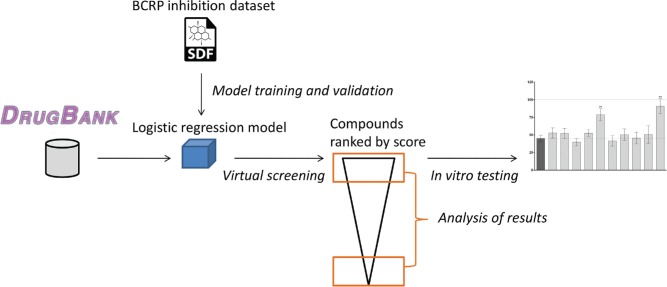
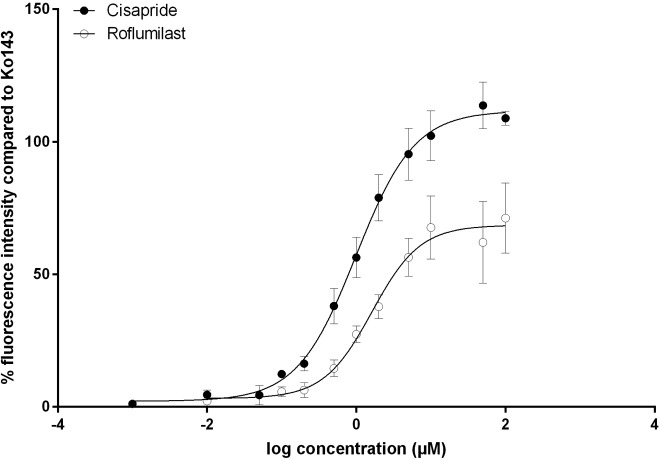
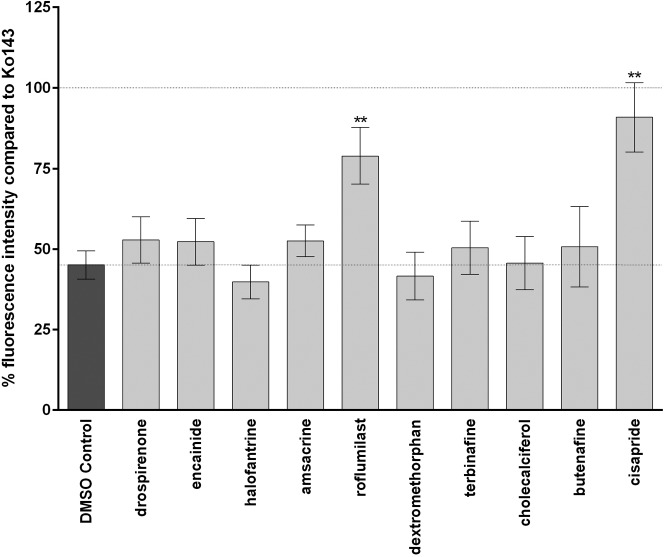
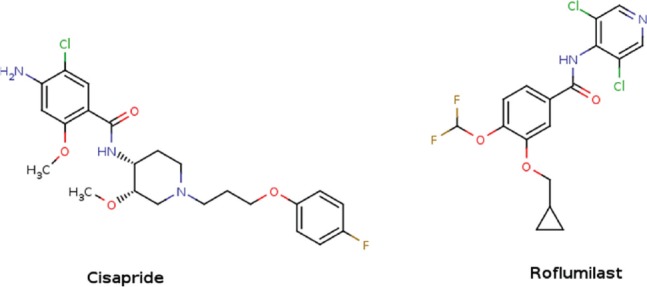
The breast cancer resistance protein (BCRP) is an ABC transporter playing a crucial role in the pharmacokinetics of drugs. The early identification of substrates and inhibitors of this efflux transporter can help to prevent or foresee drug-drug interactions. In this work, we built a ligand-based in silico classification model to predict the inhibitory potential of drugs toward BCRP. The model was applied as a virtual screening technique to identify potential inhibitors among the small-molecules subset of DrugBank. Ten compounds were selected and tested for their capacity to inhibit mitoxantrone efflux in BCRP-expressing PLB985 cells. Results identified cisapride (IC = 0.4 µM) and roflumilast (IC = 0.9 µM) as two new BCRP inhibitors. The in silico strategy proved useful to prefilter potential drug-drug interaction perpetrators among a database of small molecules and can reduce the amount of compounds to test.
乳腺癌耐药蛋白(BCRP)是一种 ABC 转运蛋白,在药物的药代动力学中起着关键作用。早期识别该外排转运蛋白的底物和抑制剂有助于预防或预见药物-药物相互作用。在这项工作中,我们建立了基于配体的计算分类模型来预测药物对 BCRP 的抑制潜力。该模型被用作虚拟筛选技术,以从 DrugBank 的小分子亚集中识别潜在的抑制剂。选择了十种化合物,并测试它们抑制 BCRP 表达的 PLB985 细胞中米托蒽醌外排的能力。结果发现西沙必利(IC = 0.4 µM)和罗氟司特(IC = 0.9 µM)是两种新的 BCRP 抑制剂。该计算策略被证明可有效从小分子数据库中预先筛选出潜在的药物-药物相互作用肇事者,并减少需要测试的化合物数量。