Collaborations Pharmaceuticals, Inc., 840 Main Campus Drive, Lab 3510 Raleigh, North Carolina 27606, United States.
Department of Physiology, College of Medicine, University of Arizona, Tucson, Arizona 85724, United States.
Mol Pharm. 2022 Nov 7;19(11):4320-4332. doi: 10.1021/acs.molpharmaceut.2c00662. Epub 2022 Oct 21.
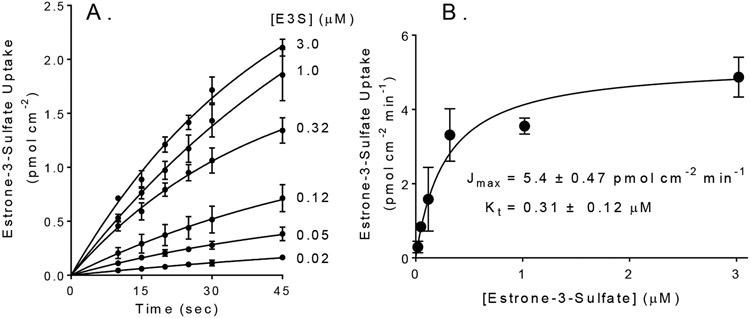
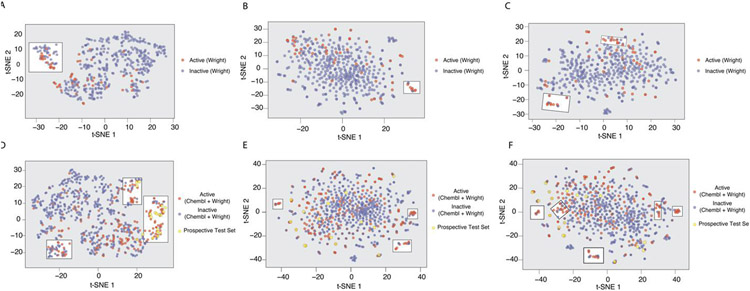
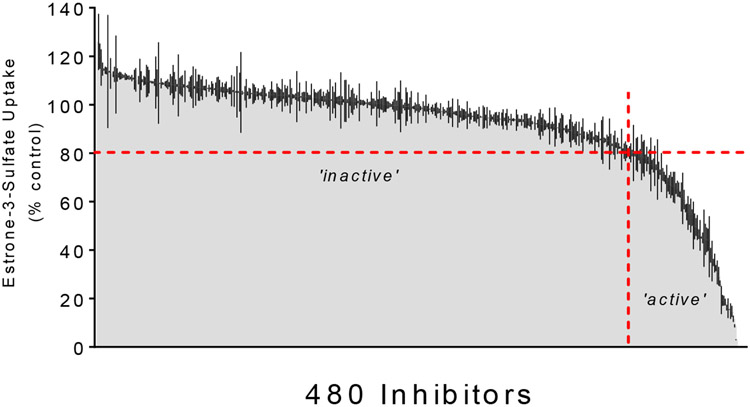
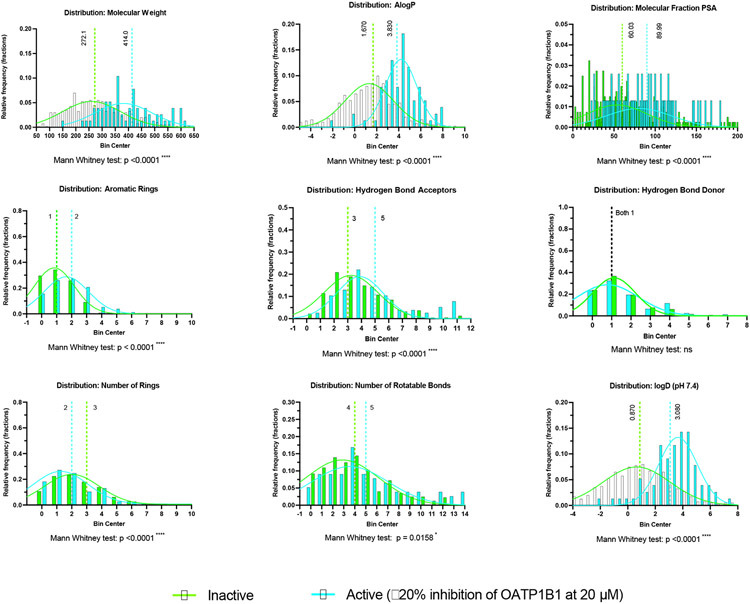
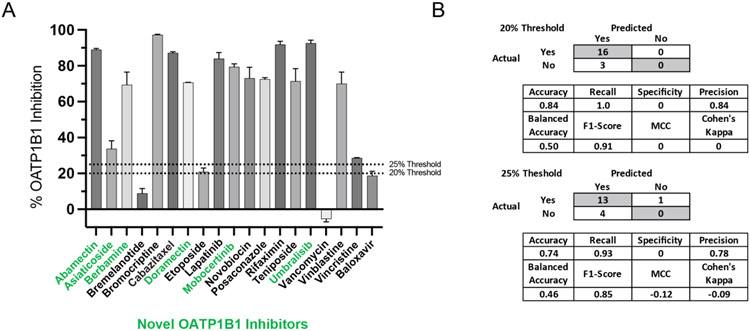
The uptake transporter OATP1B1 (SLC01B1) is largely localized to the sinusoidal membrane of hepatocytes and is a known victim of unwanted drug-drug interactions. Computational models are useful for identifying potential substrates and/or inhibitors of clinically relevant transporters. Our goal was to generate OATP1B1 in vitro inhibition data for [H] estrone-3-sulfate (E3S) transport in CHO cells and use it to build machine learning models to facilitate a comparison of seven different classification models (Deep learning, Adaboosted decision trees, Bernoulli naïve bayes, k-nearest neighbors (knn), random forest, support vector classifier (SVC), logistic regression (lreg), and XGBoost (xgb)] using ECFP6 fingerprints to perform 5-fold, nested cross validation. In addition, we compared models using 3D pharmacophores, simple chemical descriptors alone or plus ECFP6, as well as ECFP4 and ECFP8 fingerprints. Several machine learning algorithms (SVC, lreg, xgb, and knn) had excellent nested cross validation statistics, particularly for accuracy, AUC, and specificity. An external test set containing 207 unique compounds not in the training set demonstrated that at every threshold SVC outperformed the other algorithms based on a rank normalized score. A prospective validation test set was chosen using prediction scores from the SVC models with ECFP fingerprints and were tested in vitro with 15 of 19 compounds (84% accuracy) predicted as active (≥20% inhibition) showed inhibition. Of these compounds, six (abamectin, asiaticoside, berbamine, doramectin, mobocertinib, and umbralisib) appear to be novel inhibitors of OATP1B1 not previously reported. These validated machine learning models can now be used to make predictions for drug-drug interactions for human OATP1B1 alongside other machine learning models for important drug transporters in our MegaTrans software.
摄取转运体 OATP1B1(SLC01B1)主要定位于肝细胞的窦状膜,是已知的不受欢迎的药物-药物相互作用的受害者。计算模型可用于识别具有临床相关性的转运体的潜在底物和/或抑制剂。我们的目标是为 CHO 细胞中[H]雌酮-3-硫酸盐(E3S)转运产生 OATP1B1 的体外抑制数据,并使用它来构建机器学习模型,以方便比较七种不同的分类模型(深度学习、自适应增强决策树、伯努利朴素贝叶斯、k-最近邻(knn)、随机森林、支持向量分类器(SVC)、逻辑回归(lreg)和 XGBoost(xgb)),使用 ECFP6 指纹进行 5 倍嵌套交叉验证。此外,我们还使用 3D 药效团、简单的化学描述符以及 ECFP6 指纹、ECFP4 和 ECFP8 指纹比较了模型。几种机器学习算法(SVC、lreg、xgb 和 knn)具有出色的嵌套交叉验证统计数据,尤其是在准确性、AUC 和特异性方面。一个包含 207 个不在训练集中的独特化合物的外部测试集表明,在每个阈值下,SVC 都优于基于排名归一化得分的其他算法。选择了一个前瞻性验证测试集,使用 SVC 模型的预测分数和 ECFP 指纹,并在体外使用 15 种 19 种化合物(84%的准确性)进行测试,这些化合物被预测为活性(≥20%抑制)显示出抑制作用。在这些化合物中,有六种(阿维菌素、积雪草苷、小檗碱、多拉菌素、莫博赛替尼和 umbralisib)似乎是以前未报道过的 OATP1B1 的新型抑制剂。这些经过验证的机器学习模型现在可用于预测人类 OATP1B1 的药物-药物相互作用,以及我们 MegaTrans 软件中其他重要药物转运体的机器学习模型。