Marchitti Satori A, Fenton Suzanne E, Mendola Pauline, Kenneke John F, Hines Erin P
ORISE (Oak Ridge Institute for Science and Education) Fellowship Program, National Exposure Research Laboratory, U.S. Environmental Protection Agency (EPA), Athens, Georgia, USA.
Environ Health Perspect. 2017 Apr;125(4):706-713. doi: 10.1289/EHP332. Epub 2016 Jul 12.
Serum concentrations of polybrominated diphenyl ethers (PBDEs) in U.S. women are believed to be among the world's highest; however, little information exists on the partitioning of PBDEs between serum and breast milk and how this may affect infant exposure.
Paired milk and serum samples were measured for PBDE concentrations in 34 women who participated in the U.S. EPA MAMA Study. Computational models for predicting milk PBDE concentrations from serum were evaluated.
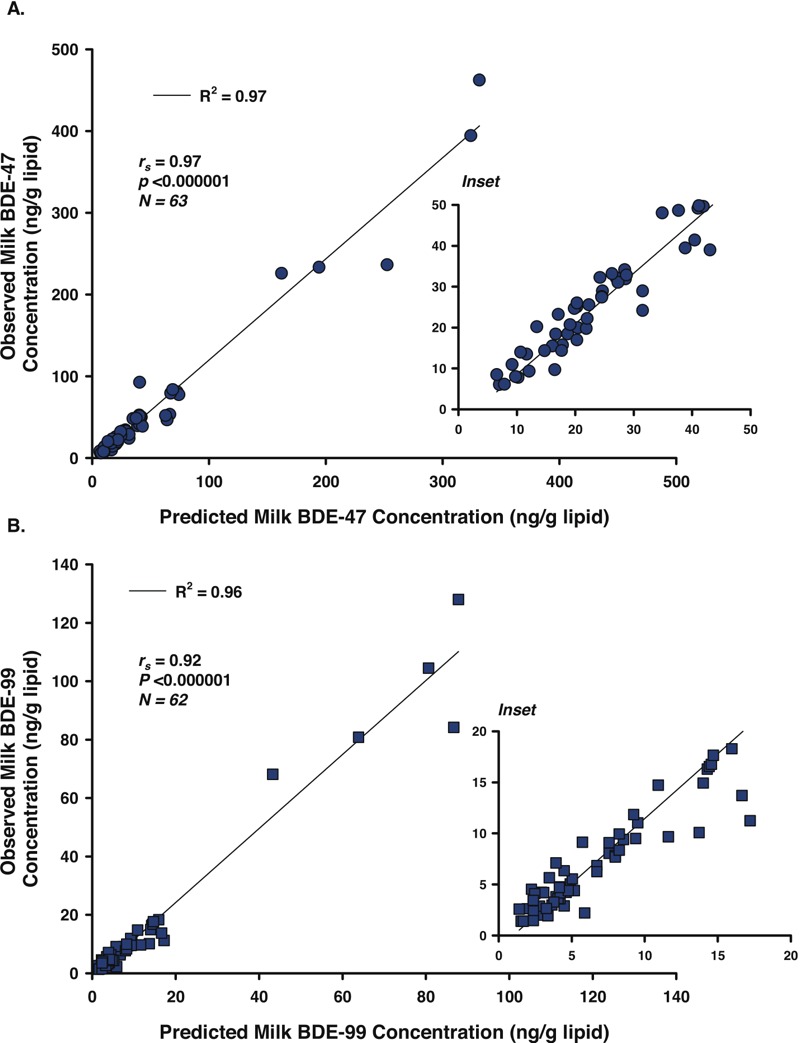
Samples were analyzed using gas chromatography isotope-dilution high-resolution mass spectrometry. Observed milk PBDE concentrations were compared with model predictions, and models were applied to NHANES serum data to predict milk PBDE concentrations and infant intakes for the U.S. population.
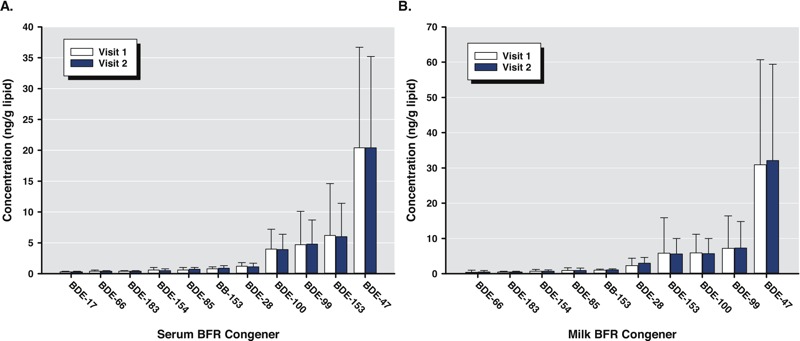
Serum and milk samples had detectable concentrations of most PBDEs. BDE-47 was found in the highest concentrations (median serum: 18.6; milk: 31.5 ng/g lipid) and BDE-28 had the highest milk:serum partitioning ratio (2.1 ± 0.2). No evidence of depuration was found. Models demonstrated high reliability and, as of 2007-2008, predicted U.S. milk concentrations of BDE-47, BDE-99, and BDE-100 appear to be declining but BDE-153 may be rising. Predicted infant intakes (ng/kg/day) were below threshold reference doses (RfDs) for BDE-99 and BDE-153 but above the suggested RfD for BDE-47.
Concentrations and partitioning ratios of PBDEs in milk and serum from women in the U.S. EPA MAMA Study are presented for the first time; modeled predictions of milk PBDE concentrations using serum concentrations appear to be a valid method for estimating PBDE exposure in U.S. infants.
据信美国女性血清中多溴二苯醚(PBDEs)的浓度处于世界最高水平之列;然而,关于PBDEs在血清和母乳之间的分配情况以及这可能如何影响婴儿暴露的信息却很少。
对参与美国环境保护局(EPA)母婴研究(MAMA Study)的34名女性的母乳和血清样本进行PBDEs浓度测量。评估了从血清预测母乳中PBDEs浓度的计算模型。
使用气相色谱同位素稀释高分辨率质谱法对样本进行分析。将观察到的母乳PBDEs浓度与模型预测值进行比较,并将模型应用于美国国家健康与营养检查调查(NHANES)的血清数据,以预测美国人群的母乳PBDEs浓度和婴儿摄入量。
血清和母乳样本中大多数PBDEs的浓度均可检测到。BDE - 47的浓度最高(血清中位数:18.6;母乳:31.5纳克/克脂质),BDE - 28的母乳与血清分配比最高(2.1±0.2)。未发现清除迹象。模型显示出高可靠性,截至2007 - 2008年,预测的美国母乳中BDE - 47、BDE - 99和BDE - 100的浓度似乎在下降,但BDE - 153可能在上升。预测的婴儿摄入量(纳克/千克/天)低于BDE - 99和BDE - 153的阈值参考剂量(RfDs),但高于BDE - 47的建议RfD。
首次呈现了美国EPA母婴研究中女性母乳和血清中PBDEs的浓度及分配比;使用血清浓度对母乳PBDEs浓度进行模型预测似乎是估算美国婴儿PBDEs暴露的有效方法。