Ke Rongqin, Mignardi Marco, Hauling Thomas, Nilsson Mats
School of Biomedical Sciences, Huaqiao University, Quanzhou, Fujian, 362021, China.
Department of Information Technology, Centre for Image Analysis, Science for Life Laboratory, Uppsala University, Uppsala, SE-75105, Sweden.
Hum Mutat. 2016 Dec;37(12):1363-1367. doi: 10.1002/humu.23051. Epub 2016 Aug 10.
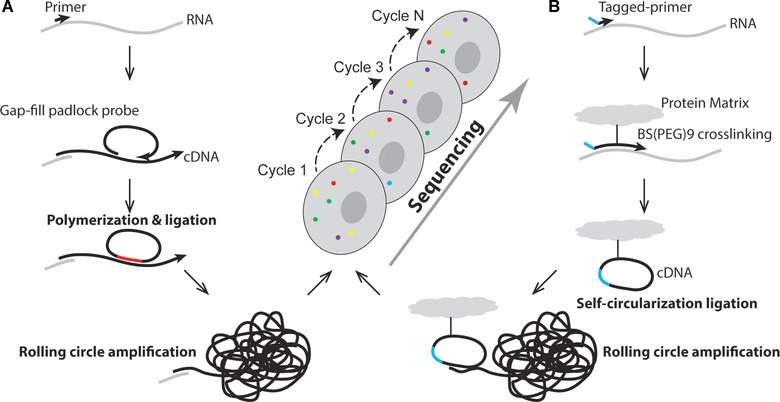
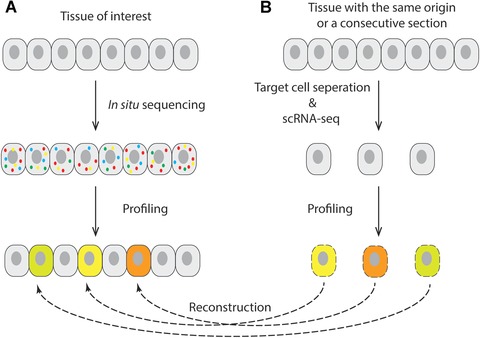
In this review, we discuss the emergence of the fourth-generation sequencing technologies that preserve the spatial coordinates of RNA and DNA sequences with up to subcellular resolution, thus enabling back mapping of sequencing reads to the original histological context. This information is used, for example, in two current large-scale projects that aim to unravel the function of the brain. Also in cancer research, fourth-generation sequencing has the potential to revolutionize the field. Cancer Research UK has named "Mapping the molecular and cellular tumor microenvironment in order to define new targets for therapy and prognosis" one of the grand challenges in tumor biology. We discuss the advantages of sequencing nucleic acids directly in fixed cells over traditional next-generation sequencing (NGS) methods, the limitations and challenges that these new methods have to face to become broadly applicable, and the impact that the information generated by the combination of in situ sequencing and NGS methods will have in research and diagnostics.
在本综述中,我们讨论了第四代测序技术的出现,这些技术能够以亚细胞分辨率保存RNA和DNA序列的空间坐标,从而实现将测序读数反向映射到原始组织学背景。例如,目前有两个旨在揭示大脑功能的大型项目正在使用这些信息。在癌症研究中,第四代测序也有可能给该领域带来变革。英国癌症研究中心已将“绘制分子和细胞肿瘤微环境以确定新的治疗和预后靶点”列为肿瘤生物学的重大挑战之一。我们讨论了在固定细胞中直接对核酸进行测序相对于传统下一代测序(NGS)方法的优势、这些新方法要广泛应用所必须面对的局限性和挑战,以及原位测序与NGS方法相结合所产生的信息在研究和诊断方面将产生的影响。