Skalska Urszula, Kozakiewicz Anna, Maśliński Włodzimierz, Jurkowska Monika
Department of Pathophysiology and Immunology, Institute of Rheumatology, Warsaw, Poland.
Department of Biochemistry and Molecular Biology, Institute of Rheumatology, Warsaw, Poland.
Reumatologia. 2015;53(2):74-8. doi: 10.5114/reum.2015.51506. Epub 2015 May 18.
The presence of human leukocyte antigen B27 (HLA-B27) is strongly associated with ankylosing spondylitis. HLA-B27 testing is routinely applied in the diagnosis of this disease. The aim of the present study was to compare two methods of HLA-B27 detection - a genetic sequence-based method and a flow cytometry assay.
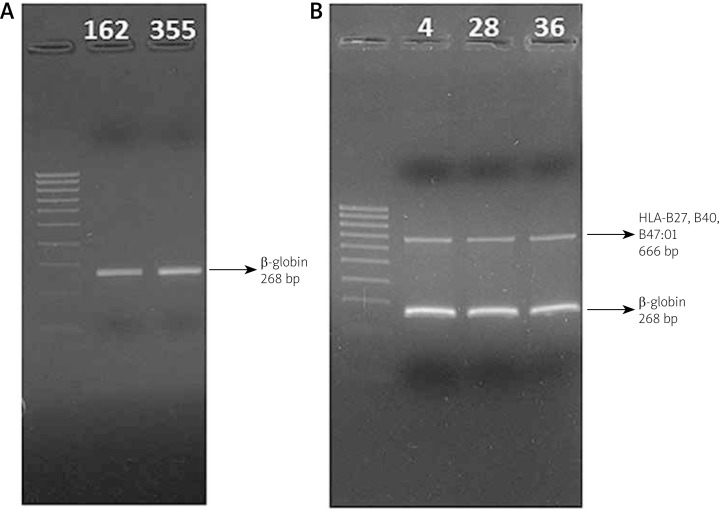
Peripheral blood was obtained from 300 individuals with suspected spondyloarthropathy. Expression of HLA-B27 on the T cell surface was analysed by flow cytometry assay using GS145.2 monoclonal antibody specific for HLA-B27. DNA was isolated from the whole blood. Genes coding for HLA-B27, -B40 and -B47:01 were detected by polymerase chain reaction using the MW02/MW09 primer pair. Then, positive samples were sequenced in order to discriminate allelic variations of the HLA-B27 gene. Results of sequencing were analysed using Chromas LITE 2.1.1 software, BLAST software and the IMGT/HLA database. Ambiguous samples were additionally analysed by polymerase chain reaction using E91 and E136 primers amplifying a 135-bp fragment of the human HLA-B27 gene.
Among 300 samples, 76 were HLA-B27-positive on the basis of flow cytometry analysis. Genetic sequence analysis confirmed positivity of 73 from among 76 samples. Two hundred twenty six samples were HLA-B27-negative, whereas the result of one sample analysis was ambiguous. Fifty-three samples were identified as allelic variation 27:05, 19 samples as allelic variation 27:02, and one sample as allelic variation 27:07.
This study shows that the genetic sequence-based method and the flow cytometry assay give consistent results in 99% of cases. The performed genetic analysis proves that the majority of HLA-B27-positive samples belong to the 27:05 allelic variation, which is strongly associated with high risk of ankylosing spondylitis.
人类白细胞抗原B27(HLA - B27)的存在与强直性脊柱炎密切相关。HLA - B27检测在该疾病的诊断中常规应用。本研究的目的是比较两种HLA - B27检测方法——一种基于基因序列的方法和一种流式细胞术检测法。
从300例疑似脊柱关节病患者中采集外周血。使用针对HLA - B27的GS145.2单克隆抗体,通过流式细胞术检测法分析T细胞表面HLA - B27的表达。从全血中分离DNA。使用MW02/MW09引物对,通过聚合酶链反应检测编码HLA - B27、-B40和 -B47:01的基因。然后,对阳性样本进行测序,以区分HLA - B27基因的等位基因变异。使用Chromas LITE 2.1.1软件、BLAST软件和IMGT/HLA数据库分析测序结果。对结果不明确的样本,另外使用扩增人HLA - B27基因135bp片段的E91和E136引物进行聚合酶链反应分析。
在300个样本中,基于流式细胞术分析,76个样本为HLA - B27阳性。基因序列分析证实76个样本中的73个为阳性。226个样本为HLA - B27阴性,而1个样本的分析结果不明确。53个样本被鉴定为等位基因变异27:05,19个样本为等位基因变异27:02,1个样本为等位基因变异27:07。
本研究表明,基于基因序列的方法和流式细胞术检测法在99%的病例中结果一致。所进行的基因分析证明,大多数HLA - B27阳性样本属于27:05等位基因变异,这与强直性脊柱炎的高风险密切相关。