Mallery Robert M, Poolman Pieter, Thurtell Matthew J, Wang Jui-Kai, Garvin Mona K, Ledolter Johannes, Kardon Randy H
Department of Neurology, Brigham and Women's Hospital, Boston, Massachusetts, United States 2Department of Ophthalmology, Massachusetts Eye and Ear Infirmary, Boston, Massachusetts, United States 3Department of Ophthalmology and Visual Sciences, Universit.
Iowa City VA Center for the Prevention and Treatment of Visual Loss, Iowa City, Iowa, United States.
Invest Ophthalmol Vis Sci. 2016 Jul 1;57(9):OCT429-37. doi: 10.1167/iovs.15-18916.
The purpose of this study was to assess whether clinically useful measures of fixation instability and eccentricity can be derived from retinal tracking data obtained during optical coherence tomography (OCT) in patients with optic neuropathy (ON) and to develop a method for relating fixation to the retinal ganglion cell complex (GCC) thickness.
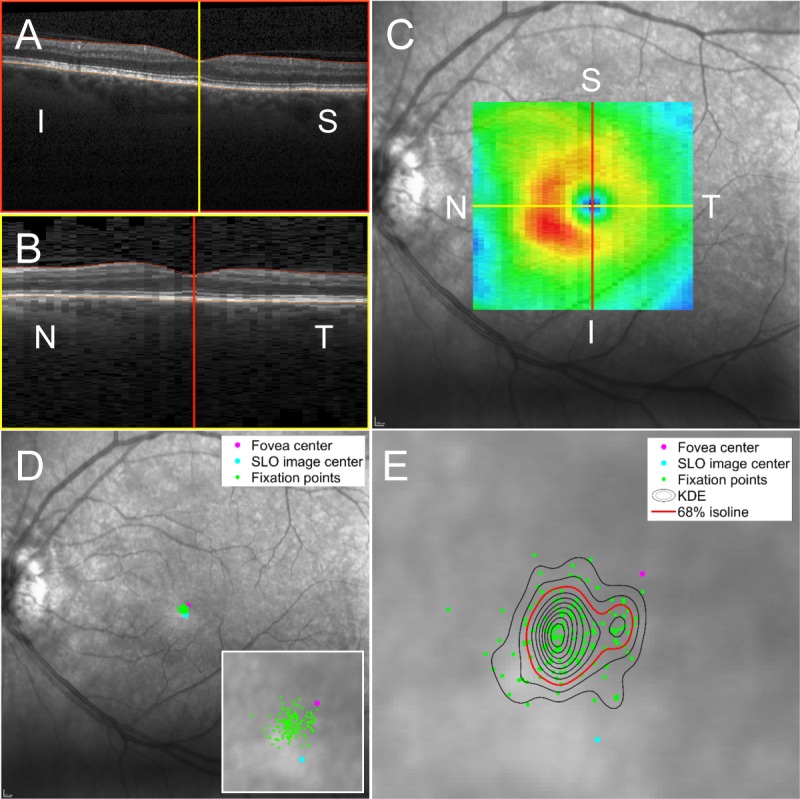
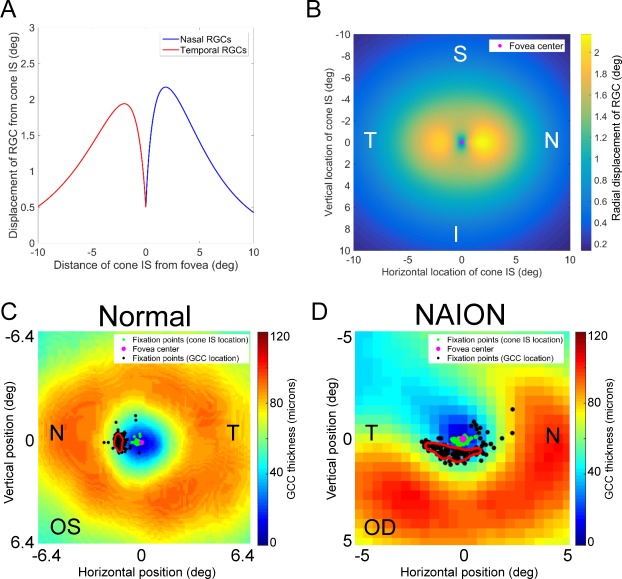
Twenty-nine patients with ON underwent macular volume OCT with 30 seconds of confocal scanning laser ophthalmoscope (cSLO)-based eye tracking during fixation. Kernel density estimation quantified fixation instability and fixation eccentricity from the distribution of fixation points on the retina. Preferred ganglion cell layer loci (PGCL) and their relationship to the GCC thickness map were derived, accounting for radial displacement of retinal ganglion cell soma from their corresponding cones.
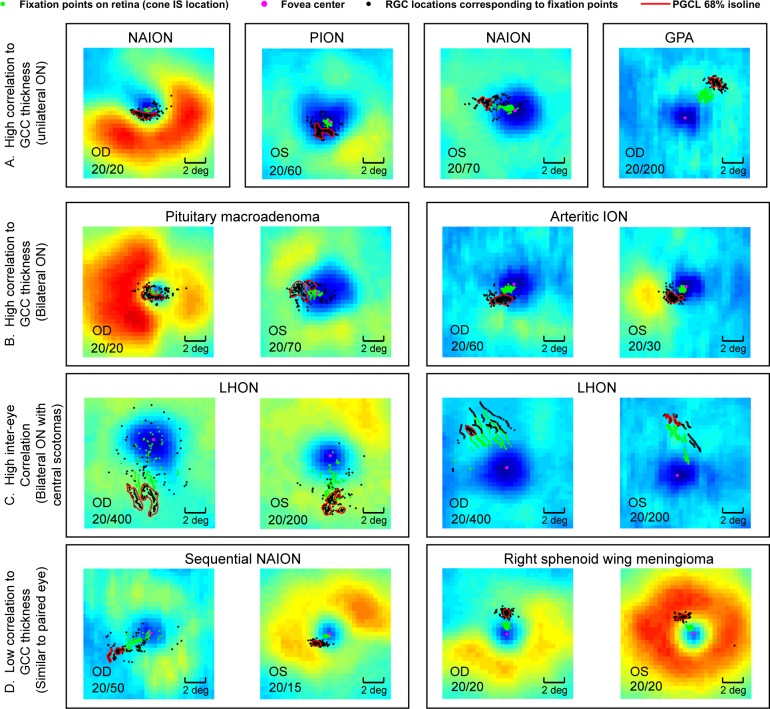
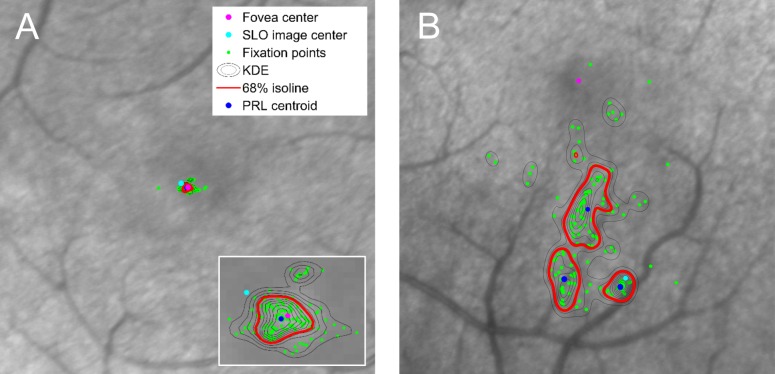
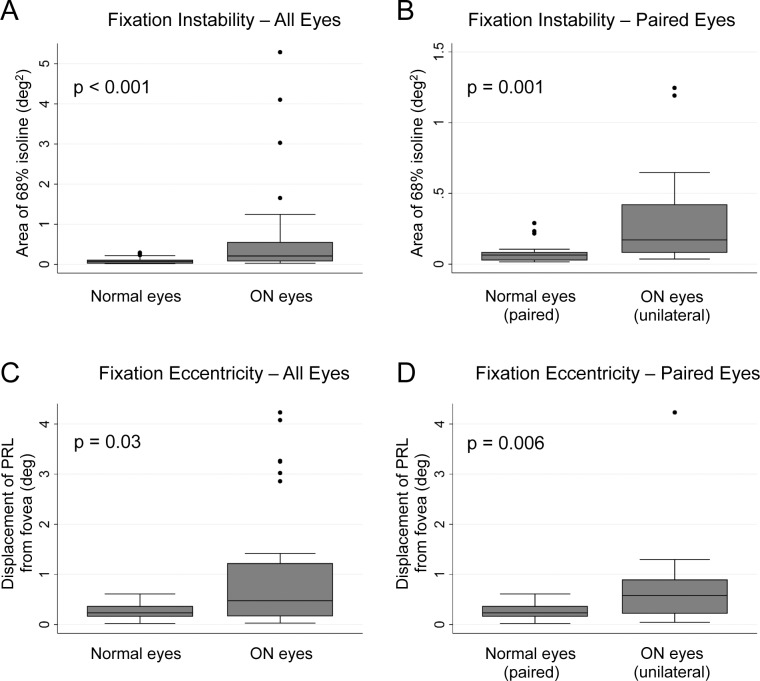
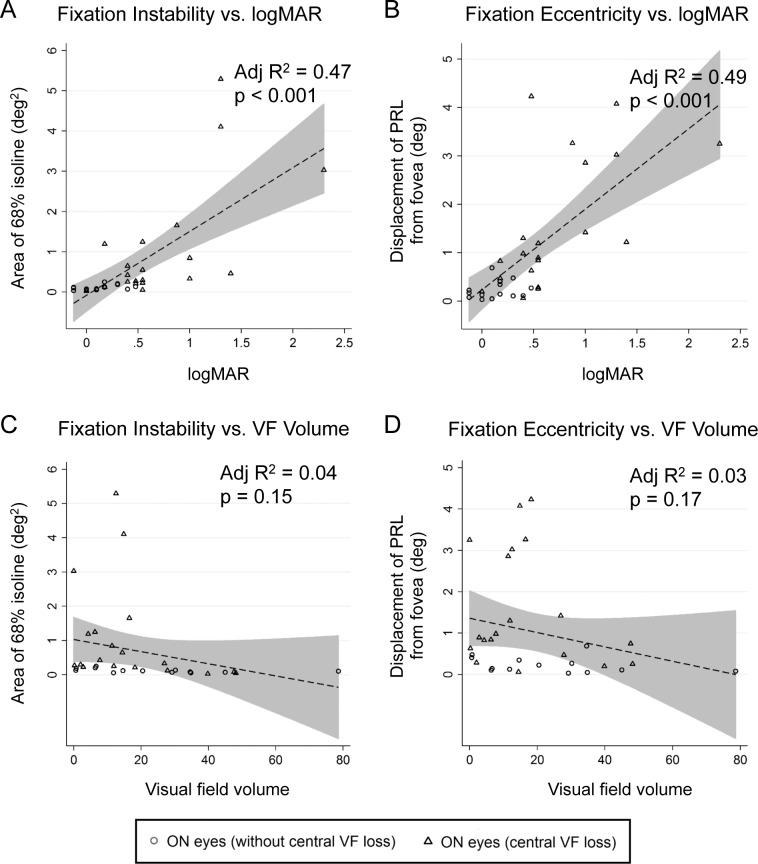
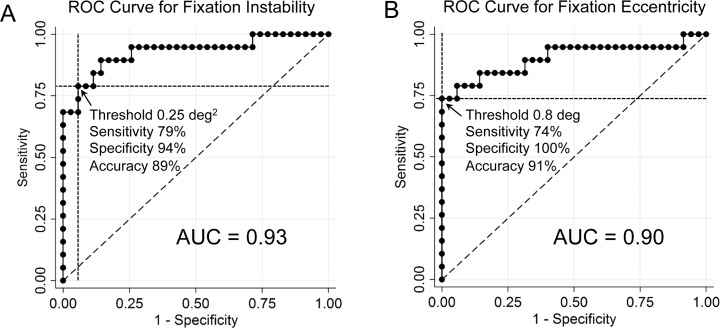
Fixation instability was increased in ON eyes (0.21 deg2) compared with normal eyes (0.06982 deg2; P < 0.001), and fixation eccentricity was increased in ON eyes (0.48°) compared with normal eyes (0.24°; P = 0.03). Fixation instability and eccentricity each correlated moderately with logMAR acuity and were highly predictive of central visual field loss. Twenty-six of 35 ON eyes had PGCL skewed toward local maxima of the GCC thickness map. Patients with bilateral dense central scotomas had PGCL in homonymous retinal locations with respect to the fovea.
Fixation instability and eccentricity measures obtained during cSLO-OCT assess the function of perifoveal retinal elements and predict central visual field loss in patients with ON. A model relating fixation to the GCC thickness map offers a method to assess the structure-function relationship between fixation and areas of preserved GCC in patients with ON.
本研究旨在评估能否从视神经病变(ON)患者的光学相干断层扫描(OCT)过程中获得的视网膜追踪数据中得出临床上有用的注视不稳定和偏心度测量值,并开发一种将注视与视网膜神经节细胞复合体(GCC)厚度相关联的方法。
29例ON患者在注视期间接受了黄斑容积OCT检查,并使用基于共焦扫描激光检眼镜(cSLO)的眼动追踪技术进行了30秒的扫描。核密度估计从视网膜上注视点的分布量化了注视不稳定和注视偏心度。得出了首选神经节细胞层位点(PGCL)及其与GCC厚度图的关系,同时考虑了视网膜神经节细胞胞体相对于其相应视锥细胞的径向位移。
与正常眼(0.06982 deg2;P < 0.001)相比,ON患者患眼的注视不稳定增加(0.21 deg2),与正常眼(0.24°;P = 0.03)相比,ON患者患眼的注视偏心度增加(0.48°)。注视不稳定和偏心度均与logMAR视力呈中度相关,并能高度预测中心视野缺损。35只ON患眼中有26只的PGCL偏向GCC厚度图的局部最大值。双侧致密中心暗点的患者在相对于中央凹的同名视网膜位置有PGCL。
在cSLO-OCT期间获得的注视不稳定和偏心度测量值可评估中心凹周围视网膜元件的功能,并预测ON患者的中心视野缺损。一种将注视与GCC厚度图相关联的模型提供了一种方法,用于评估ON患者注视与保留GCC区域之间的结构-功能关系。