Qu Yanji, Liu Xiaoqing, Zhuang Jian, Chen Guanchun, Mai Jinzhuang, Guo Xiaoling, Ou Yanqiu, Chen Jimei, Gong Wei, Gao Xiangmin, Wu Yong, Nie Zhiqiang
Department of Cardiovascular Disease Epidemiology, Guangdong Cardiovascular Institute, Guangdong Provincial Key Laboratory of South China Structural Heart Disease, Guangdong General Hospital, Guangdong Academy of Medical Sciences, Guangzhou, Guangdong, China.
Department of Cardiac Surgery, Guangdong Cardiovascular Institute, Guangdong Provincial Key Laboratory of South China Structural Heart Disease, Guangdong General Hospital, Guangdong Academy of Medical Sciences, Guangzhou, Guangdong, China.
PLoS One. 2016 Jul 13;11(7):e0159257. doi: 10.1371/journal.pone.0159257. eCollection 2016.
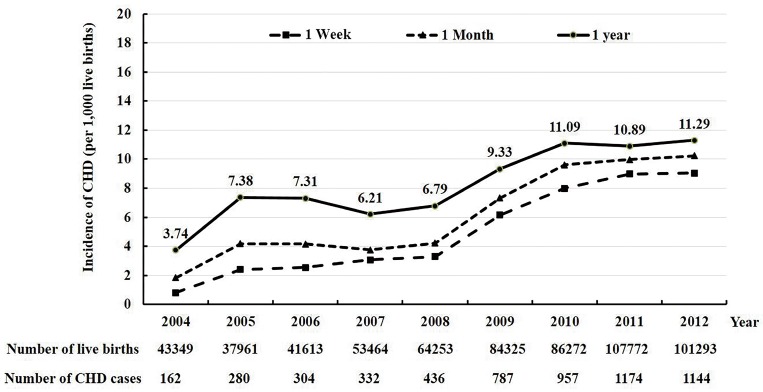
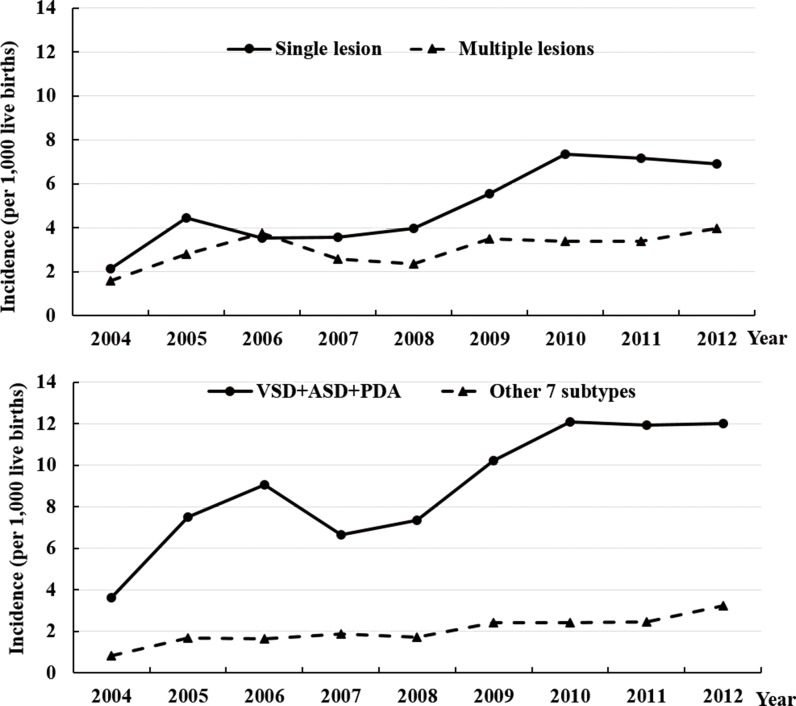
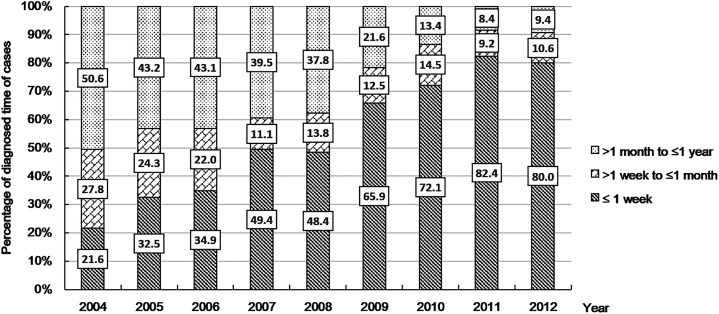
There are 16.5 million newborns in China annually. However, the incidence of congenital heart disease (CHD) has not been evaluated. In 2004, we launched an active province-wide hospital-based CHD registry in the Guangdong Province of southern China. In this study, we examined the incidence of CHD and its subtypes from 2004 to 2012 and compared our findings to the literature. Our results indicate there is an increasing trend of CHD incidence. The increase in incidence occurred mainly for single lesion and the most common subtypes (e.g., ventricular or atrial septal defect, patent ductus arteriosus). There were no increases found for multiple lesions or more complex subtypes. The proportion of CHD cases that were detected early (e.g., 1 week) increased over time. The incidence of CHD stabilized in 2010-2012 with the average cumulative incidences of 9.7, 9.9, and 11.1 per 1,000 live births at 1 week, 1 month, and 1 year, respectively. The incidences of CHD subtypes were comparable with recent international results. The data did not support previous reports that Asian children have a higher incidence of pulmonary outflow obstructions and lower incidence of transposition of the great arteries. However, there was a lower incidence of left ventricular outflow tract obstructions observed in our series. The increase in CHD incidence observed over time was due to improved detection and diagnosis. The true incidence of CHD in China was approximately 11.1 per 1,000 live births, which is higher than previously reported.
中国每年有1650万新生儿。然而,先天性心脏病(CHD)的发病率尚未得到评估。2004年,我们在中国南方的广东省开展了一项积极的全省范围内基于医院的CHD登记工作。在本研究中,我们调查了2004年至2012年CHD及其亚型的发病率,并将我们的研究结果与文献进行了比较。我们的结果表明CHD发病率呈上升趋势。发病率的增加主要发生在单一病变以及最常见的亚型(例如室间隔或房间隔缺损、动脉导管未闭)。多病变或更复杂亚型的发病率没有增加。早期(例如1周)检测到的CHD病例比例随时间增加。CHD发病率在2010 - 2012年趋于稳定,1周、1个月和1岁时每1000例活产儿的平均累积发病率分别为9.7、9.9和11.1。CHD亚型的发病率与近期国际结果相当。数据不支持先前的报道,即亚洲儿童肺动脉流出道梗阻的发病率较高,大动脉转位的发病率较低。然而,在我们的系列研究中观察到左心室流出道梗阻的发病率较低。随时间观察到的CHD发病率增加是由于检测和诊断的改善。中国CHD的实际发病率约为每1000例活产儿11.1例,高于先前报道。