Chaudhari Atul A, Ashmore D'andrea, Nath Subrata Deb, Kate Kunal, Dennis Vida, Singh Shree R, Owen Don R, Palazzo Chris, Arnold Robert D, Miller Michael E, Pillai Shreekumar R
Center for Nanobiotechnology Research, Alabama State University, Montgomery, AL, USA.
Department of Mechanical Engineering, University of Louisville, Louisville, KY, USA.
J Nanobiotechnology. 2016 Jul 13;14(1):58. doi: 10.1186/s12951-016-0211-z.
Due to increasing antibiotic resistance, the use of silver coated single walled carbon nanotubes (SWCNTs-Ag) and antimicrobial peptides (APs) is becoming popular due to their antimicrobial properties against a wide range of pathogens. However, stability against various conditions and toxicity in human cells are some of the major drawbacks of APs and SWCNTs-Ag, respectively. Therefore, we hypothesized that APs-functionalized SWCNTs-Ag could act synergistically. Various covalent functionalization protocols described previously involve harsh treatment of carbon nanotubes for carboxylation (first step in covalent functionalization) and the non-covalently functionalized SWCNTs are not satisfactory.
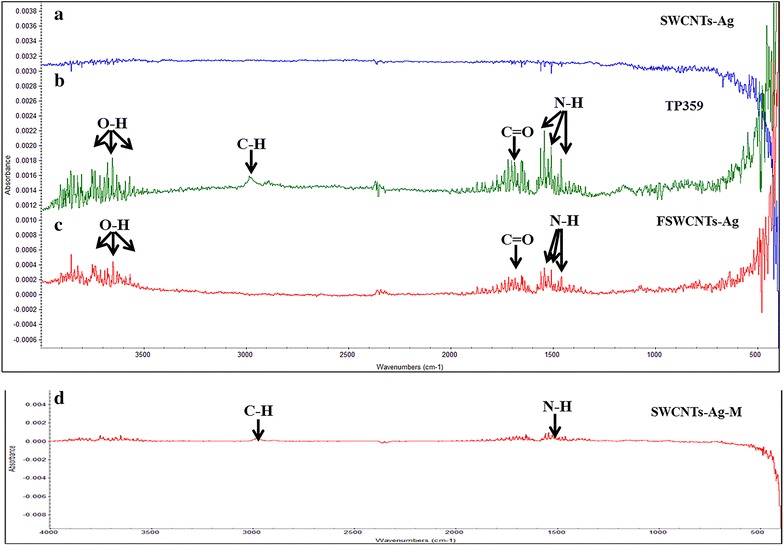
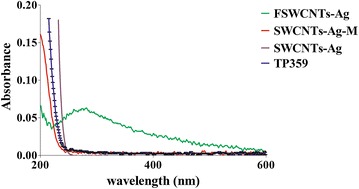
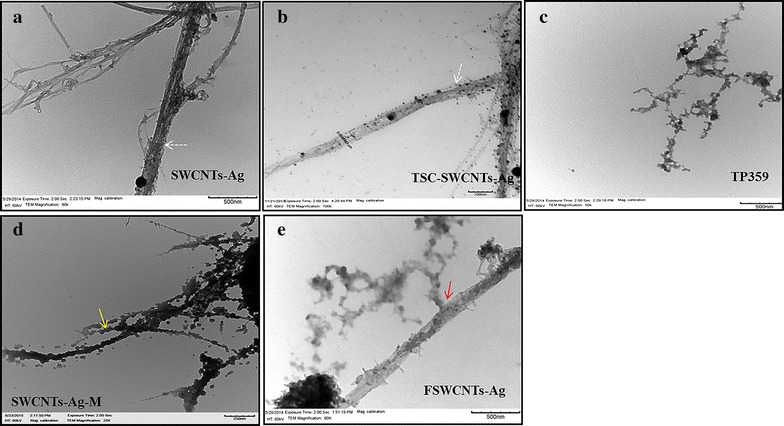
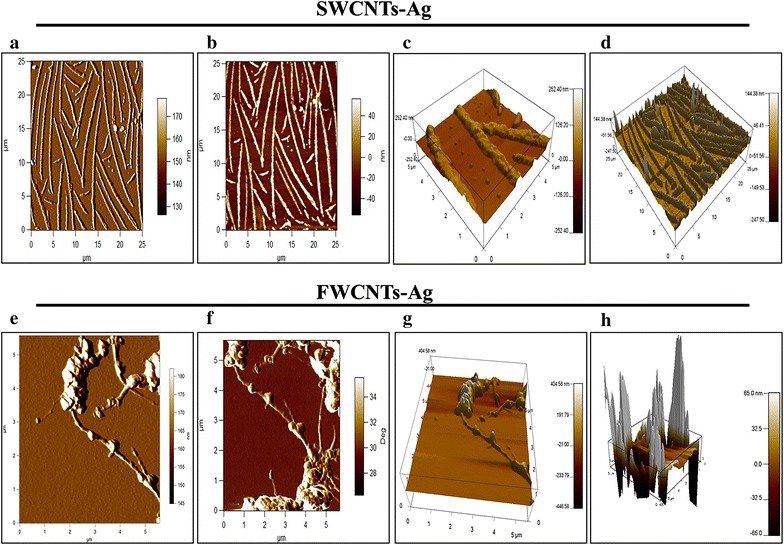
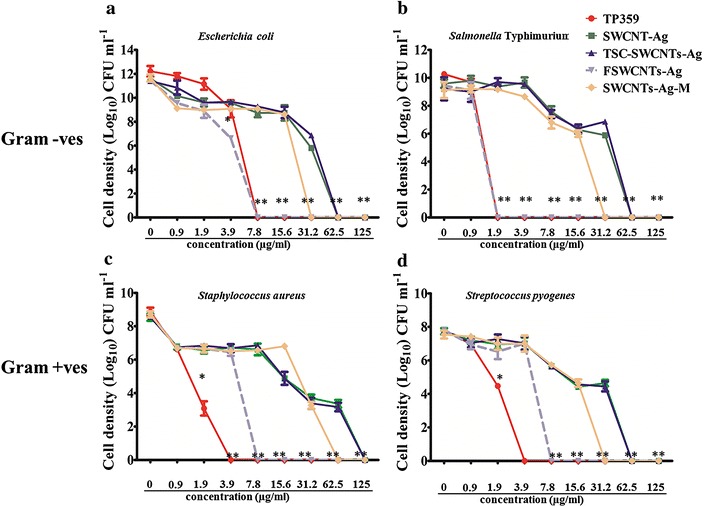
The present study is the first report wherein SWCNTs-Ag were first carboxylated using Tri sodium citrate (TSC) at 37 °C and then subsequently functionalized covalently with an effective antimicrobial peptide from Therapeutic Inc., TP359 (FSWCNTs-Ag). SWCNTs-Ag were also non covalently functionalized with TP359 by simple mixing (SWCNTs-Ag-M) and both, the FSWCNTs-Ag (covalent) and SWCNTs-Ag-M (non-covalent), were characterized by Fourier transform infrared spectroscopy (FT-IR), Ultraviolet visualization (UV-VIS) and transmission electron microscopy (TEM). Further the antibacterial activity of both and TP359 were investigated against two gram positive (Staphylococcus aureus and Streptococcus pyogenes) and two gram negative (Salmonella enterica serovar Typhimurium and Escherichia coli) pathogens and the cellular toxicity of TP359 and FSWCNTs-Ag was compared with plain SWCNTs-Ag using murine macrophages and lung carcinoma cells.
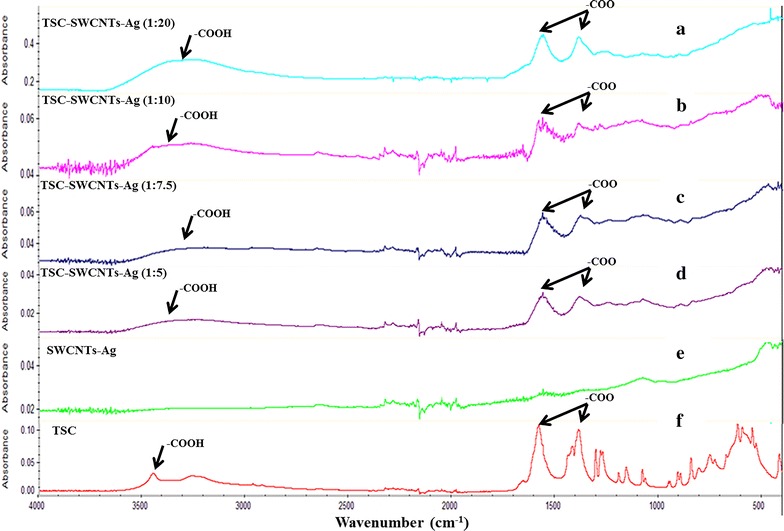
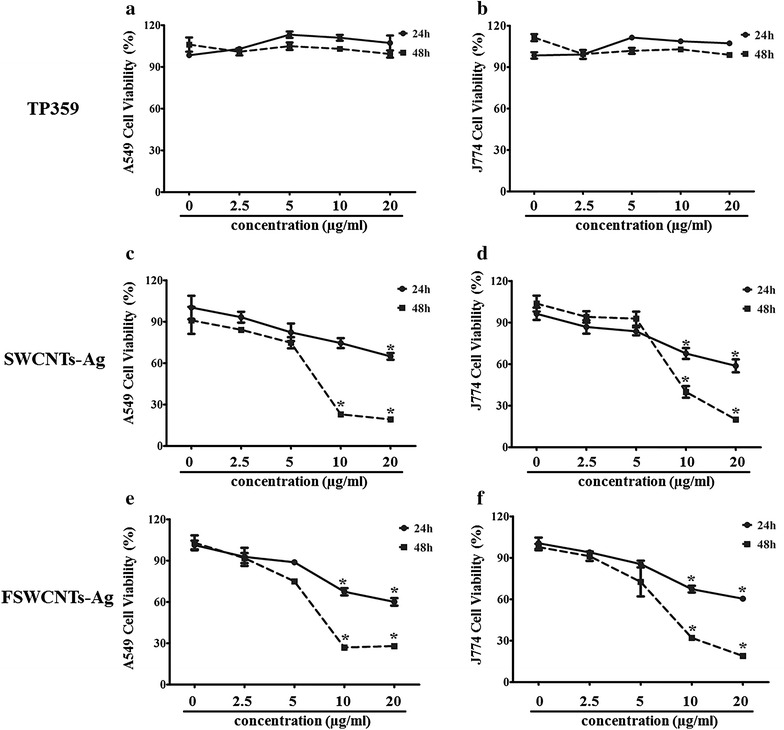
FT-IR analysis revealed that treatment with TSC successfully resulted in carboxylation of SWCNTs-Ag and the peptide was indeed attached to the SWCNTs-Ag evidenced by TEM images. More importantly, the present study results further showed that the minimum inhibitory concentration (MIC) of FSWCNTs-Ag were much lower (~7.8-3.9 µg/ml with IC50: ~4-5 µg/ml) compared to SWCNTs-Ag-M and plain SWCNTs-Ag (both 62.6 µg/ml, IC50: ~31-35 µg/ml), suggesting that the covalent conjugation of TP359 with SWCNTs-Ag was very effective on their counterparts. Additionally, FSWCNTs-Ag are non-toxic to the eukaryotic cells at their MIC concentrations (5-2.5 µg/ml) compared to SWCNTs-Ag (62.5 µg/ml).
In conclusion, we demonstrated that covalent functionalization of SWCNTs-Ag and TP359 exhibited an additive antibacterial activity. This study described a novel approach to prepare SWCNT-Ag bio-conjugates without loss of antimicrobial activity and reduced toxicity, and this strategy will aid in the development of novel and biologically important nanomaterials.
由于抗生素耐药性不断增加,涂银单壁碳纳米管(SWCNTs-Ag)和抗菌肽(APs)因其对多种病原体的抗菌特性而越来越受欢迎。然而,APs对各种条件的稳定性以及SWCNTs-Ag在人类细胞中的毒性分别是它们的一些主要缺点。因此,我们推测APs功能化的SWCNTs-Ag可能具有协同作用。先前描述的各种共价功能化方案涉及对碳纳米管进行苛刻的羧化处理(共价功能化的第一步),并且非共价功能化的SWCNTs并不令人满意。
本研究是首篇报道,其中SWCNTs-Ag首先在37°C下用柠檬酸钠(TSC)进行羧化,然后随后与Therapeutic Inc.的一种有效的抗菌肽TP359进行共价功能化(FSWCNTs-Ag)。SWCNTs-Ag也通过简单混合用TP359进行非共价功能化(SWCNTs-Ag-M),并且FSWCNTs-Ag(共价)和SWCNTs-Ag-M(非共价)均通过傅里叶变换红外光谱(FT-IR)、紫外可见分光光度法(UV-VIS)和透射电子显微镜(TEM)进行表征。此外,研究了两者以及TP359对两种革兰氏阳性菌(金黄色葡萄球菌和化脓性链球菌)和两种革兰氏阴性菌(鼠伤寒沙门氏菌和大肠杆菌)病原体的抗菌活性,并使用鼠巨噬细胞和肺癌细胞将TP359和FSWCNTs-Ag的细胞毒性与普通SWCNTs-Ag进行比较。
FT-IR分析表明,用TSC处理成功导致SWCNTs-Ag羧化,并且TEM图像证明肽确实附着在SWCNTs-Ag上。更重要的是,本研究结果进一步表明,与SWCNTs-Ag-M和普通SWCNTs-Ag(两者均为62.6μg/ml,IC50:约31 - 35μg/ml)相比,FSWCNTs-Ag的最低抑菌浓度(MIC)要低得多(约7.8 - 3.9μg/ml,IC50:约4 - 5μg/ml),这表明TP359与SWCNTs-Ag的共价结合对它们的同类物非常有效。此外,与SWCNTs-Ag(62.5μg/ml)相比,FSWCNTs-Ag在其MIC浓度(5 - 2.5μg/ml)下对真核细胞无毒。
总之,我们证明了SWCNTs-Ag和TP359的共价功能化表现出相加的抗菌活性。本研究描述了一种制备SWCNT-Ag生物共轭物的新方法,该方法不会丧失抗菌活性且降低了毒性,并且这种策略将有助于新型和具有生物学重要性的纳米材料的开发。