Zander Heike, Claes Laurence, Voth Eva M, de Zwaan Martina, Müller Astrid
1 Department of Psychosomatic Medicine and Psychotherapy, Hannover Medical School , Hannover, Germany.
2 Faculty of Psychology and Educational Sciences, KU Leuven , Leuven, Belgium.
J Behav Addict. 2016 Sep;5(3):457-64. doi: 10.1556/2006.5.2016.050. Epub 2016 Jul 14.
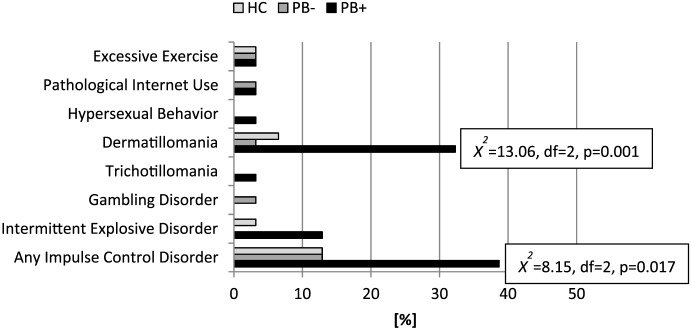
Aim To investigate impulsive behaviors in pathological buying (PB). Methods The study included three groups matched for age and gender: treatment seeking outpatients with PB (PB+), treatment seeking psychiatric inpatients without PB (PB-), and a healthy control group (HC). PB was assessed by means of the Compulsive Buying Scale and by the impulse control disorder (ICD) module of the research version of the Structured Clinical Interview for DSM-IV (SCID-ICD). All participants answered questionnaires concerning symptoms of borderline personality disorder, self-harming behaviors, binge eating and symptoms of attention deficit and hyperactivity disorder (ADHD). In addition, comorbid ICDs were assessed using the SCID-ICD. Results The PB+ and PB- groups did not differ with regard to borderline personality disorder or ADHD symptoms, but both groups reported significantly more symptoms than the HC group. Frequencies of self-harming behaviors did not differ between the three groups. Patients with PB were more often diagnosed with any current ICD (excluding PB) compared to those without PB and the HC group (38.7% vs. 12.9% vs. 12.9%, respectively, p=.017). Discussion Our findings confirm prior research suggesting more impulsive behaviors in patients with and without PB compared to healthy controls. The results of the questionnaire-based assessment indicate that outpatients with PB perceive themselves equally impulsive and self-harm as frequently as inpatients without PB; but they seem to suffer more often from an ICD as assessed by means of an interview.
调查病理性购物(PB)中的冲动行为。方法:该研究包括三组年龄和性别匹配的人群:寻求治疗的PB门诊患者(PB+)、寻求治疗的无PB精神科住院患者(PB-)和健康对照组(HC)。通过强迫性购买量表以及《精神疾病诊断与统计手册》第四版(DSM-IV)结构化临床访谈研究版的冲动控制障碍(ICD)模块对PB进行评估。所有参与者都回答了关于边缘性人格障碍症状、自我伤害行为、暴饮暴食以及注意力缺陷多动障碍(ADHD)症状的问卷。此外,使用SCID-ICD评估共病的ICD。结果:PB+组和PB-组在边缘性人格障碍或ADHD症状方面没有差异,但两组报告的症状均明显多于HC组。三组之间自我伤害行为的频率没有差异。与无PB的患者和HC组相比,PB患者更常被诊断为患有任何当前的ICD(不包括PB)(分别为38.7%、12.9%和12.9%,p = 0.017)。讨论:我们的研究结果证实了先前的研究,即与健康对照组相比,有和无PB的患者都存在更多的冲动行为。基于问卷评估的结果表明,PB门诊患者认为自己与无PB的住院患者一样冲动且自我伤害频率相同;但通过访谈评估,他们似乎更常患有ICD。