Lombardo Michael V, Auyeung Bonnie, Holt Rosemary J, Waldman Jack, Ruigrok Amber N V, Mooney Natasha, Bullmore Edward T, Baron-Cohen Simon, Kundu Prantik
Center for Applied Neuroscience, Department of Psychology, University of Cyprus, Cyprus; Autism Research Centre, Department of Psychiatry, University of Cambridge, UK.
Autism Research Centre, Department of Psychiatry, University of Cambridge, UK; Department of Psychology, School of Philosophy, Psychology, and Language Sciences, University of Edinburgh, UK.
Neuroimage. 2016 Nov 15;142:55-66. doi: 10.1016/j.neuroimage.2016.07.022. Epub 2016 Jul 11.
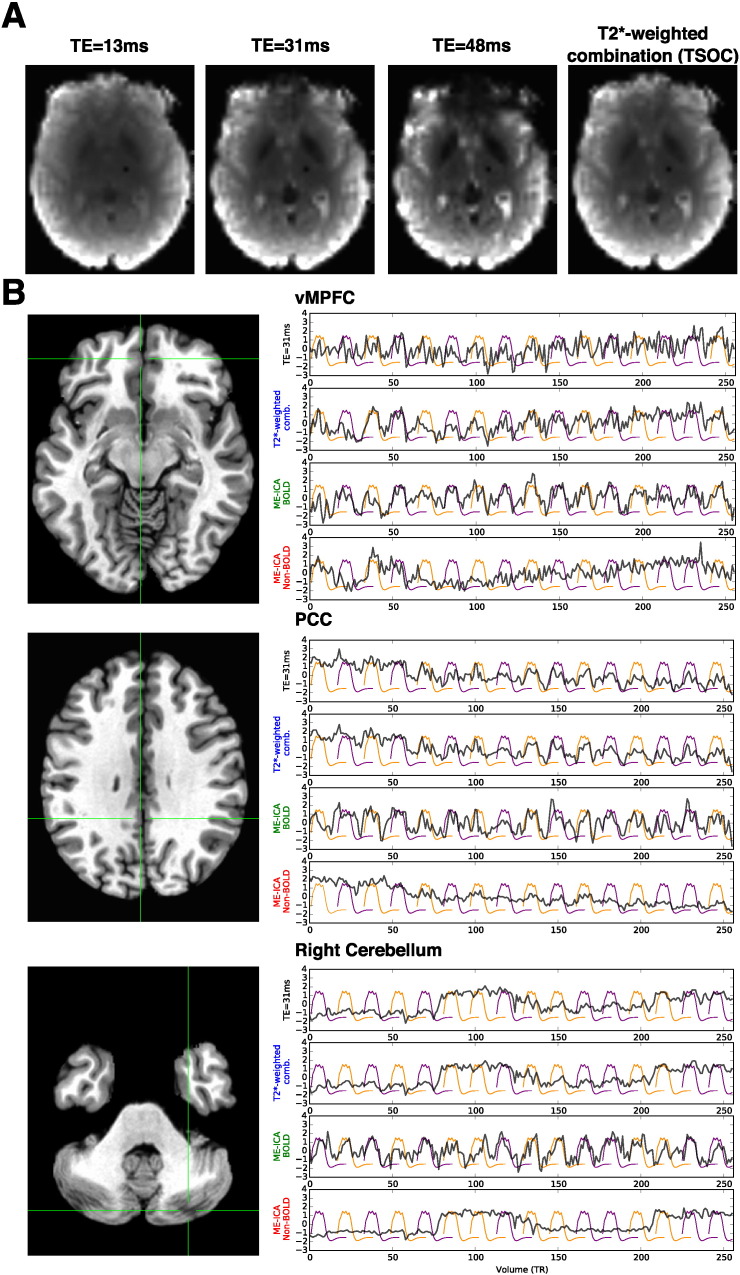
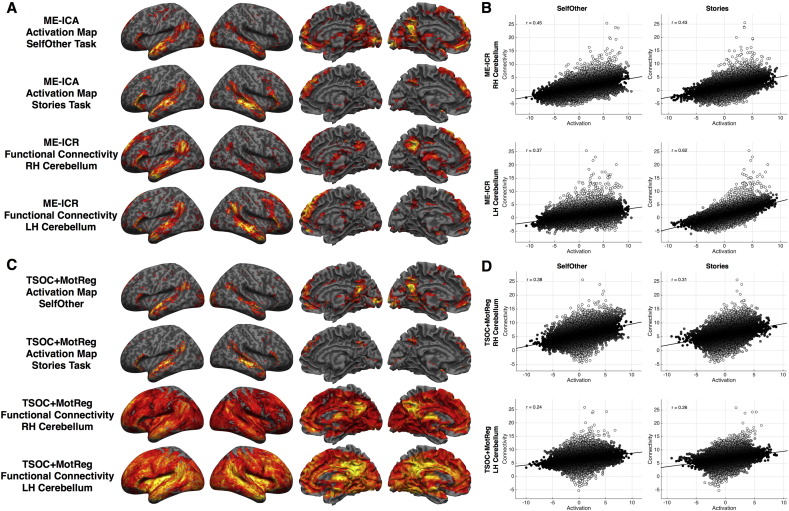
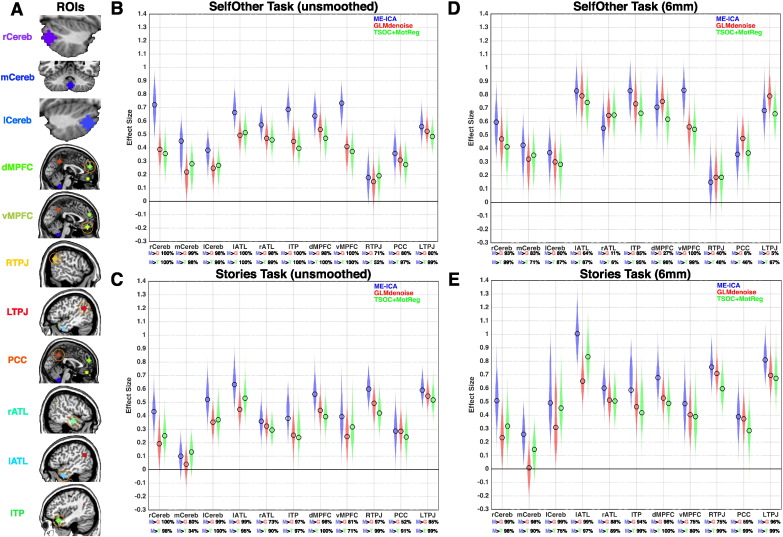
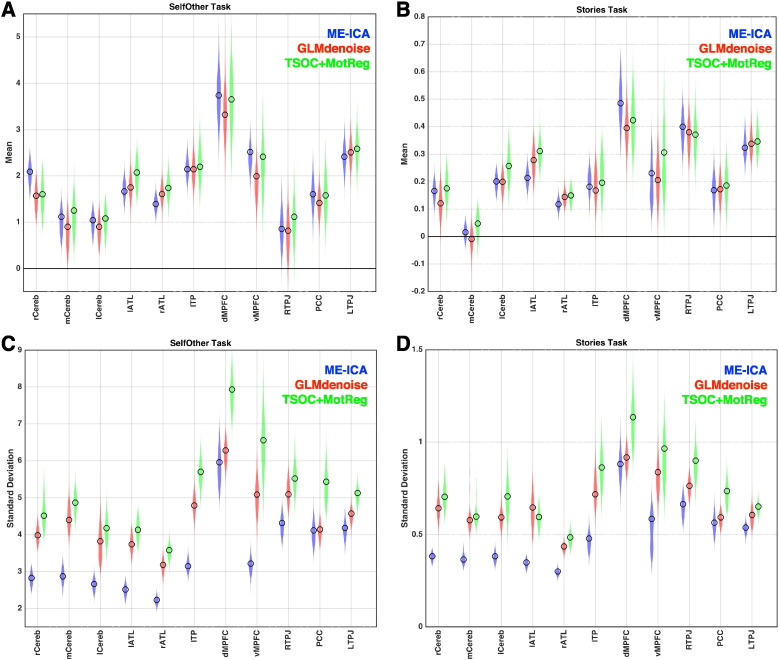
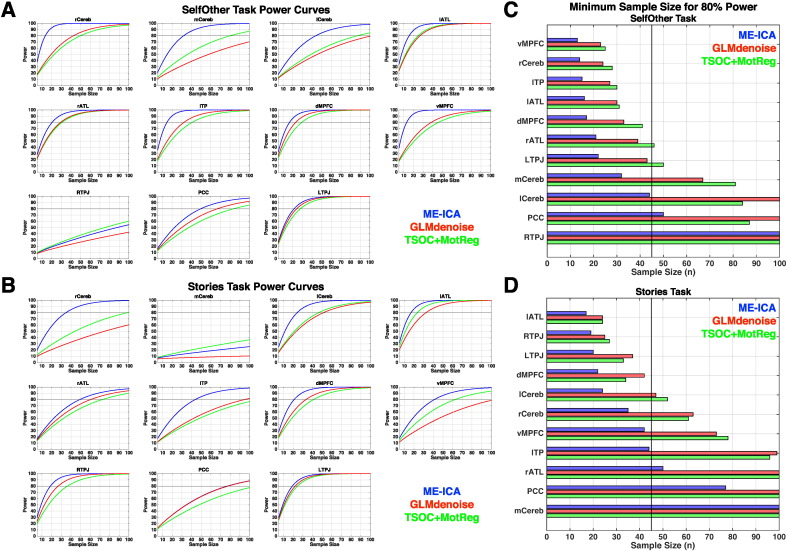
Functional magnetic resonance imaging (fMRI) research is routinely criticized for being statistically underpowered due to characteristically small sample sizes and much larger sample sizes are being increasingly recommended. Additionally, various sources of artifact inherent in fMRI data can have detrimental impact on effect size estimates and statistical power. Here we show how specific removal of non-BOLD artifacts can improve effect size estimation and statistical power in task-fMRI contexts, with particular application to the social-cognitive domain of mentalizing/theory of mind. Non-BOLD variability identification and removal is achieved in a biophysical and statistically principled manner by combining multi-echo fMRI acquisition and independent components analysis (ME-ICA). Without smoothing, group-level effect size estimates on two different mentalizing tasks were enhanced by ME-ICA at a median rate of 24% in regions canonically associated with mentalizing, while much more substantial boosts (40-149%) were observed in non-canonical cerebellar areas. Effect size boosting occurs via reduction of non-BOLD noise at the subject-level and consequent reductions in between-subject variance at the group-level. Smoothing can attenuate ME-ICA-related effect size improvements in certain circumstances. Power simulations demonstrate that ME-ICA-related effect size enhancements enable much higher-powered studies at traditional sample sizes. Cerebellar effects observed after applying ME-ICA may be unobservable with conventional imaging at traditional sample sizes. Thus, ME-ICA allows for principled design-agnostic non-BOLD artifact removal that can substantially improve effect size estimates and statistical power in task-fMRI contexts. ME-ICA could mitigate some issues regarding statistical power in fMRI studies and enable novel discovery of aspects of brain organization that are currently under-appreciated and not well understood.
功能磁共振成像(fMRI)研究常因样本量通常较小而在统计上缺乏效力而受到批评,因此越来越多地建议采用更大的样本量。此外,fMRI数据中固有的各种伪影源可能会对效应量估计和统计效力产生不利影响。在这里,我们展示了如何在任务fMRI环境中通过特定去除非BOLD伪影来改善效应量估计和统计效力,特别是应用于心理化/心理理论的社会认知领域。通过结合多回波fMRI采集和独立成分分析(ME-ICA),以生物物理和统计原则的方式实现非BOLD变异性的识别和去除。在不进行平滑处理的情况下,ME-ICA在与心理化典型相关的区域将两个不同心理化任务的组水平效应量估计提高了24%的中位数,而在非典型小脑区域观察到了更大幅度的提高(40%-149%)。效应量的提高是通过在个体水平上减少非BOLD噪声以及随之而来的在组水平上减少个体间方差来实现的。在某些情况下,平滑处理会减弱与ME-ICA相关的效应量改善。功效模拟表明,与ME-ICA相关的效应量增强能够在传统样本量下进行更高功效的研究。在应用ME-ICA后观察到的小脑效应在传统样本量下使用传统成像可能无法观察到。因此,ME-ICA允许进行原则性的、与设计无关的非BOLD伪影去除,这可以在任务fMRI环境中显著改善效应量估计和统计效力。ME-ICA可以缓解fMRI研究中关于统计效力的一些问题,并能够发现目前未得到充分重视和理解的脑组织方面的新情况。