Gaab Erin Mary
University of California, 5200 Lake Road, Merced, CA 95343, USA.
Children (Basel). 2015 Mar 23;2(1):131-45. doi: 10.3390/children2010131.
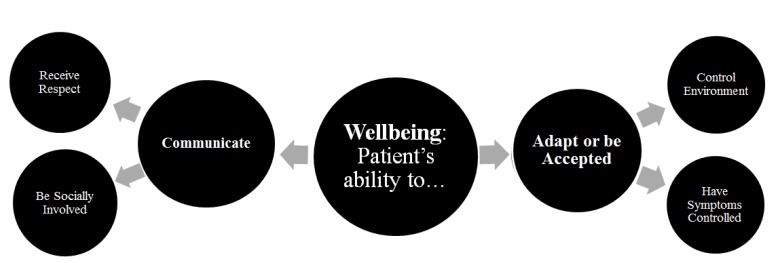
Medical and academic institutions began prioritizing Pediatric Palliative Care (PPC) less than two decades ago. Although policies and institutions claim to improve the Quality of Life (QoL) of PPC patients and their families, family-defined QoL remains ambiguous. This research investigates the definitions of QoL for PPC patients according to their primary caregivers. We conducted qualitative, semi-structured focus groups of the primary caregivers of PPC patients. The transcripts were analysed for themes using inductive thematic analysis. Participants included primary caregivers of children currently receiving PPC from a healthcare institution in California. We identified several factors that primary caregivers considered components of QoL for their children. The ability to communicate and adapt or be accepted underpinned the concept of QoL for families. QoL for PPC patients was defined by primary caregivers as being able to communicate in a respectful, controlled, physically- and socially-comfortable environment. Attempts to improve QoL should focus not only on pain and symptom control, but also on enhancing opportunities for children to communicate and maintain a sense of dignity.
不到二十年前,医学和学术机构才开始将儿童姑息治疗(PPC)列为优先事项。尽管政策和机构声称要提高PPC患者及其家庭的生活质量(QoL),但家庭定义的生活质量仍然模糊不清。本研究根据PPC患者的主要照顾者来调查他们对生活质量的定义。我们对PPC患者的主要照顾者进行了定性的、半结构化的焦点小组访谈。使用归纳主题分析法对访谈记录进行主题分析。参与者包括加利福尼亚州一家医疗机构中目前正在接受PPC治疗的儿童的主要照顾者。我们确定了几个主要照顾者认为是其子女生活质量组成部分的因素。沟通、适应或被接纳的能力是家庭生活质量概念的基础。PPC患者的生活质量被主要照顾者定义为能够在一个尊重他人、可控、身体和社会舒适的环境中进行沟通。改善生活质量的努力不仅应集中在疼痛和症状控制上,还应集中在增加儿童沟通和维护尊严感的机会上。