Jiménez Diego Javier, de Lima Brossi Maria Julia, Schückel Julia, Kračun Stjepan Krešimir, Willats William George Tycho, van Elsas Jan Dirk
Department of Microbial Ecology, Groningen Institute for Evolutionary Life Sciences, University of Groningen, Nijenborgh 7, 9747 AG, Groningen, The Netherlands.
Department of Plant and Environmental Sciences, University of Copenhagen, Thorvaldsensvej 40, Frederiksberg C 1871, Copenhagen, Denmark.
Appl Microbiol Biotechnol. 2016 Dec;100(24):10463-10477. doi: 10.1007/s00253-016-7713-3. Epub 2016 Jul 14.
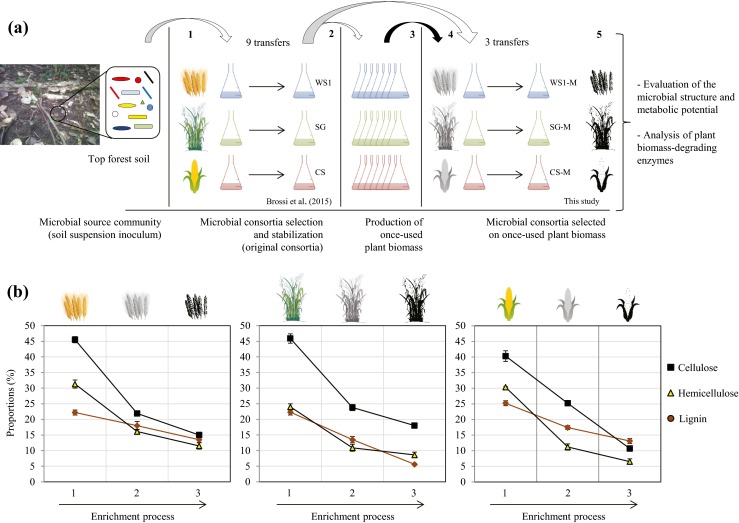
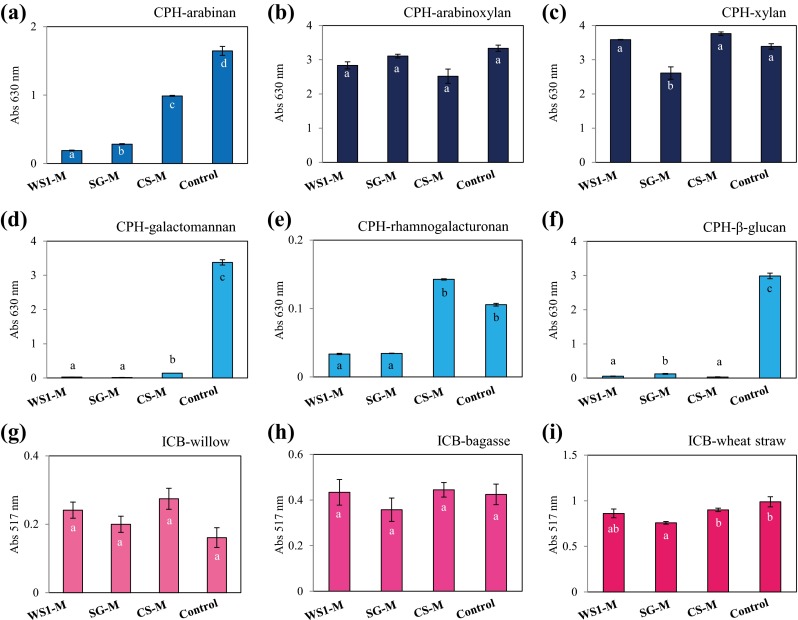
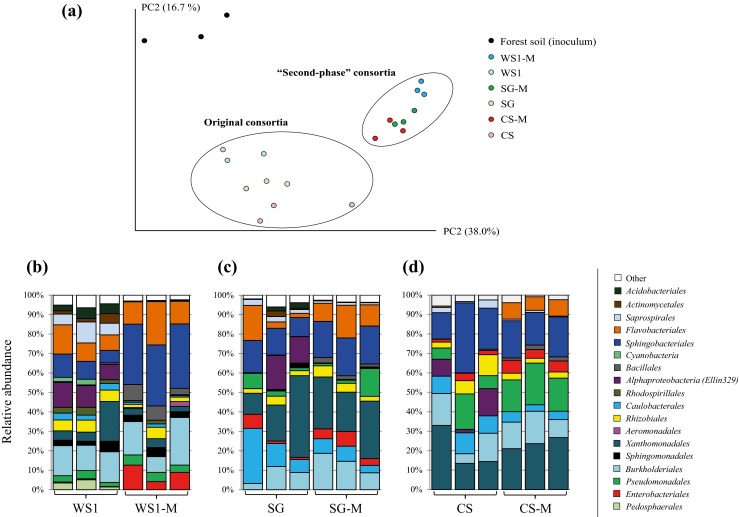
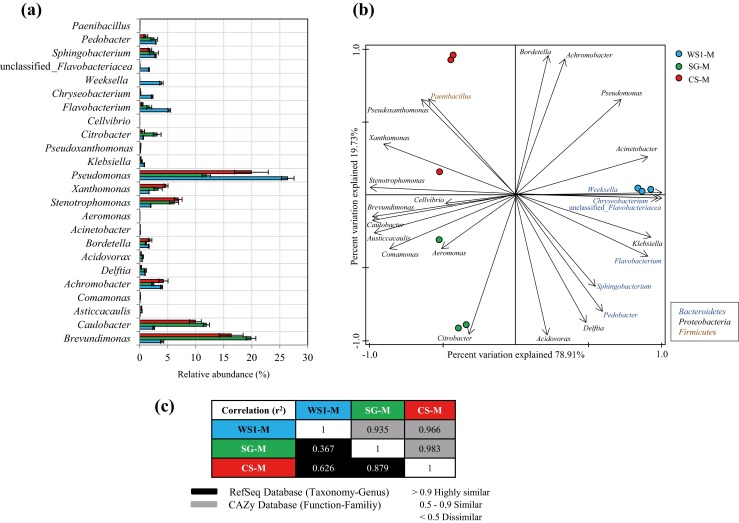
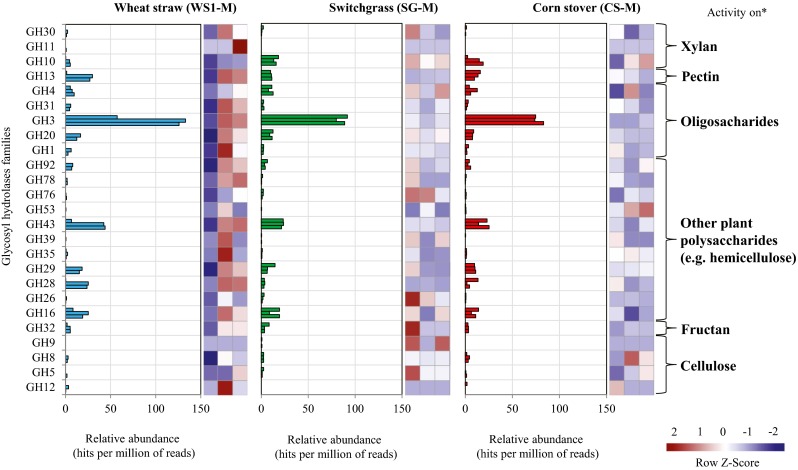
The selection of microbes by enrichment on plant biomass has been proposed as an efficient way to develop new strategies for lignocellulose saccharification. Here, we report an in-depth analysis of soil-derived microbial consortia that were trained to degrade once-used wheat straw (WS1-M), switchgrass (SG-M) and corn stover (CS-M) under aerobic and mesophilic conditions. Molecular fingerprintings, bacterial 16S ribosomal RNA (rRNA) gene amplicon sequencing and metagenomic analyses showed that the three microbial consortia were taxonomically distinct. Based on the taxonomic affiliation of protein-encoding sequences, members of the Bacteroidetes (e.g. Chryseobacterium, Weeksella, Flavobacterium and Sphingobacterium) were preferentially selected on WS1-M, whereas SG-M and CS-M favoured members of the Proteobacteria (e.g. Caulobacter, Brevundimonas, Stenotrophomonas and Xanthomonas). The highest degradation rates of lignin (~59 %) were observed with SG-M, whereas CS-M showed a high consumption of cellulose and hemicellulose. Analyses of the carbohydrate-active enzymes in the three microbial consortia showed the dominance of glycosyl hydrolases (e.g. of families GH3, GH43, GH13, GH10, GH29, GH28, GH16, GH4 and GH92). In addition, proteins of families AA6, AA10 and AA2 were detected. Analysis of secreted protein fractions (metasecretome) for each selected microbial consortium mainly showed the presence of enzymes able to degrade arabinan, arabinoxylan, xylan, β-glucan, galactomannan and rhamnogalacturonan. Notably, these metasecretomes contain enzymes that enable us to produce oligosaccharides directly from wheat straw, sugarcane bagasse and willow. Thus, the underlying microbial consortia constitute valuable resources for the production of enzyme cocktails for the efficient saccharification of plant biomass.
通过在植物生物质上进行富集培养来选择微生物,已被提议作为开发木质纤维素糖化新策略的有效方法。在此,我们报告了对土壤来源的微生物群落进行的深入分析,这些群落经过驯化,能够在需氧和中温条件下降解一次性使用的小麦秸秆(WS1-M)、柳枝稷(SG-M)和玉米秸秆(CS-M)。分子指纹分析、细菌16S核糖体RNA(rRNA)基因扩增子测序和宏基因组分析表明,这三个微生物群落的分类学特征不同。根据蛋白质编码序列的分类归属,拟杆菌门的成员(如金黄杆菌属、韦荣氏菌属、黄杆菌属和鞘氨醇杆菌属)在WS1-M上被优先选择,而SG-M和CS-M则有利于变形菌门的成员(如柄杆菌属、短波单胞菌属、嗜麦芽窄食单胞菌属和黄单胞菌属)。SG-M对木质素的降解率最高(约59%),而CS-M对纤维素和半纤维素的消耗量较高。对这三个微生物群落中碳水化合物活性酶的分析表明,糖苷水解酶(如GH3、GH43、GH13、GH10、GH29、GH28、GH16、GH4和GH92家族)占主导地位。此外,还检测到了AA6、AA10和AA2家族的蛋白质。对每个选定的微生物群落的分泌蛋白组分(元分泌组)分析主要表明,存在能够降解阿拉伯聚糖、阿拉伯木聚糖、木聚糖、β-葡聚糖、半乳甘露聚糖和鼠李糖半乳糖醛酸聚糖的酶。值得注意的是,这些元分泌组包含的酶能够使我们直接从小麦秸秆、甘蔗渣和柳树中生产低聚糖。因此,潜在的微生物群落构成了用于生产高效糖化植物生物质的酶混合物的宝贵资源。