Duraiswamy Anand, Shanmugasundaram Devanand, Sasikumar Changam Sheela, Cherian Sanjay M, Cherian Kotturathu Mammen
Department of Cellular and Molecular Biochemistry, Frontier Mediville (A Unit of Frontier Lifeline and Dr. K. M. Cherian Heart Foundation), Affiliated to University of Madras, Chennai, Tamil Nadu, India.
Department of Cardiothoracic Surgery, Frontier Lifeline Hospital, Chennai, Tamil Nadu, India.
J Tradit Complement Med. 2015 Feb 28;6(3):204-8. doi: 10.1016/j.jtcme.2014.12.006. eCollection 2016 Jul.
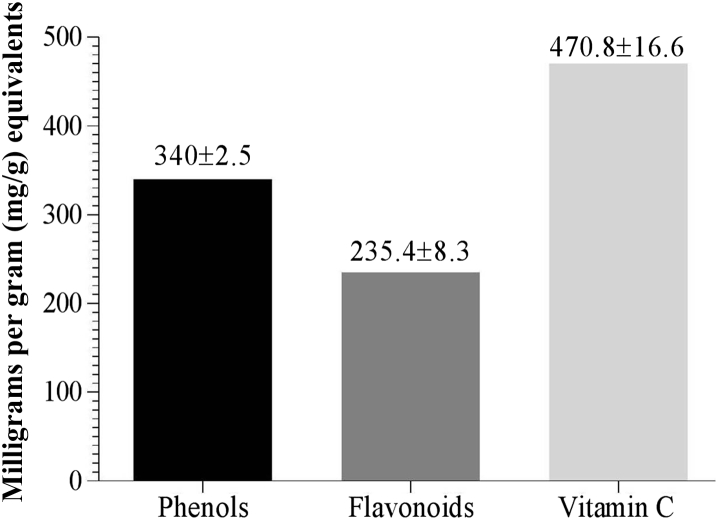
There has recently been much advancement in the diagnosis, treatment, and research of metabolic disorders, especially diabetes. Current research around the world is focused on finding an alternative source of treatment from natural resources for diabetic management, apart from the available synthetic medicines. The present study is a preliminary study of a polyherbal formulation using edible natural resources and an assessment of its antidiabetic activity. The formulation was screened for its phytochemical constituents, total phenols, flavonoids, and vitamin C content. It was also analyzed for its inhibitory effect against the digestive enzymes α-amylase and α-glucosidase, compared with the standard drug acarbose. The formulation showed the presence of major constituents such as steroids, cardiac glycosides, phenols, flavonoids, and saponins. It also had a high level of phenols (340 ± 2.5 mg/g), flavonoids (235.4 ± 8.3 mg/g), and vitamin C (470.8 ± 16.6 mg/g), and showed a half-maximal inhibitory concentration (IC50) value of 0.41 ± 0.03 mg/mL and 0.51 ± 0.01 mg/mL for amylase and glucosidase, respectively. The results showed that ADJ6 had a significant inhibitory activity on α-amylase and α-glucosidase; however, its inhibitory activity was less than that of acarbose. The plants that are formulated in ADJ6 possess potent antidiabetic activity. Thus, we found that ADJ6 is a potent lead for effective diabetic management; however, an evaluation of the formulation must be illustrated using an in vivo model.
近年来,代谢紊乱尤其是糖尿病的诊断、治疗和研究取得了很大进展。除了现有的合成药物外,世界各地目前的研究都集中在从自然资源中寻找治疗糖尿病的替代方法。本研究是对一种使用可食用自然资源的多草药配方的初步研究,并对其抗糖尿病活性进行评估。对该配方进行了植物化学成分、总酚、黄酮类化合物和维生素C含量的筛选。还与标准药物阿卡波糖相比,分析了其对消化酶α-淀粉酶和α-葡萄糖苷酶的抑制作用。该配方显示含有甾体、强心苷、酚类、黄酮类和皂苷等主要成分。它还含有高水平的酚类(340±2.5毫克/克)、黄酮类(235.4±8.3毫克/克)和维生素C(470.8±16.6毫克/克),淀粉酶和葡萄糖苷酶的半数抑制浓度(IC50)值分别为0.41±0.03毫克/毫升和0.51±0.01毫克/毫升。结果表明,ADJ6对α-淀粉酶和α-葡萄糖苷酶具有显著的抑制活性;然而,其抑制活性低于阿卡波糖。ADJ6中配制的植物具有强大的抗糖尿病活性。因此,我们发现ADJ6是有效管理糖尿病的有力先导;然而,必须使用体内模型对该配方进行评估。