Oury Cécile, Servais Laurence, Bouznad Nassim, Hego Alexandre, Nchimi Alain, Lancellotti Patrizio
GIGA-Cardiovascular Sciences, Interdisciplinary Cluster for Applied Genoproteomics (GIGA), University of Liège, 4000 Liège, Belgium.
Department of Cardiology, University of Liège Hospital, 4000 Liège, Belgium.
Int J Mol Sci. 2016 Jul 13;17(7):1120. doi: 10.3390/ijms17071120.
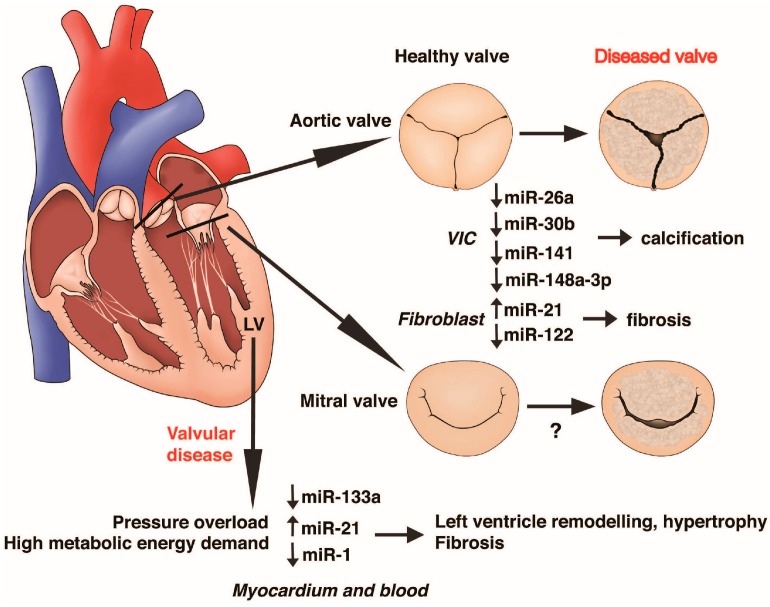
miRNAs are a class of over 5000 noncoding RNAs that regulate more than half of the protein-encoding genes by provoking their degradation or preventing their translation. miRNAs are key regulators of complex biological processes underlying several cardiovascular disorders, including left ventricular hypertrophy, ischemic heart disease, heart failure, hypertension and arrhythmias. Moreover, circulating miRNAs herald promise as biomarkers in acute myocardial infarction and heart failure. In this context, this review gives an overview of studies that suggest that miRNAs could also play a role in valvular heart diseases. This area of research is still at its infancy, and further investigations in large patient cohorts and cellular or animal models are needed to provide strong data. Most studies focused on aortic stenosis, one of the most common valvular diseases in developed countries. Profiling and functional analyses indicate that miRNAs could contribute to activation of aortic valve interstitial cells to a myofibroblast phenotype, leading to valvular fibrosis and calcification, and to pressure overload-induced myocardial remodeling and hypertrophy. Data also indicate that specific miRNA signatures, in combination with clinical and functional imaging parameters, could represent useful biomarkers of disease progression or recovery after aortic valve replacement.
微小RNA(miRNA)是一类超过5000种的非编码RNA,它们通过促使蛋白质编码基因降解或阻止其翻译来调控超过半数的此类基因。miRNA是多种心血管疾病(包括左心室肥厚、缺血性心脏病、心力衰竭、高血压和心律失常)所涉及的复杂生物学过程的关键调节因子。此外,循环miRNA有望成为急性心肌梗死和心力衰竭的生物标志物。在此背景下,本综述概述了一些研究,这些研究表明miRNA在心脏瓣膜疾病中也可能发挥作用。该研究领域仍处于起步阶段,需要在大量患者队列以及细胞或动物模型中进行进一步研究以提供有力数据。大多数研究聚焦于主动脉瓣狭窄,这是发达国家最常见的瓣膜疾病之一。分析和功能研究表明,miRNA可能促使主动脉瓣间质细胞转变为肌成纤维细胞表型,导致瓣膜纤维化和钙化,并引发压力超负荷诱导的心肌重塑和肥厚。数据还表明,特定的miRNA特征与临床和功能成像参数相结合,可能成为疾病进展或主动脉瓣置换术后恢复情况的有用生物标志物。