Yeung Kristen R, Chiu Christine L, Pears Suzanne, Heffernan Scott J, Makris Angela, Hennessy Annemarie, Lind Joanne M
Western Sydney University, School of Medicine, Sydney, Australia.
Department of Renal Medicine, Royal Prince Alfred Hospital, Sydney, Australia.
PLoS One. 2016 Jul 18;11(7):e0159576. doi: 10.1371/journal.pone.0159576. eCollection 2016.
Ageing is associated with changes at the molecular and cellular level that can alter cardiovascular function and ultimately lead to disease. The baboon is an ideal model for studying ageing due to the similarities in genetic, anatomical, physiological and biochemical characteristics with humans. The aim of this cross-sectional study was to investigate the changes in cardiovascular profile of baboons over the course of their lifespan.
Data were collected from 109 healthy baboons (Papio hamadryas) at the Australian National Baboon Colony. A linear regression model, adjusting for sex, was used to analyse the association between age and markers of ageing with P < 0.01 considered significant.
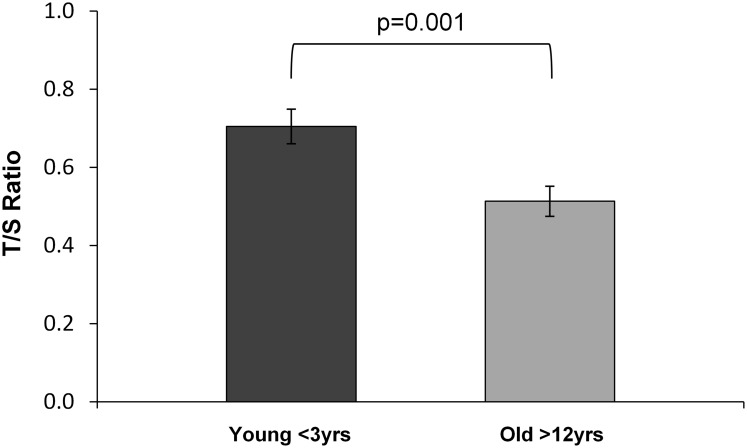
Male (n = 49, 1.5-28.5 years) and female (n = 60, 1.8-24.6 years) baboons were included in the study. Age was significantly correlated with systolic (R2 = 0.23, P < 0.001) and diastolic blood pressure (R2 = 0.44, P < 0.001), with blood pressure increasing with age. Age was also highly correlated with core augmentation index (R2 = 0.17, P < 0.001) and core pulse pressure (R2 = 0.30, P < 0.001). Creatinine and urea were significantly higher in older animals compared to young animals (P < 0.001 for both). Older animals (>12 years) had significantly shorter telomeres when compared to younger (<3 years) baboons (P = 0.001).
This study is the first to demonstrate that cardiovascular function alters with age in the baboon. This research identifies similarities within cardiovascular parameters between humans and baboon even though the length of life differs between the two species.
衰老与分子和细胞水平的变化相关,这些变化会改变心血管功能并最终导致疾病。由于在遗传、解剖、生理和生化特征方面与人类相似,狒狒是研究衰老的理想模型。这项横断面研究的目的是调查狒狒在其生命周期中心血管状况的变化。
从澳大利亚国家狒狒殖民地的109只健康狒狒(阿拉伯狒狒)收集数据。使用调整了性别的线性回归模型来分析年龄与衰老标志物之间的关联,P<0.01被认为具有显著性。
研究纳入了雄性(n = 49,1.5 - 28.5岁)和雌性(n = 60,1.8 - 24.6岁)狒狒。年龄与收缩压(R2 = 0.23,P < 0.001)和舒张压(R2 = 0.44,P < 0.001)显著相关,血压随年龄增加。年龄也与核心增强指数(R2 = 0.17,P < 0.001)和核心脉压(R2 = 0.30,P < 0.001)高度相关。与年轻动物相比,老年动物的肌酐和尿素显著更高(两者P < 0.001)。与年轻(<3岁)狒狒相比,老年动物(>12岁)的端粒明显更短(P = 0.001)。
本研究首次证明狒狒的心血管功能随年龄而改变。这项研究确定了人类和狒狒在心血管参数方面的相似性,尽管这两个物种的寿命不同。