Wang Dongming, Li Wenzhen, Xiao Yang, He Wulong, Wei Weiquan, Yang Longyu, Yu Jincong, Song Fujian, Wang Zengzhen
Department of Epidemiology and Biostatistics, School of Public Health, Tongji Medical College, Huazhong University of Science and Technology Wuhan Hospital for the Prevention and Treatment of Occupational Diseases Department of Social Medicine and Health Management, School of Public Health, Tongji Medical College, Huazhong University of Science and Technology Compulsory Residential Drug Abstinence Institution, Wuhan Public Security Bureau, Wuhan, China Norwich Medical School, University of East Anglia, Norwich, UK.
Medicine (Baltimore). 2016 Jul;95(28):e4135. doi: 10.1097/MD.0000000000004135.
New-type drugs are popular with adolescents and could lead to psychiatry disorders, but no medications have been proven to be effective for these disorders of new-type drug dependence. We aimed to evaluate the efficacy of tryptophan on sleeping disorders and mental symptoms in detoxified individuals with new-type drug dependence.
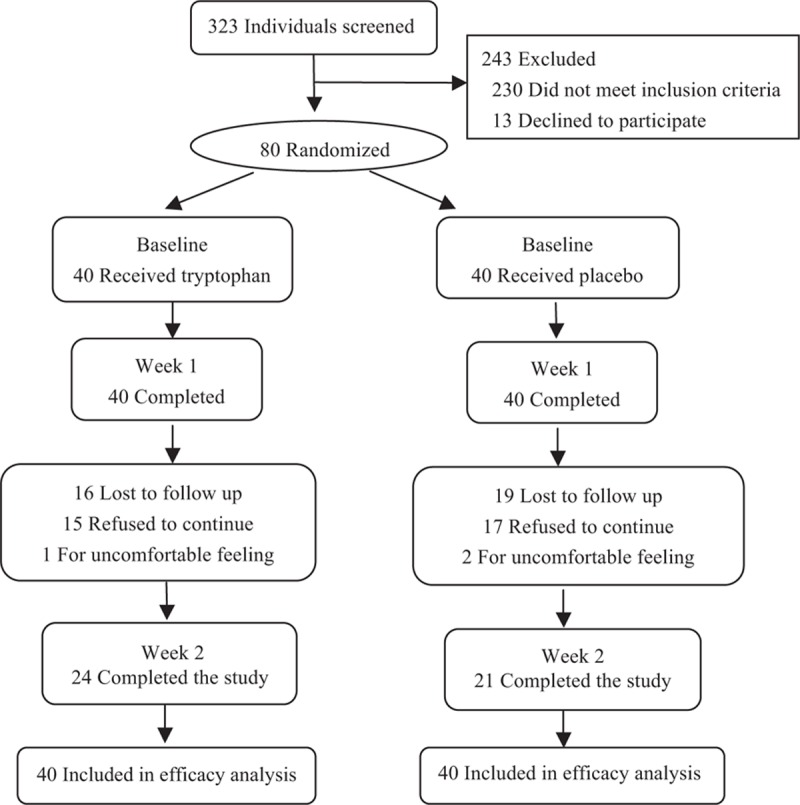
This randomized, placebo-controlled trial included 80 detoxified individuals with new-type drug dependence, recruited successively from a Compulsory Residential Drug Abstinence Institution in Wuhan, China, from April 2012 to November 2012. Eligible participants were randomly allocated to be treated with tryptophan (1000 mg/d, n = 40) or placebo (n = 40) for 2 weeks. The sleeping disorders and mental symptoms were assessed using Athens Insomnia Scale and Symptom Check-List-90 at baseline and 2 weeks. Results were analyzed according to the "intention-to-treat" approach.
Forty-five participants completed the 2-week study, 24 in the tryptophan group and 21 in the placebo group. There were no statistically significant differences in baseline characteristics between groups and the treatment adherence was similar between groups. The reduction in the Athens Insomnia Scale score in the tryptophan group was significantly greater than that in the placebo group (P = 0.017). However, no significant differences were found in Symptom Check-List-90 scores (either by individual dimension or the overall score) between groups (all P > 0.05). The frequency of adverse events was similar and no serious adverse events were reported during the study.
Tryptophan was unlikely to be effective for mental symptoms, but could alleviate sleep disorders in short term among detoxified individuals with new-type drug dependence. Future large-scale trials are required to confirm findings from this study.
新型毒品在青少年中很流行,可能导致精神障碍,但尚无药物被证明对这些新型毒品依赖所致障碍有效。我们旨在评估色氨酸对新型毒品依赖戒毒者睡眠障碍和精神症状的疗效。
这项随机、安慰剂对照试验纳入了80名新型毒品依赖戒毒者,于2012年4月至2012年11月在中国武汉一家强制戒毒所连续招募。符合条件的参与者被随机分配接受色氨酸治疗(1000毫克/天,n = 40)或安慰剂治疗(n = 40),为期2周。在基线和2周时使用雅典失眠量表和症状自评量表90评估睡眠障碍和精神症状。结果根据“意向性分析”方法进行分析。
45名参与者完成了为期2周的研究,色氨酸组24名,安慰剂组21名。两组间基线特征无统计学显著差异,两组治疗依从性相似。色氨酸组雅典失眠量表评分的降低显著大于安慰剂组(P = 0.017)。然而,两组间症状自评量表90评分(无论是单个维度还是总分)均无显著差异(所有P>0.05)。不良事件发生频率相似,研究期间未报告严重不良事件。
色氨酸对精神症状可能无效,但可在短期内缓解新型毒品依赖戒毒者的睡眠障碍。未来需要大规模试验来证实本研究结果。