Rizzo Francesca, Rinaldi Antonio, Marchese Giovanna, Coviello Elena, Sellitto Assunta, Cordella Angela, Giurato Giorgio, Nassa Giovanni, Ravo Maria, Tarallo Roberta, Milanesi Luciano, Destro Anna, Torzilli Guido, Roncalli Massimo, Di Tommaso Luca, Weisz Alessandro
Laboratory of Molecular Medicine and Genomics, Department of Medicine, Surgery and Dentistry 'Schola Medica Salernitana', University of Salerno, Baronissi (SA), Italy.
Genomix4life, University of Salerno, Baronissi (SA), Italy.
Oncotarget. 2016 Aug 23;7(34):54650-54661. doi: 10.18632/oncotarget.10567.
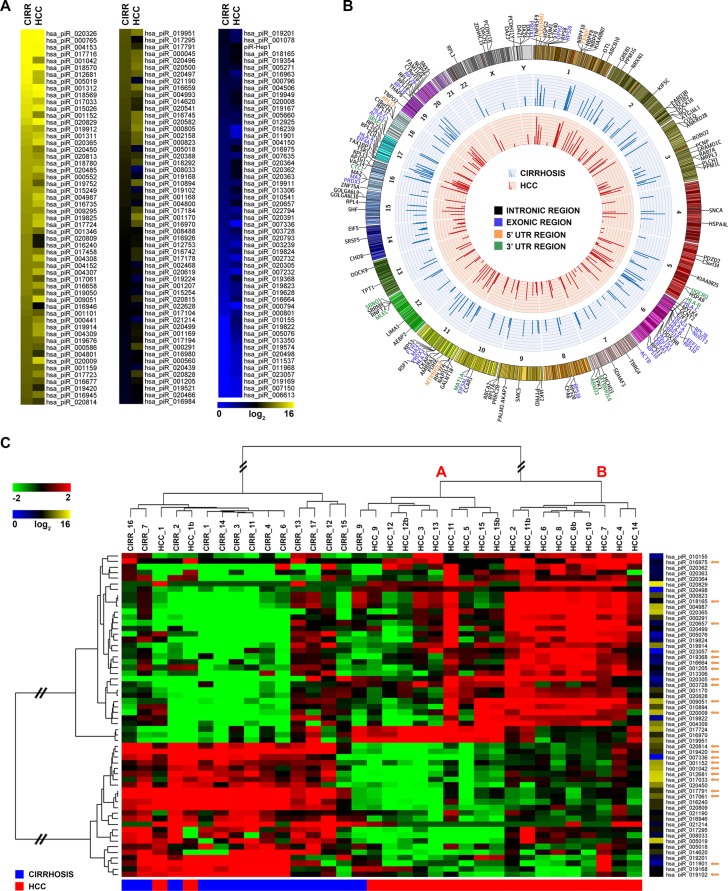
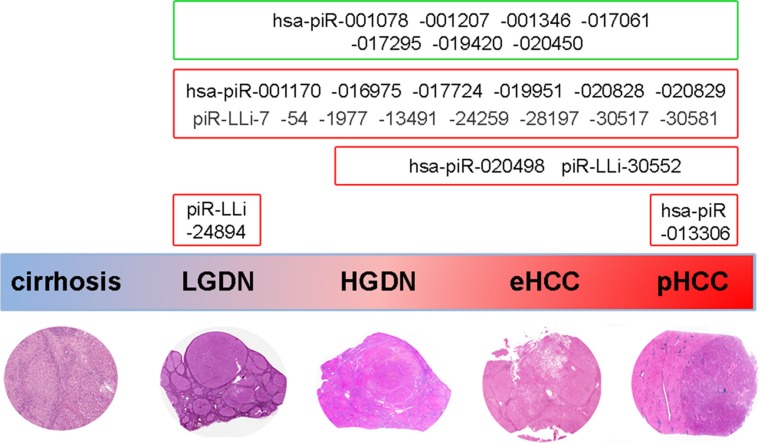
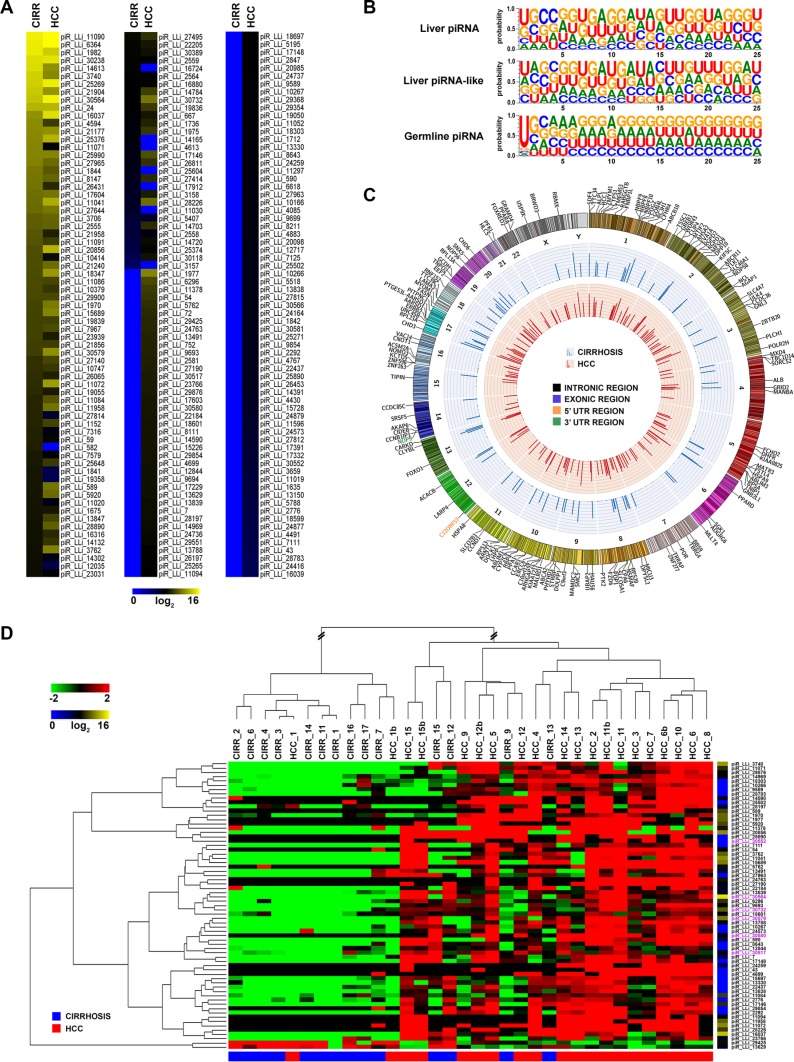
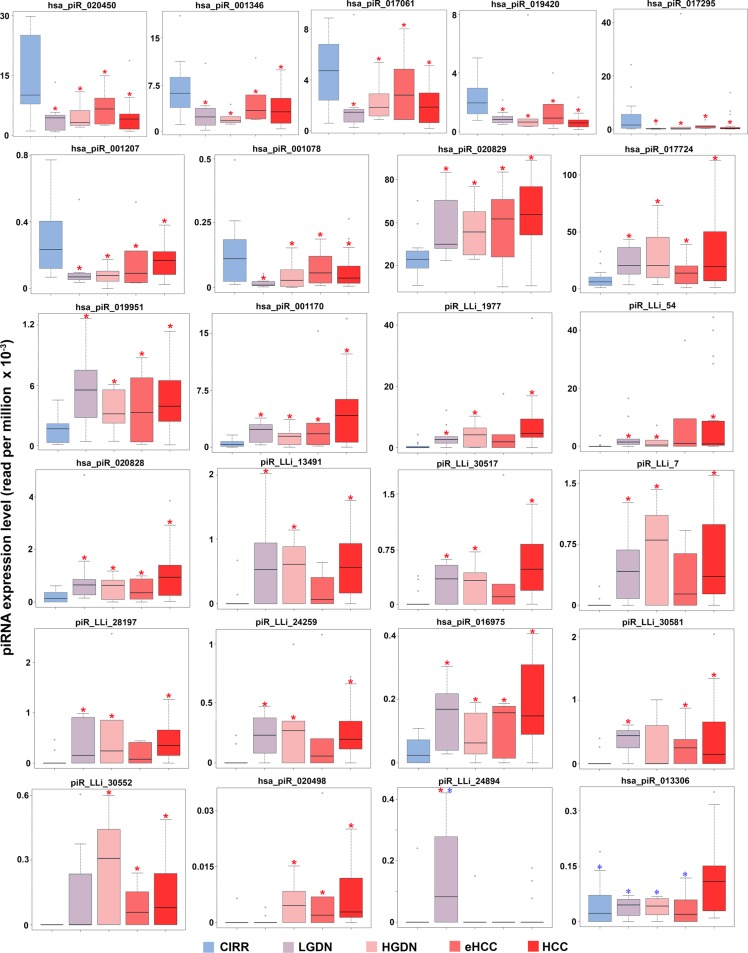
Hepatocellular carcinoma (HCC) is the result of a stepwise process, often beginning with development within a cirrhotic liver of premalignant lesions, morphologically characterized by low- (LGDN) and high-grade (HGDN) dysplastic nodules. PIWI-interacting RNAs (piRNAs) are small noncoding RNAs (sncRNAs), 23-35 nucleotide-long, exerting epigenetic and post-transcriptional regulation of gene expression. Recently the PIWI-piRNA pathway, best characterized in germline cells, has been identified also in somatic tissues, including stem and cancer cells, where it influences key cellular processes.Small RNA sequencing was applied to search for liver piRNAs and to profile their expression patterns in cirrhotic nodules (CNs), LGDN, HGDN, early HCC and progressed HCC (pHCC), analyzing 55 samples (14 CN, 9 LGDN, 6 HGDN, 6 eHCC and 20 pHCC) from 17 patients, aiming at identifying possible relationships between these sncRNAs and liver carcinogenesis. We identified a 125 piRNA expression signature that characterize HCC from matched CNs, correlating also to microvascular invasion in HCC. Functional analysis of the predicted RNA targets of deregulated piRNAs indicates that these can target key signaling pathways involved in hepatocarcinogenesis and HCC progression, thereby affecting their activity. Interestingly, 24 piRNAs showed specific expression patterns in dysplastic nodules, respect to cirrhotic liver and/or pHCC.The results demonstrate that the PIWI-piRNA pathway is active in human liver, where it represents a new player in the molecular events that characterize hepatocarcinogenesis, from early stages to pHCC. Furthermore, they suggest that piRNAs might be new disease biomarkers, useful for differential diagnosis of dysplastic and neoplastic liver lesions.
肝细胞癌(HCC)是一个逐步发展的过程,通常始于肝硬化肝脏内癌前病变的形成,这些病变在形态学上的特征为低级别(LGDN)和高级别(HGDN)发育异常结节。PIWI相互作用RNA(piRNA)是长度为23 - 35个核苷酸的小型非编码RNA(sncRNA),可对基因表达进行表观遗传和转录后调控。最近,PIWI - piRNA途径在生殖细胞中表现最为典型,在包括干细胞和癌细胞在内的体细胞组织中也已被发现,它在这些组织中影响关键细胞过程。应用小RNA测序来寻找肝脏piRNA,并分析其在肝硬化结节(CN)、LGDN、HGDN、早期HCC和进展期HCC(pHCC)中的表达模式,对17例患者的55个样本(14个CN、9个LGDN、6个HGDN、6个早期HCC和20个pHCC)进行分析,旨在确定这些sncRNA与肝癌发生之间的可能关系。我们鉴定出一个125种piRNA的表达特征,可将HCC与匹配的CN区分开来,并且这一特征也与HCC中的微血管侵犯相关。对失调piRNA的预测RNA靶标的功能分析表明,这些靶标可针对参与肝癌发生和HCC进展的关键信号通路,从而影响其活性。有趣的是,相对于肝硬化肝脏和/或pHCC,24种piRNA在发育异常结节中表现出特定的表达模式。结果表明,PIWI - piRNA途径在人类肝脏中具有活性,它在表征肝癌发生(从早期到pHCC)的分子事件中是一个新的参与者。此外,研究结果还表明,piRNA可能是新的疾病生物标志物,有助于发育异常和肿瘤性肝脏病变的鉴别诊断。